
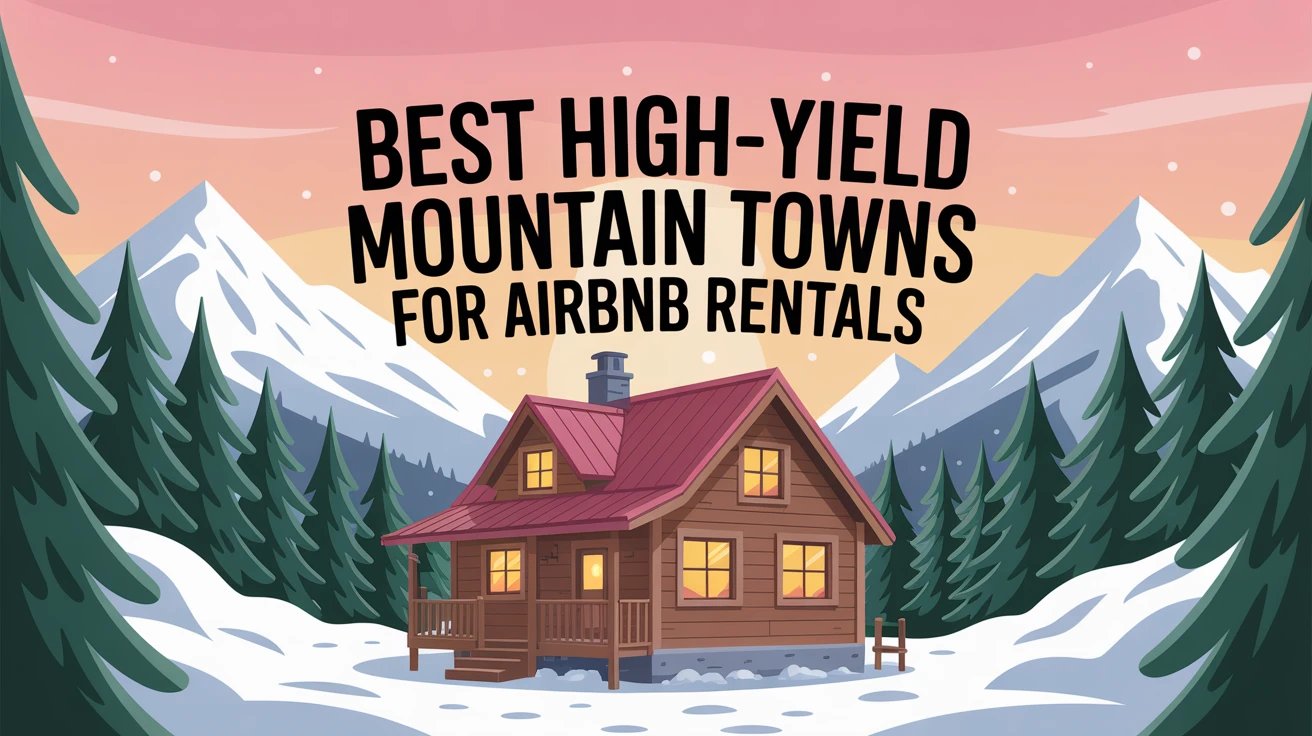
High-yield mountain towns are a rare breed. The best combine steady demand for cabins, pronounced seasonality, and entry prices that haven’t yet caught up with their rental revenue. When you line up the numbers, the top-yielding US mountain markets in 2026 stretch from a 15.4% gross yield in Broken Bow, Oklahoma down to 7.8% in Santa Fe, New Mexico. That’s a spread that would make most coastal or ski trophy markets blush.
What do these towns have in common? They’re not the household names. Instead, they’re places where travelers pay a premium for the mountain experience, lakefront cabins, national park gateways, desert retreats, but where home prices remain accessible relative to the nightly rates. The yield math is simple.
Gross yield measures annual rental revenue divided by the median home value, before expenses. Famous ski towns miss the cut because, even with high rates and full calendars, their home prices push yields down into single digits. The real opportunity sits in these overlooked or emerging destinations, where the numbers still work for investors.
Across this set, you’ll see yields cluster in the upper percentiles nationally, with entry prices ranging from under $300,000 to just under $600,000. Seasonality is pronounced, think summer peaks in Duluth or fall surges in the Smokies, but several markets offer year-round revenue streams. If you’re looking for a market where the numbers justify a closer look, start with the table and profiles below. Connect with an STR-specialist agent when you’re ready to move from research to reality.
Mountain Town Airbnb Rankings 2026 (and the City-by-City Breakdown)
| Rank | Market | Gross Yield | Annual Revenue | Median Home Value | ADR | Occupancy | Active Listings |
|---|---|---|---|---|---|---|---|
| 1 | Broken Bow, OK | 15.4% | $53,541 | $348,343 | $407 | 36% | 1,929 |
| 2 | Duluth, MN | 13.2% | $39,148 | $297,470 | $254 | 33% | 289 |
| 3 | Gatlinburg, TN | 12.8% | $52,659 | $410,822 | $319 | 52% | 2,823 |
| 4 | Pigeon Forge, TN | 11.9% | $50,639 | $423,906 | $286 | 52% | 1,474 |
| 5 | Yucca Valley, CA | 10.5% | $37,991 | $360,731 | $286 | 40% | 611 |
| 6 | Traverse City, MI | 9.5% | $42,587 | $446,500 | $258 | 21% | 950 |
| 7 | Santa Fe, NM | 7.8% | $45,791 | $587,554 | $263 | 50% | 1,280 |
Data as of August 5, 2026, covering trailing-12-months through July 2026. Each market’s annual revenue is calculated from its own ADR × occupancy × 365, reporting the median listing’s revenue. Median ADR and median occupancy are computed independently, so multiplying the table’s ADR by occupancy will not reproduce the revenue figure. Gross yield divides median revenue by the median home value (Zillow Home Value Index). See the full data methodology for details.
Headline revenue averages all listings, but the active-operator benchmark filters for properties with sustained booking activity, this is the figure a committed buyer should underwrite against. In most of these markets, the active-operator number sits close to the headline, signaling that the top hosts capture much of the upside.
1. Broken Bow, OK: Cabin Luxury Meets High Yield
Broken Bow leads the mountain-town yield rankings at 15.4%, a figure that puts it in the 91st percentile of 501 US markets. The story here is high nightly rates paired with a median home value that’s still accessible by national standards, $348,343, down 5.5% year-over-year. Occupancy is modest at 36%, but ADR sits at a robust $407, and annual revenue for the median listing hits $53,541.
Seasonality is pronounced. Occupancy peaks at 52% in July and drops to 27% in January, with summer accounting for 29% of annual revenue. The past year saw ADR climb 20% even as occupancy slipped 5% and listings contracted by 18%, a sign of steady demand despite a tightening market. Three-bedroom cabins are most common, but the real earners are the 7-bedroom properties, which clear nearly $99,000 a year.
For underwriting, the active-operator benchmark sits just below the headline at $52,604, translating to a payback period of about 6.6 years on gross revenue. For a deeper breakdown of cabin types and revenue, the Broken Bow analytics page is essential reading.
| Gross yield | 15.4% |
| Annual revenue | $53,541 |
| Active-operator revenue | $52,604 |
| Occupancy | 36% |
| ADR | $407 |
| Median home value (YoY) | $348,343 (-5.5%) |
| Full-time listings | 1,929 |
| US yield rank | #41 |
Who it fits. Buyers seeking high cash-on-cash returns in a proven cabin market.
Regulation: Short-term rental rules vary by city, county, and HOA. Verify current requirements for the specific property before buying.
2. Duluth, MN: Lake Superior Views at a Midwest Price
Duluth cracks the 84th percentile for yield, posting a 13.2% gross return. The median home value is $297,470, up 8.2% year-over-year, with annual revenue at $39,148 and a median ADR of $254. Occupancy is lower than the national median at 33%, but the market’s affordability keeps yields high.
Seasonality is dramatic. Occupancy surges to 72% in August before bottoming out at 26% in January. Revenue is balanced across the year, with spring and summer each contributing 26%. The past year saw ADR rise 10% while occupancy slipped 9%, a sign of softening demand but resilient rates. One-bedroom units dominate the supply, but four-bedrooms are the top earners, clearing over $45,000 a year.
Active operators see annual revenue of $37,271, translating to an 8-year payback period. Duluth’s analytics page (see here) offers a granular look at bedroom mix and seasonality for those weighing entry.
| Gross yield | 13.2% |
| Annual revenue | $39,148 |
| Active-operator revenue | $37,271 |
| Occupancy | 33% |
| ADR | $254 |
| Median home value (YoY) | $297,470 (+8.2%) |
| Full-time listings | 289 |
| US yield rank | #73 |
Who it fits. Investors looking for affordable entry and strong summer peaks in a four-season market.
Regulation: Short-term rental rules vary by city, county, and HOA. Verify current requirements for the specific property before buying.
3. Gatlinburg, TN: Smoky Mountain Demand, Year-Round
Gatlinburg’s 12.8% gross yield places it in the 82nd percentile nationally, driven by $52,659 in annual revenue and a median home value of $410,822 (down 9.2% YoY). Occupancy is strong at 52%, with a $319 median ADR. The market’s scale, 2,823 full-time listings, reflects its status as a gateway to the most visited national park in America.
Seasonality is sharp. Occupancy peaks at 70% in October and drops to 30% in January. Fall and summer each contribute 28% of annual revenue. Over the past year, ADR jumped 18% even as occupancy fell 7% and listings dropped by 16%. Two-bedroom properties are the most common, but 7-bedrooms top the revenue chart at nearly $95,000 annually.
Active operators see $51,496 per year, with a payback period of about 8 years. For those wanting to dissect the revenue curve or bedroom mix, the Gatlinburg analytics page is a useful resource.
| Gross yield | 12.8% |
| Annual revenue | $52,659 |
| Active-operator revenue | $51,496 |
| Occupancy | 52% |
| ADR | $319 |
| Median home value (YoY) | $410,822 (-9.2%) |
| Full-time listings | 2,823 |
| US yield rank | #84 |
Who it fits. Buyers seeking high occupancy and proven tourist demand in a large, liquid market.
Regulation: Short-term rental rules vary by city, county, and HOA. Verify current requirements for the specific property before buying.
4. Pigeon Forge, TN: Steady Returns in a Cabin Powerhouse
Autumn travelers drive occupancy to its October peak of 69%, while the winter low in January sees occupancy drop to just 24%. This pronounced seasonality means fall and summer are equally critical, each delivering 28% of annual revenue, and operators must budget for leaner winter months when just 20% of revenue is earned.
The market’s $286 average daily rate outpaces the US median by over $50, reflecting strong guest demand for premium cabins during peak periods and offsetting softer shoulder seasons.
Compared to the national landscape, Pigeon Forge’s 11.9% gross yield ranks it in the 78th percentile of US vacation-rental markets, well above the 8.8% median. The active-operator annual revenue of $49,256 supports a payback period of about 8.6 years, a solid mark given the scale of 1,474 full-time listings.
This large operator base signals a mature, competitive environment where two-bedroom cabins dominate supply but six-bedrooms command the highest returns at $74,740 per year, making property selection and amenity upgrades crucial for outperforming the median. Recent momentum data show ADRs surging 22% year-over-year even as occupancy fell 7% and listings climbed 11%, suggesting that pricing power remains strong but new supply is starting to outpace demand.
Active operators bring in $49,256 annually, with a payback period of 8.6 years. For a closer look at the numbers, see the Pigeon Forge analytics page.
| Gross yield | 11.9% |
| Annual revenue | $50,639 |
| Active-operator revenue | $49,256 |
| Occupancy | 52% |
| ADR | $286 |
| Median home value (YoY) | $423,906 (-8.4%) |
| Full-time listings | 1,474 |
| US yield rank | #103 |
Who it fits. Investors wanting scale, high occupancy, and a deep vendor ecosystem.
Regulation: Short-term rental rules vary by city, county, and HOA. Verify current requirements for the specific property before buying.
5. Yucca Valley, CA: Desert Peaks, California Yields
Desert seasonality shapes Yucca Valley’s short-term rental returns, with occupancy peaking at 60% in March and dropping to 33% by September. This pattern reflects the area’s climate-driven guest demand, as travelers prefer the cooler spring and winter months, together, these two seasons account for a commanding 56% of annual revenue. The average daily rate has surged 22% year-over-year to $286, outpacing the US median by more than $50, while occupancy has held steady, dipping just 1% despite the higher pricing.
Owners here see a median gross yield of 10.5%, placing the market in the 68th percentile nationwide and ahead of the US median of 8.8%. With 611 full-time listings, Yucca Valley’s operator base is sizable enough to suggest a mature but not oversaturated market.
The typical investor faces a payback window of about 9.8 years, making underwriting straightforward for those prioritizing cash flow. The bedroom mix favors two-bedroom properties, but four-bedrooms command the highest annual revenue ($40,128 at a $417 ADR), highlighting opportunities for those able to acquire or upgrade larger homes to capture premium rates.
Active-operator revenue is $36,939, with a payback period of 9.8 years. For those exploring the high desert, the Yucca Valley analytics page details the revenue and seasonality mix.
| Gross yield | 10.5% |
| Annual revenue | $37,991 |
| Active-operator revenue | $36,939 |
| Occupancy | 40% |
| ADR | $286 |
| Median home value (YoY) | $360,731 (-3.9%) |
| Full-time listings | 611 |
| US yield rank | #151 |
Who it fits. Buyers seeking California exposure with cash-flow potential and manageable entry prices.
Regulation: Short-term rental rules vary by city, county, and HOA. Verify current requirements for the specific property before buying.
6. Traverse City, MI: Wine Country with Seasonal Swings
Price-driven investors will note Traverse City’s median gross yield of 9.5%, which matches the 60th percentile among US short-term rental markets and edges out the national median of 8.8%. The region’s headline annual revenue of $42,587 reflects a pronounced split between high-earning summer months and a sluggish off-season, with the average daily rate sitting above the US median at $258.
Occupancy soars to 71% in August, when demand is fueled by lake vacations and wine tourism, while March sees a stark drop to just 9%, a swing that underscores the need for careful cash flow planning.
Data from the past year show momentum cooling, as occupancy fell 10% and ADR slipped 6% by July 2026, likely a result of macroeconomic pressures and increased competition for guests. The payback period stands at 11.2 years based on active-operator revenue, making underwriting more challenging for those seeking rapid returns.
Most listings are two-bedroom homes, but five-bedroom properties command the highest earnings at $61,541 annually, suggesting that larger groups drive the lucrative peak-season bookings. For a full breakdown of seasonality and bedroom mix, see the Traverse City analytics page.
| Gross yield | 9.5% |
| Annual revenue | $42,587 |
| Active-operator revenue | $39,829 |
| Occupancy | 21% |
| ADR | $258 |
| Median home value (YoY) | $446,500 (+1.8%) |
| Full-time listings | 950 |
| US yield rank | #188 |
Who it fits. Investors comfortable with pronounced seasonality and strong summer cash flow.
Regulation: Short-term rental rules vary by city, county, and HOA. Verify current requirements for the specific property before buying.
7. Santa Fe, NM: Year-Round Demand, Premium Entry
Santa Fe rounds out the list with a 7.8% gross yield, ranking in the 39th percentile of US markets. The median home value is $587,554 (down 0.7% YoY), with annual revenue at $45,791 and a median ADR of $263. Occupancy is robust at 50%, and there are 1,280 full-time listings in the market.
Seasonality is moderate. Occupancy peaks at 72% in August and dips to 31% in January. Fall and summer each contribute 27% of annual revenue. Over the past year, ADR soared 26% while occupancy fell 18%, and listings increased by 55%. One-bedroom units are common, but five-bedrooms earn the most at $74,305 a year.
Active-operator revenue is $43,737, with a payback period of 13.4 years. For a closer look at the revenue mix and property types, the Santa Fe analytics page offers more detail.
| Gross yield | 7.8% |
| Annual revenue | $45,791 |
| Active-operator revenue | $43,737 |
| Occupancy | 50% |
| ADR | $263 |
| Median home value (YoY) | $587,554 (-0.7%) |
| Full-time listings | 1,280 |
| US yield rank | #285 |
Who it fits. Buyers seeking stable, year-round demand and are comfortable with a higher entry price.
Regulation: Short-term rental rules vary by city, county, and HOA. Verify current requirements for the specific property before buying.
Why the Famous Mountain Towns Miss This List
The mountain towns everyone can name, Aspen, Park City, Vail, don’t appear in these rankings, and the reason is simple. Price. Even with strong demand and high nightly rates, home values have climbed so high that gross yields compress into the single digits. The trophy markets are appreciation plays or lifestyle purchases, not cash-flow engines. The towns above deliver the rare combination of strong demand and entry prices that still make sense for yield-focused investors.
How to Read These Rankings Before You Buy
Gross yield is your first filter, not your last. It measures annual rental revenue against the median home value, before expenses. The headline revenue averages every listing, but the active-operator benchmark filters for hosts with real, sustained booking activity, this is the number a serious buyer should use for underwriting.
Even in high-yield markets, actual net returns depend on management costs, taxes, maintenance, and local regulations. Seasonality can swing revenue from month to month, and regulatory changes can shift the landscape quickly. Always verify rules and run the numbers for your specific property before committing capital.
Ready to act? Connect with an STR-specialist agent for your target market. Analyze the active-operator revenue, payback timeline, and bedroom mix for your property type. Find your agent match and start your search with confidence.