
Data as of: July 2026, Chalet Airbnb Analytics
Five years ago, everyone knew where to buy an Airbnb. Palm Springs. Joshua Tree. Gatlinburg and the Smokies. Big Bear. The playbook was simple. You bought in a famous vacation town, listed it, and let the demand do the work.
That playbook is dead.
Here’s what those markets look like in 2026, according to Chalet’s data:
- Palm Springs delivers a gross yield of roughly 5% on a median home price north of $600K, with more than 3,000 active listings competing for the same guests.
- Joshua Tree sits around 7%.
- The Smoky Mountain trio (Gatlinburg, Pigeon Forge, Sevierville) has compressed to 12–13% gross yields on $400K+ entry prices. Nashville is at 10%.
Two forces created this. Prices ran up during the 2020–2022 buying frenzy and pushed home values in trophy STR markets far past what nightly rates could justify. And supply exploded, causing thousands of new listings to enter these markets chasing the same demand, dragging down occupancy for everyone. A new investor buying into Palm Springs today is paying 2026 prices for 2019 economics.
The investors winning in 2026 are running a different strategy entirely by focusing on secondary markets. These are smaller cities with real demand drivers (e.g. college football, regional tourism, business travel, drive-to beach access) where home prices never inflated, listing counts stay in the hundreds instead of thousands, and gross yields run 3–7x what the famous markets deliver.
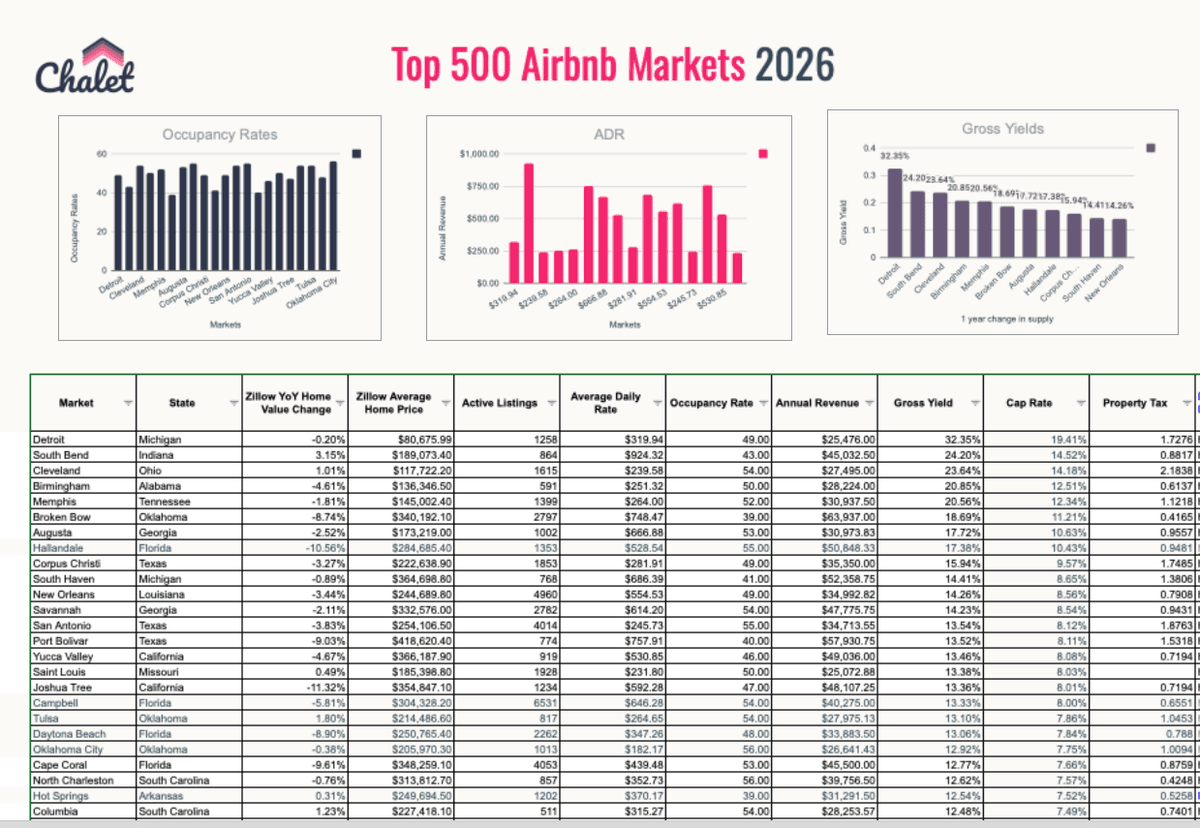
We ranked every market in Chalet’s Airbnb Analytics (500+ US markets, updated monthly) by gross yield, which is annual revenue divided by median home value. Annual revenue here isn’t a list price or a best-case number. It’s what a typical full-time active listing actually earns over a year, calculated from each market’s average daily rate and its occupancy across all four seasons (ADR × occupancy × 365), based on trailing 12-month booking data. That means the winter-slow markets below are already penalized for their slow months in the numbers you see. Our full data methodology breaks down every metric. These are the top 10 for 2026.
The 10 Best Airbnb Markets Ranked for 2026
| Rank | Market | Gross Yield | Annual Revenue | Median Home Value | ADR | Occupancy | Active Listings | Property Tax |
|---|---|---|---|---|---|---|---|---|
| 1 | Michigan City, IN | 37% | $78,576 | $178,959 | $391 | 45% | 278 | 0.79% |
| 2 | Detroit, MI | 35% | $30,187 | $74,572 | $159 | 46% | 797 | 1.64% |
| 3 | South Bend, IN | 36%* | $66,348 | $183,750 | $259 | 39% | 458 | 0.87% |
| 4 | Freeport, TX | 31% | $52,597 | $144,911 | $347 | 33% | 394 | 1.75% |
| 5 | Jackson, MS | 29% | $29,029 | $84,672 | $128 | 59% | 228 | 0.92% |
| 6 | Tuscaloosa, AL | 29% | $76,021 | $223,349 | $244 | 36% | 151 | 0.32% |
| 7 | Sandusky, OH | 27% | $45,247 | $143,493 | $240 | 32% | 142 | 1.27% |
| 8 | Birmingham, AL | 21% | $33,162 | $133,465 | $168 | 46% | 491 | 0.60% |
| 9 | Memphis, TN | 21% | $29,532 | $141,489 | $155 | 48% | 994 | 1.03% |
| 10 | Cleveland, OH | 20% | $22,289 | $111,060 | $119 | 50% | 1,501 | 2.08% |
Source: Chalet Airbnb Analytics, May–June 2026. Gross yield is average annual revenue per full-time listing divided by median home value (Zillow Home Value Index). *South Bend figures from March 2026 refresh.
This list is full of Lake Michigan beach towns, college football markets, Gulf Coast fishing towns, and Midwest cities with sub-$100K entry prices. What you won’t find is a single “famous” vacation market.
1. Michigan City, IN: 37% Gross Yield
Annual revenue: $78,576 · ADR: $391 · Occupancy: 45% · Median home: $178,959 · 278 active listings
The #1 Airbnb market in the US for 2026 is a Lake Michigan beach town an hour from Chicago. Michigan City combines a $391 average daily rate, which is resort-market pricing, with a sub-$180K median home value. That gap is how it produces a gross yield no trophy market can touch.
The demand engine is Chicago. Sixteen percent of all guests come from the city, with Indianapolis adding another 6%. It’s a drive-to summer beach market with strong shoulder-season pricing. ADR peaks at $426 in late summer and fall, and occupancy hits 77% in August. Winter is the tradeoff, with occupancy dropping below 30% from December through February, so underwrite the year on realistic seasonality rather than peak months.
The momentum data is striking. Q1 2026 revenue per active listing ran 156% ahead of Q1 2025, with occupancy nearly doubling year over year. Larger properties dominate, with 4- and 5-bedroom homes averaging $99,869 and $139,706 in annual revenue respectively. Home values are up 3.46% YoY, and property tax is a modest 0.79%.
Regulation: Registration with the city and lodging tax compliance are required, and rules can vary by zone.
2. Detroit, MI: 35% Gross Yield
Annual revenue: $30,187 · ADR: $159 · Occupancy: 46% · Median home: $74,572 · 797 active listings
Detroit is the lowest entry price on this list by a wide margin, a $74,572 median home value, and that denominator is what drives its 35% yield. This is a cash-flow play, not an appreciation play. Home values slipped 3.89% over the past year, which cuts both ways (cheaper acquisitions, weaker equity growth).
The market rewards specific segments. Three-bedroom properties average $31,456 annually and 4-bedrooms reach $46,326 at a $316 ADR, while the flood of 1-bedroom listings (over half the market) earns far less. Demand is regional and steady, built on Midwest drive traffic and 4-night average stays, and Q1 2026 revenue per listing was up 12% YoY even with flat occupancy, because operators are pricing more aggressively.
Regulation, read before you buy. Detroit enforces a 90-day annual rental cap per property with active enforcement and a $500 annual license. That cap fundamentally changes the underwriting math, because you’re optimizing revenue within 90 rentable days, not 365. Supply also grew 6.2% YoY, so competition is intensifying.
3. South Bend, IN: 36% Gross Yield
Annual revenue: $66,348 · ADR: $259 · Occupancy: 39% · Median home: $183,750 · 458 active listings
South Bend is the clearest single-demand-driver market in the top 10, and that driver is Notre Dame. Fall ADRs tell the story. September through November average $685 a night, roughly double the annual average, and monthly revenue peaks above $10,000 during football season. Guests book far in advance (77-day average lead time), which gives operators unusual revenue visibility.
Outside of football weekends, the university itself sustains demand through graduation, admissions visits, and events, and 3- and 4-bedroom homes built for game-day groups earn $72,299 and $112,958 annually. Home values rose 4.08% YoY, and the entry price remains under $185K.
Regulation. South Bend is rated investor-friendly in Chalet’s regulatory data, one of the cleanest regulatory profiles on this list.
4. Freeport, TX: 31% Gross Yield
Annual revenue: $52,597 · ADR: $347 · Occupancy: 33% · Median home: $144,911 · 394 active listings
Freeport is Houston’s beach. Nearly 19% of guests come from Houston, with Austin and Dallas adding another 9%. It’s a Gulf Coast drive-to market with a $347 ADR against a $145K median home price. Home values are appreciating fast, up 7.47% YoY, the strongest appreciation in the top 10.
Seasonality is sharp. July occupancy hits 61% while January drops to 10%. That makes Freeport a summer-concentrated cash flow play. The Q1 2026 numbers (revenue per listing up 74% YoY) suggest operators are getting better at capturing shoulder demand, but the winter trough is real. Note the 1.75% property tax, the highest on this list, standard for Texas.
Regulation. Registration and hotel occupancy tax compliance are required. Verify current rules before purchase.
5. Jackson, MS: 29% Gross Yield
Annual revenue: $29,029 · ADR: $128 · Occupancy: 59% · Median home: $84,672 · 228 active listings
Jackson has the highest occupancy of any market in the top 10 at 59%, above the US average of 54%, on a sub-$85K entry price. This is a year-round demand market rather than a seasonal one. Government, healthcare, and university traffic keep listings booked without needing a summer spike to carry the whole year.
One honest caution. Jackson’s Q1 2026 momentum was negative, with revenue per listing down about 20% YoY and occupancy off 8.6 points. The yield remains among the best in the country, but the trend is softening rather than accelerating, so underwrite conservatively and buy at prices where the deal works even if revenue keeps drifting.
Regulation. Registration and lodging tax compliance are required. Verify current rules before purchase.
6. Tuscaloosa, AL: 29% Gross Yield
Annual revenue: $76,021 · ADR: $244 · Occupancy: 36% · Median home: $223,349 · 151 active listings
Tuscaloosa runs South Bend’s playbook in the SEC, and the driver is Alabama football. Spring and fall ADRs spike to $389, August occupancy hits 70%, and 4-bedroom game-day houses average $67,356 a year. With only 151 active listings, the second-thinnest supply in the top 10, demand on peak weekends dramatically outstrips inventory.
Two more numbers are worth knowing. The 0.32% property tax is the lowest on this list, and Q1 2026 revenue per listing ran 52% ahead of last year. The tradeoff is the same as any event-driven market. A handful of weekends carry a disproportionate share of annual revenue, so a pricing mistake in October costs more than one in February.
Regulation. Registration and lodging tax compliance are required. Verify current rules before purchase.