

This guide covers Lake Worth Beach, Florida. Nearby markets often confused with Lake Worth Beach in STR regulation research include:
- West Palm Beach: Larger city directly north with its own STR rules and enforcement.
- Boynton Beach: Coastal city south of Lake Worth Beach, separate STR licensing and zoning.
- Lantana: Small town just south, distinct STR ordinances and enforcement.
- Palm Springs: Inland municipality west of Lake Worth Beach, different STR requirements.
Legality Verdict
Short-term rentals are legal in Lake Worth Beach, but city rules are strict: most residential zones prohibit rentals under 60 days unless specific permits and inspections are obtained. Both city and state licensing are required.
- Legality Status: 2/5
- License Availability: 4/5
- Compliance Cost (% revenue): 3/5
- Regulatory Stability: 3/5
- Enforcement Climate: 2/5
TL;DR
Lake Worth Beach defines STRs as rentals under 60 days. A city business license and state DBPR license are required; total lodging tax is 12% (6% state, 6% county). Most residential zones prohibit stays under 60 days unless you secure all permits and pass inspections. The biggest gotcha: strict local enforcement and the 60-day minimum in most neighborhoods.
Quick Facts
| Item | Detail |
|---|---|
| STR Definition | Rental of a residential property for less than 60 consecutive days in most zones Guestable |
| Registration Required | Yes — City business license and Florida DBPR license City of Lake Worth Beach, LegalClarity |
| Permit Cost | Not codified — No separate STR permit; city business license required City of Lake Worth Beach |
| Annual Renewal | Not codified — City business license renewal required; state DBPR license renews annually City of Lake Worth Beach, DBPR |
| State Sales Tax | 6% Florida Short Term Rental Taxes |
| County Tourist Development Tax | 6% (Palm Beach County) Airbnb Help Center |
| Local Accommodations Tax | Not codified — No separate city-level lodging tax Avalara |
| Total Effective Lodging Tax | 12% (6% state + 6% county) Luxehausstays |
| License Cap | Not codified — No cap identified in city code City of Lake Worth Beach Code of Ordinances |
| Permitted Zones | Not codified — Zoning restrictions apply; most residential zones prohibit <60-day rentals Guestable |
| Prohibited Zones | Most residential zones for <60-day rentals Guestable |
| Occupancy Cap | Not codified — No city rule identified City of Lake Worth Beach Code of Ordinances |
| Parking Requirement | Not codified — No city rule identified City of Lake Worth Beach Code of Ordinances |
| Primary Regulator | City of Lake Worth Beach; Florida DBPR; Palm Beach County Tax Collector City of Lake Worth Beach |
| Inspection Requirement | Yes — Use & Occupancy Inspection required City of Lake Worth Beach |
| Local Contact Requirement | Yes — Must have a local contact within 4-hour radius Guestable |
| HOA/Condo Override | Not codified — No city rule identified City of Lake Worth Beach Code of Ordinances |
| Transferability | Not codified — No city rule identified City of Lake Worth Beach Code of Ordinances |
| Enforcement Penalties | Not codified — State penalties apply for unlicensed operation LegalClarity |
| Last Updated | May 22, 2026 |
Regulatory Impact Snapshot
Lake Worth Beach’s regulatory regime is defined by a strict 60-day minimum rental period in most residential zones, enforced by city code compliance. Investors must secure both a city business license and a Florida DBPR license, plus pass a Use & Occupancy Inspection. The combined 12% lodging tax (state + county) is a material cost, and hosts must remit the county TDT directly. The binding constraint for underwriters is the zoning restriction on stays under 60 days, which sharply limits STR inventory and revenue potential. Run this market in our Airbnb Calculator →
Top 500 US Airbnb Rental Markets - 2026
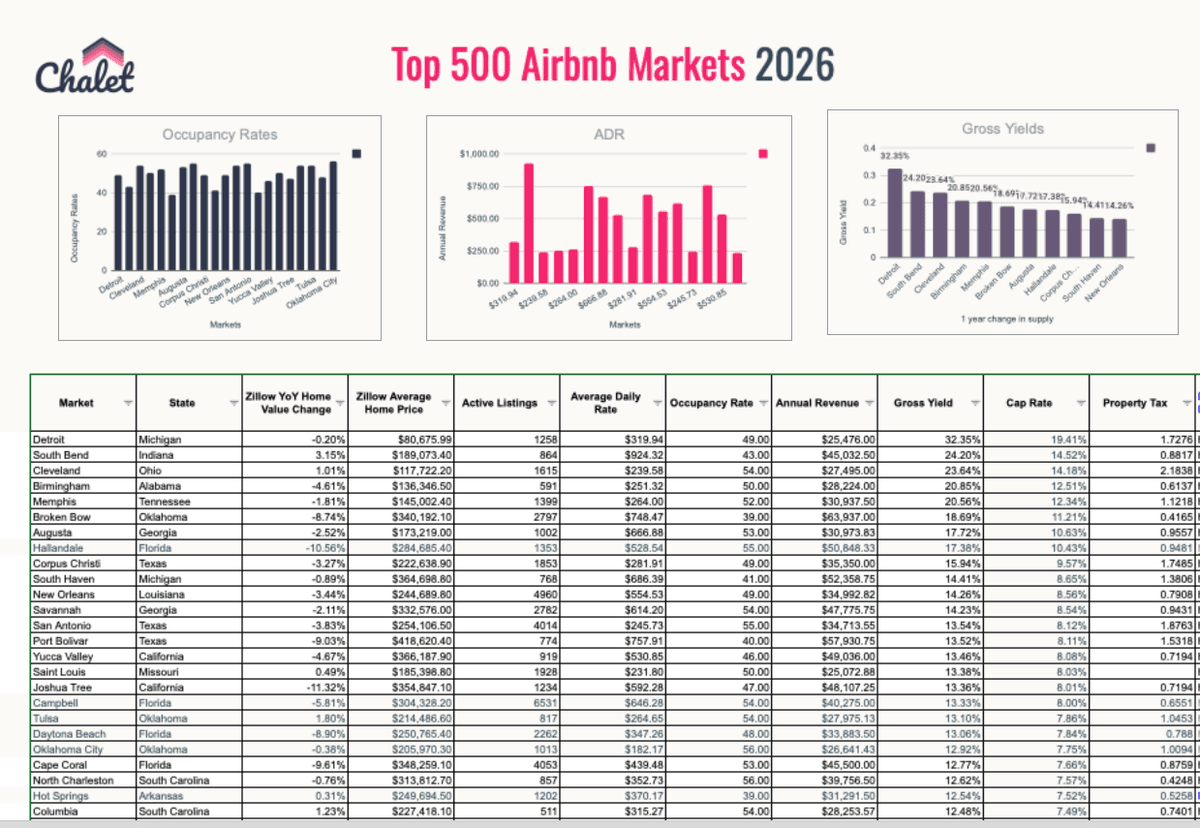
Instantly compare top 500 short-term (Airbnb) rental markets in the US
Frequently Asked Questions
Basics
What is considered a short-term rental in Lake Worth Beach?
A short-term rental is generally defined as renting a property for less than 60 consecutive days in most residential zones Guestable.
Are short-term rentals legal in Lake Worth Beach?
Yes, but most residential zones prohibit rentals under 60 days unless you obtain all required permits and inspections Guestable.
Does Lake Worth Beach have its own STR ordinance?
Lake Worth Beach regulates STRs through its business license and zoning code, but does not have a separate STR ordinance City of Lake Worth Beach.
Licensing
Do I need a city license to operate an STR?
Yes, a city business license is required for all residential rentals, including STRs City of Lake Worth Beach.
Is a state license required for STRs?
Yes, you must obtain a Florida DBPR vacation rental license for any property rented more than three times per year for periods under 30 days LegalClarity.
Is there a separate STR permit in Lake Worth Beach?
No, the city does not have a separate STR permit; the business license covers all rentals City of Lake Worth Beach.
How do I apply for a business license?
Apply online via the city’s portal or in person at 7 North Dixie Highway, Lake Worth Beach, FL 33460 City of Lake Worth Beach.
Taxes
What taxes apply to STRs in Lake Worth Beach?
A 6% Florida state transient rental tax and a 6% Palm Beach County Tourist Development Tax (TDT) apply, totaling 12% Luxehausstays.
Does the city charge its own lodging tax?
No, Lake Worth Beach does not impose a separate city-level lodging tax Avalara.
Who remits the county TDT?
Hosts must register for a TDT account and remit the 6% county tax directly to Palm Beach County Airbnb Help Center.
Does Airbnb collect all required taxes?
Airbnb collects the 6% state tax but not the county TDT; hosts must remit the TDT themselves Luxehausstays.
Operations
Is an inspection required for STRs?
Yes, a Use & Occupancy Inspection is required for all residential rentals City of Lake Worth Beach.
Are there safety requirements?
Yes, city inspections include checks for smoke detectors and fire extinguishers Guestable.
Do I need a local contact?
Yes, you must have a local contact or property manager within a 4-hour radius Guestable.
Are there occupancy or parking limits?
No separate city rules on occupancy or parking for STRs were identified in available sources City of Lake Worth Beach Code of Ordinances.
Enforcement
How strict is enforcement in Lake Worth Beach?
Enforcement is strict, with the city actively monitoring compliance and imposing fines for violations Guestable.
What are the penalties for unlicensed STRs?
City penalties are not codified; state penalties for unlicensed operation include fines and possible license suspension LegalClarity.
Has there been recent legislative change?
A 2024 bill to centralize STR regulation was vetoed; local rules remain in effect Avantio.
Permit Process
Lake Worth Beach requires a business license for all residential rentals, including STRs. The application can be completed online or in person at City Hall. A Use & Occupancy Inspection is mandatory before a license is issued, ensuring compliance with safety standards such as smoke detectors and fire extinguishers City of Lake Worth Beach, Guestable.
Florida state law also requires a DBPR vacation rental license for properties rented more than three times per year for periods under 30 days. The state license must be renewed annually, and fees are based on the number of units LegalClarity, DBPR.
Zoning
Most residential zones in Lake Worth Beach prohibit rentals of less than 60 consecutive days unless specific city permits and state licenses are obtained. This 60-day rule is the primary operational constraint for STR investors Guestable.
The city’s code does not separately codify occupancy caps, parking requirements, or density limits for STRs. Zoning compliance is enforced through the business license and inspection process City of Lake Worth Beach Code of Ordinances.
Taxes and Remittance
Short-term rentals in Lake Worth Beach are subject to a 6% Florida state transient rental tax and a 6% Palm Beach County Tourist Development Tax (TDT), totaling 12%. The city does not impose a separate lodging tax Luxehausstays, Avalara.
Hosts must register with the Florida Department of Revenue for state tax and with Palm Beach County for the TDT. Airbnb collects the state tax but not the TDT; hosts must remit the TDT directly Airbnb Help Center.
Enforcement and Recent Actions
Lake Worth Beach maintains a strict enforcement posture, with active code compliance and the risk of significant fines for violations. The city commission is known for strict rules, especially the 60-day minimum rental period Guestable.
Specific fine amounts are not codified in city ordinances; state penalties for unlicensed operation include fines and possible license suspension by the DBPR LegalClarity.
Recent Changes and Pending Legislation
In June 2024, Florida’s governor vetoed a bill that would have centralized STR regulation statewide, leaving local ordinances in effect. Lake Worth Beach retains control over STR enforcement and zoning as of 2026 Avantio.
In October 2025, the city commission approved the first reading of an ordinance to align zoning with the future land use plan, pending state review WFLX.
Comparable Markets
- West Palm Beach, FL — Consider if you want a larger city with its own STR rules and enforcement.
- Boynton Beach, FL — Consider for coastal proximity and distinct licensing requirements.
- Lantana, FL — Consider for a smaller-town regulatory environment.
- Palm Springs, FL — Consider for different STR requirements and enforcement.
Sources
- City of Lake Worth Beach Official Website: https://lakeworthbeachfl.gov/planning-and-zoning/vacation-short-term-rentals
- City of Lake Worth Beach – Business License: https://lakeworthbeachfl.gov/planning-and-zoning/business-license
- City of Lake Worth Beach – Code Compliance: https://lakeworthbeachfl.gov/planning-and-zoning/code-compliance
- City of Lake Worth Beach – Business License Application Portal: https://portal.lakeworthbeachfl.gov/online-services/business-license-application/
- City of Lake Worth Beach Code of Ordinances: https://library.municode.com/fl/lake_worth_beach/codes/code_of_ordinances
- Florida DBPR Vacation Rentals & Timeshare Projects (Form HR 5025-753): https://www2.myfloridalicense.com/hr/forms/documents/5025_753.pdf
- LegalClarity: https://legalclarity.org/florida-short-term-rental-laws-compliance-and-regulations/
- Avantio: https://www.avantio.com/blog/florida-vacation-rental-laws/
- Guestable: https://www.guestable.com/blog/short-term-rentals-lake-worth-beach/
- Guestable: https://www.guestable.com/blog/potential-short-term-rental-regulations-in-the-city-of-lake-worth-beach/
- Airbnb Help Center: https://www.airbnb.com/help/article/2580
- Avalara: https://www.avalara.com/taxrates/en/state-rates/florida/cities/lake-worth.html
- Luxehausstays: https://www.luxehausstays.com/insights/florida-tourist-development-tax/
- WFLX: https://www.wflx.com/2025/10/22/lake-worth-beach-takes-step-align-zoning-with-future-land-use-plan/
- Florida Short Term Rental Taxes: https://blog.strsearch.com/post/florida-short-term-rental-taxes
This page is research, not legal advice. Consult local counsel before acquiring or operating a short-term rental in City of Lake Worth Beach, Palm Beach County, Florida.
Ready to evaluate Lake Worth as an STR market?
- See Lake Worth revenue data → — Get up-to-date STR revenue, occupancy, and ADR benchmarks for Lake Worth.
- Run this deal in our calculator → — Model cash flow and compliance costs for your Lake Worth property.
- Match with a Lake Worth STR agent → — Connect with a local expert for STR acquisitions and compliance.