

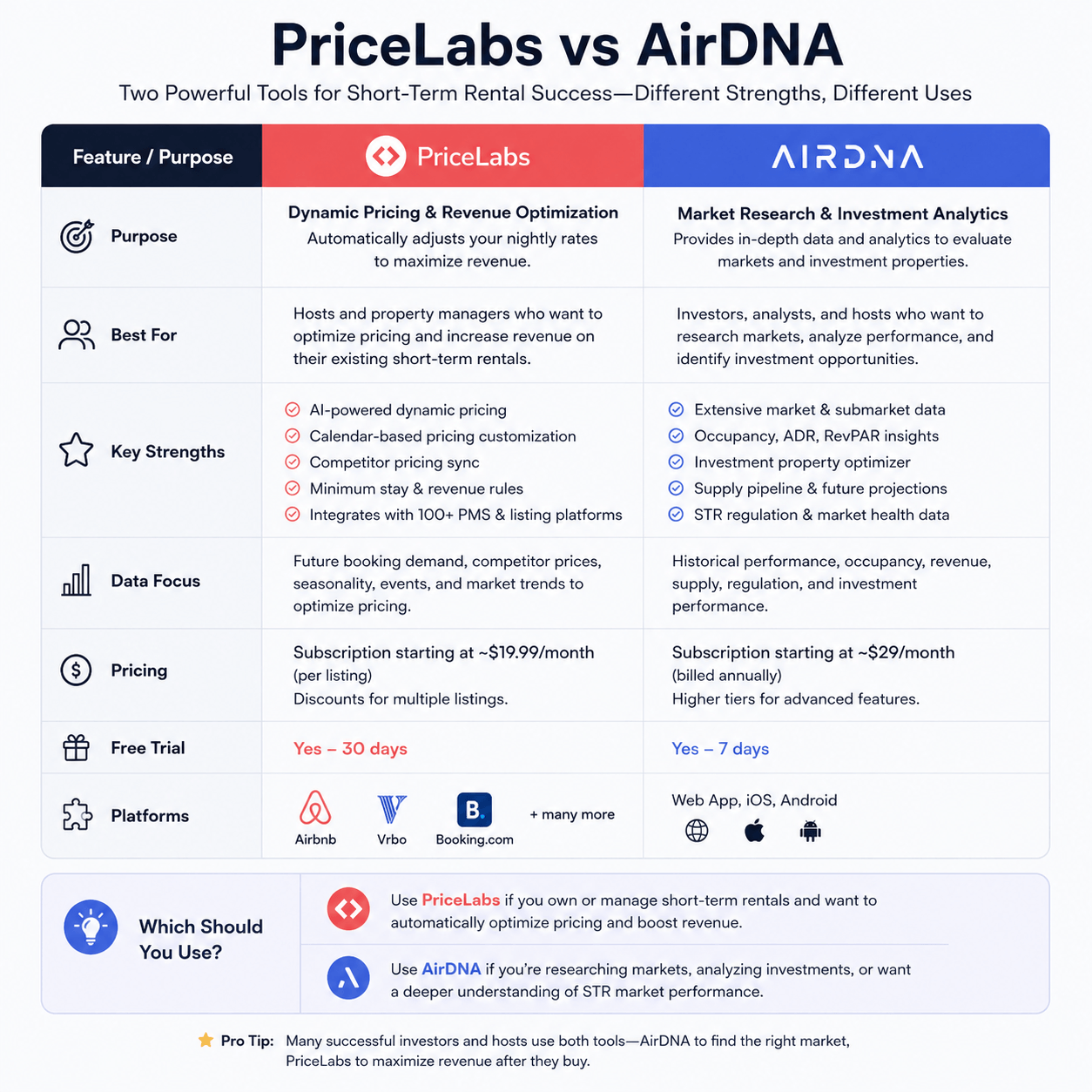
If you’re researching short-term rental software, PriceLabs and AirDNA come up constantly, usually named together as if you have to choose one. The honest answer in 2026 is more interesting than it used to be, because both tools have spent the last couple of years pushing into each other’s territory.
The old shorthand was simple. AirDNA was the tool you used before you bought a property, to research a market and estimate what a deal would earn. PriceLabs was the tool you used after you bought, to price the listing every night and squeeze out more revenue. That split still holds at the core, but the edges have blurred, and they’ve blurred in a lopsided way.
AirDNA has expanded hard into the after-the-buy world. It launched automated dynamic pricing, rebranded its revenue tooling as AirDNA Adapt, and bought Uplisting, a full property-management and channel-management platform. Its stated goal is now a single platform for both investing in and operating STRs.
PriceLabs has moved the other direction, but more cautiously. It added market research tools like Market Dashboards and a revenue calculator, yet its center of gravity is still pricing and revenue management, and it plugs into other property-management systems rather than trying to become one.
Here’s the short version of who each one fits today:
- AirDNA. Best for investors who want the deepest short-term rental market data for underwriting, and who like the idea of research, pricing, and property management living under one roof.
- PriceLabs. Best for owners and managers who want the most control over nightly pricing and revenue, paired with whatever property-management system they already use.
Below is a full breakdown of each platform as it stands in 2026, a category-by-category comparison, and a clear recommendation based on where you are right now.
PriceLabs vs AirDNA at a Glance
The pricing figures below move around on both platforms and vary by market and portfolio size, so confirm current numbers on each vendor’s own pricing page before you subscribe.
| AirDNA | PriceLabs | |
|---|---|---|
| Started as | Market data and analytics (research) | Dynamic pricing and revenue management (operating) |
| Now also does | Dynamic pricing (Adapt), property management (Uplisting) | Market research (dashboards, calculator) |
| Deepest strength | Market coverage and underwriting data | Pricing control and integrations |
| Core products | Rentalizer, MarketMinder, Smart Rates / Adapt, Uplisting | Dynamic Pricing, Market Dashboards, Revenue Estimator Pro |
| Data scale | 10M+ properties, 120,000+ markets | 500,000+ listings priced, 150+ countries |
| Pricing model | Priced per market, scales with market size | Flat fee per listing, or 1% of revenue |
| Entry cost (2026) | Free tier, paid roughly $15 to $40/mo per market | Free portfolio analytics, pricing from about $20/listing/mo |
| Best fit | Investors wanting deep data and an all-in-one platform | Operators wanting the most pricing control |
AirDNA: From Market Data Leader to All-in-One STR Platform
AirDNA has been the default reference source for short-term rental market data since 2015. It pulls listing-level data from Airbnb and Vrbo and turns it into market-level and property-level performance estimates. Its reach is hard to match, with coverage across more than 10 million properties and 120,000 markets globally. That data shows up in bank underwriting, DSCR loan decisions, investment-fund prospectuses, and academic research.
For years AirDNA answered a single question. Is this worth my money? That made it a research and underwriting tool, something you reached for when you were about to move capital. Over the last couple of years the company has aggressively widened that scope. It acquired the location-intelligence platform Arrivalist in 2023, then acquired Uplisting, a property-management and channel-management system, and launched automated dynamic pricing that syncs its Smart Rates recommendations straight to Airbnb. Backed by private equity, its mission now is an end-to-end platform covering research, pricing, and daily operations.
That makes AirDNA a strong fit for investors who value the deepest market data and want to keep their whole workflow in one place. The tradeoff is that the operations and pricing pieces are newer and less battle-tested than the market data it built its name on.
Key features
- Rentalizer. Enter an address and get estimated annual revenue, occupancy, and ADR for that property as a short-term rental. Most investors reach for this first when underwriting a deal.
- MarketMinder. City-level and submarket-level views of ADR, occupancy, RevPAR, supply growth, seasonality, and top-performing properties, updated monthly.
- Market Score. Every market and submarket gets graded from 0 to 100 across categories like demand and revenue growth, so you can screen locations fast.
- Smart Rates and AirDNA Adapt. Automated dynamic pricing and revenue management, with rate recommendations that sync to your listings, now positioned as a core product rather than an afterthought.
- Uplisting property management. Booking management, guest messaging, payments, and channel sync across Airbnb, Vrbo, and Booking.com, folded in through the 2024 acquisition and offered in the Host tier.
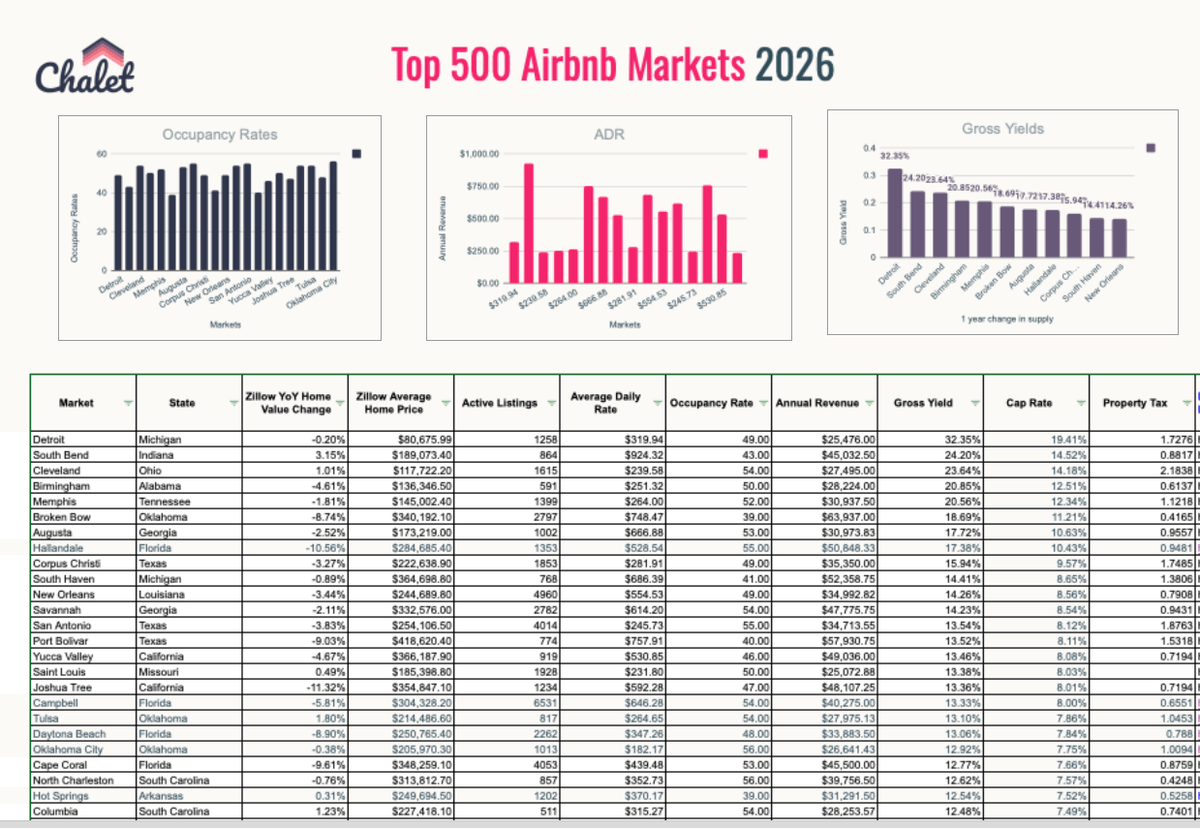
- Comps and exports. Custom comparable sets, historical data, and CSV exports on paid tiers.
Strengths
- Deep market coverage. For market-level analysis, few tools match its breadth. If you want a first read on almost any market, AirDNA usually has it.
- A useful free tier. The free Explorer plan gives you top-line market stats for a quick sanity check without a credit card, which helps a lot with early screening.
- Institutional trust. Because lenders, DSCR underwriters, and funds cite AirDNA, its estimates carry weight in conversations with partners and capital providers.
- A widening toolkit. With pricing and property management now in the mix, an investor can research, price, and run a listing without leaving the platform.
Shortcomings
- Averages, not your property. AirDNA works off market averages. Your specific unit can perform above or below the estimate depending on layout, finish, reviews, and management, so treat projections as a starting point rather than a promise.
- The newer pieces are still maturing. Dynamic pricing and property management are recent additions built partly through acquisition, so they don’t yet carry the same depth or track record as the market data.
- Cost scales with market size. The bigger and deeper the markets you research, the more you pay, and heavy multi-market work can get expensive.
- Uneven support. Response quality can be inconsistent, especially on data questions, so plan to lean on the documentation.
PriceLabs: Dynamic Pricing and Revenue Management, With Research on the Side
PriceLabs is the most widely used dynamic pricing and revenue-management platform in the vacation rental industry, with more than 500,000 properties priced across more than 150 countries. Where AirDNA grew out of data, PriceLabs grew out of operations. It recalculates your nightly rates based on real-time demand, competitor availability, booking pace, seasonality, and local events, then applies them inside the rules you set.
Its signature is the Hyper Local Pulse algorithm, which reads demand at the neighborhood level rather than the broad city level. That distinction matters, because a downtown market and a suburb 20 minutes away can behave nothing alike. PriceLabs is also the most configurable tool in its category, which is both its biggest strength and its steepest barrier to entry.
The company has added research tools of its own, including Market Dashboards for competitive benchmarking and a Revenue Estimator Pro calculator for underwriting. These are genuinely useful, but they read as companions to the pricing engine rather than the main event. Notably, PriceLabs has not tried to become a property-management system. Instead it connects to more than 150 of them, which keeps it focused and lets operators keep the PMS they already trust.
Key features
- Dynamic pricing. Automated daily rate recommendations pushed straight to your listings, with granular rules for minimum and maximum prices, seasonality, gap nights, and last-minute discounts.
- Hyper Local Pulse. Neighborhood-level demand signals instead of citywide averages.
- Market Dashboards. Competitive benchmarking and market intelligence, a research layer that overlaps with what AirDNA offers.
- Revenue Estimator Pro. A property-level revenue calculator for underwriting, sold in per-estimate packs.
- Portfolio Analytics. Occupancy and ADR monitoring across a whole portfolio, free to use.
- 150+ integrations. Broad connectivity with property-management and channel-manager tools, so your rates actually reach your calendars.
Strengths
- Deep pricing control. For hosts who want to shape exactly how their prices move, few tools offer more levers.
- Predictable flat pricing. A per-listing flat fee keeps your software cost steady as revenue grows, which is a real advantage over percentage-of-revenue competitors at higher ADRs.
- Best-in-class integrations. The integration list is among the broadest in the category, so it slots into almost any existing tech stack.
- Focused by design. By staying out of the property-management business, it avoids spreading itself thin and does one job unusually well.
Shortcomings
- A real learning curve. The configurability that power users love can overwhelm beginners, and getting full value takes time dialing in base prices and rules.
- Dense interface. Users regularly ask for a cleaner interface.
- No mobile app. Everything runs through the web dashboard.
- Lighter on research. Its dashboards and calculator help, but for deep pre-purchase underwriting across many markets, AirDNA still goes further.
PriceLabs vs AirDNA, Category by Category
Both tools now touch research, pricing, and (in AirDNA’s case) operations. The categories below show where each one is genuinely strong versus where it is playing catch-up.
Market research and coverage
| AirDNA | PriceLabs |
|---|---|
| Deepest in the category, with 10M+ properties across 120,000+ markets and underwriting-grade data used by lenders and funds | Solid research via Market Dashboards and a revenue calculator, but built as a companion to pricing rather than a primary use |
Dynamic pricing
| AirDNA | PriceLabs |
|---|---|
| Now a core product through Smart Rates and AirDNA Adapt, syncing automated rates to listings, though newer to the game | The original strength, with the deepest rule-based control and the broadest integration list in the category |
Property management and operations
| AirDNA | PriceLabs |
|---|---|
| Owns a full PMS and channel manager through the Uplisting acquisition, covering bookings, guest messaging, payments, and multi-channel sync | Not a PMS by design, but integrates with 150+ of them so you keep the system you already use |
Deal underwriting (estimating what a property earns)
| AirDNA | PriceLabs |
|---|---|
| Core competency, built directly into Rentalizer and MarketMinder | Revenue Estimator Pro calculator covers it as a secondary feature |
Cost and pricing model
| AirDNA | PriceLabs |
|---|---|
| Free tier, then paid plans priced per market (about $15 to $40 per month at entry, more for larger markets and higher tiers). Property management is priced in the Host tier | Free portfolio analytics, then dynamic pricing from about $20 per listing per month, with volume discounts and a 1%-of-revenue alternative |
Platform direction
| AirDNA | PriceLabs |
|---|---|
| Betting on all-in-one, pulling research, pricing, and operations together through acquisitions | Betting on focus, staying best-in-class at pricing and integrating with everything else |
Which Short-Term Rental Tool Should You Choose?
Because the two now overlap more than they used to, the choice is really about which strength you weight most and how you feel about the all-in-one versus best-of-breed question.
Choose AirDNA if data and consolidation matter most. If you’re evaluating markets, underwriting deals, or entering new geographies, AirDNA’s market data is still the deepest available, and it now lets you carry that same account into pricing and property management. It suits investors who want research, rates, and operations under one roof and are comfortable with the newer pieces still maturing. Start with the free Explorer tier to screen markets before you commit to a paid plan.
Choose PriceLabs if pricing execution is the priority. If your listings are live and getting the nightly rate right is where the money is, PriceLabs gives you more control than anything else, on a predictable flat fee, and it drops into whatever property-management system you already run. It rewards a few hours of setup, and that setup is where the returns come from.
Consider both if you want depth on each side. Plenty of serious operators still underwrite with AirDNA and price with PriceLabs, treating each as the best tool for its job rather than committing to one platform for everything. AirDNA clearly wants to end that split, but for now, running the two side by side gets you the deepest data and the deepest pricing control at the same time.
What Neither Tool Covers: Financing and Finding the Property
Here’s the part neither platform solves, no matter how wide their toolkits get. AirDNA can tell you a market looks strong and even help you run the listing afterward. PriceLabs can dial in your nightly rates. Neither one helps you finance the purchase or find the right property and agent to actually close the deal, and for most investors that’s where the real friction lives.
A market that grades well means little if you can’t secure short-term-rental-friendly financing, and a strong revenue projection is worth nothing if you overpay or buy with an agent who doesn’t understand how STRs get underwritten.
That’s the gap Chalet fills. Chalet matches short-term rental investors with agents who specialize in this asset class, the kind who understand STR-income underwriting, know which lenders finance these deals, and can point you toward properties that actually pencil out. Getting matched is free.
So once your data tools tell you a deal looks good, and before you hand pricing over to software, get matched with an STR-focused agent through Chalet. The tools tell you whether a deal works. Chalet helps you get it done.


