



You’ve sold an investment property and want to defer the tax bill with a Section 1031 like-kind exchange. Smart move. But here’s what catches many investors off guard. Where you exchange into matters just as much as what you buy.
Federal rules for 1031 exchanges are uniform across the country. The IRS doesn’t care if your replacement property is next door or across state lines. State tax codes, though, are a patchwork. Some states let you roll your short-term rental profits forward indefinitely. Others will track your deferred gain for years and eventually demand their cut.
The good news is that as of 2023, all 50 states now recognize 1031 exchanges for state tax purposes. Pennsylvania was the last holdout, and that changed in 2022. So you can execute a 1031 anywhere.
This guide breaks down the best and worst states for 1031 exchanges if you’re investing in Airbnb rentals or other STR properties. We’ll cover tax rates, clawback provisions, and strategies savvy investors use to maximize their after-tax returns.
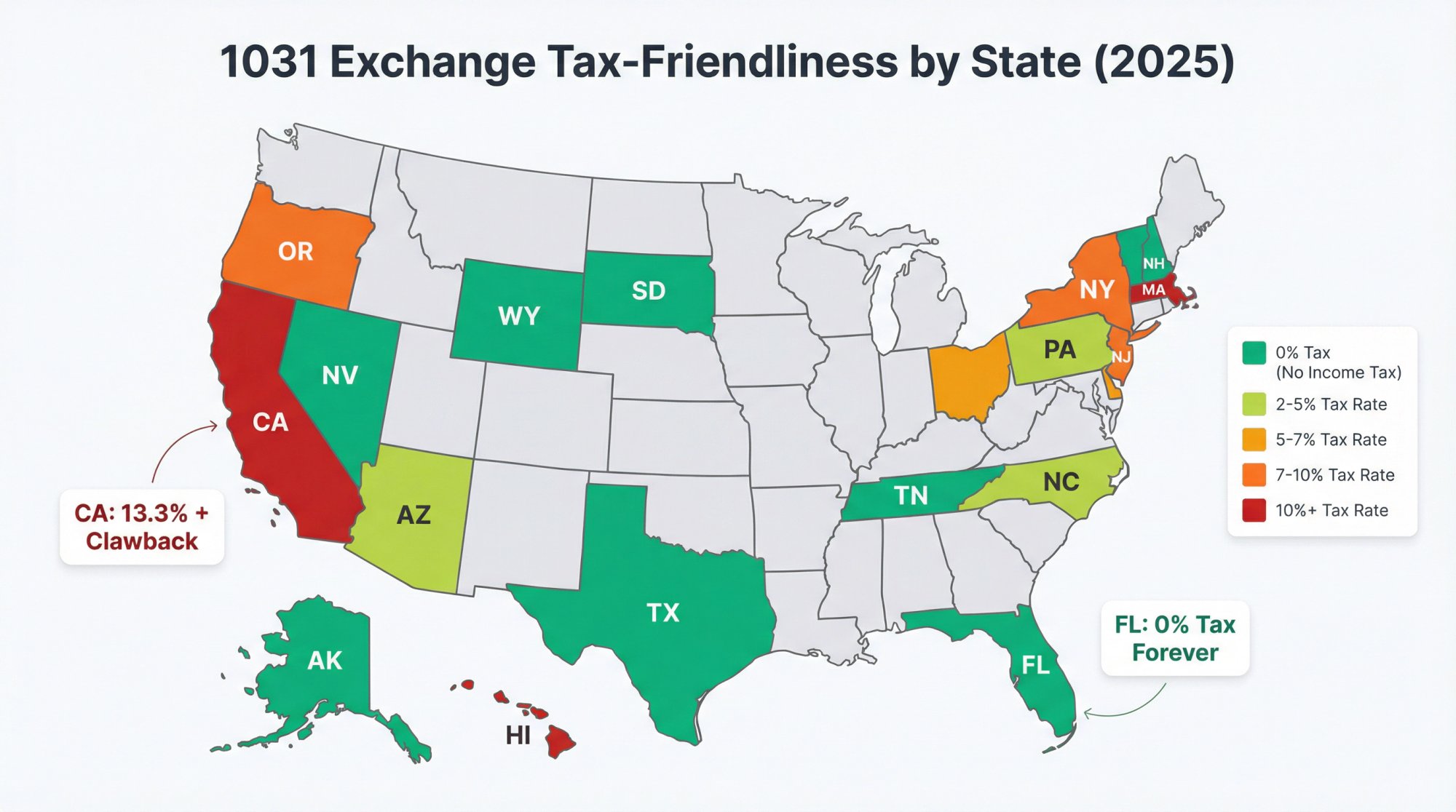
How State Tax Laws Affect Your 1031 Exchange
A 1031 exchange lets you defer capital gains tax when you sell an investment property and reinvest the proceeds into another. At the federal level, that’s straightforward. But state income taxes add complexity.
State capital gains rates range from 0% to over 13%, and most states tax real estate gains as ordinary income. Whether your state conforms to federal 1031 rules determines how much that rate will bite you, and when.
Three key state-level factors you need to understand:
1031 Exchange Clawback Provisions
Some states let you defer their tax when you exchange out. But if you later sell the replacement property in a different state without doing another exchange, the original state comes back for its share.
What this means in practice: You can move your investment from California to Nevada and defer California tax. But when you eventually sell that Nevada property for cash, California will demand taxes on the gain that originally accrued there.
States with clawback provisions include:
- California (annual reporting required)
- Oregon (annual reporting required)
- Massachusetts (no annual reporting)
- Montana (no annual reporting)
Non-Resident Withholding
Many states require a portion of sale proceeds to be withheld when a non-resident sells property. States with these provisions include New York, Georgia, and New Jersey.
If you’re completing a valid 1031 exchange, most states allow an exemption. You fill out the right paperwork at closing, and nothing gets held back. Extra forms, but it prevents cash from being tied up during your 45/180-day window.
State Capital Gains Tax Rates for Real Estate
Eight states have no income tax at all. Others approach 14%. If you’re planning to eventually cash out, where you sell makes a massive difference.
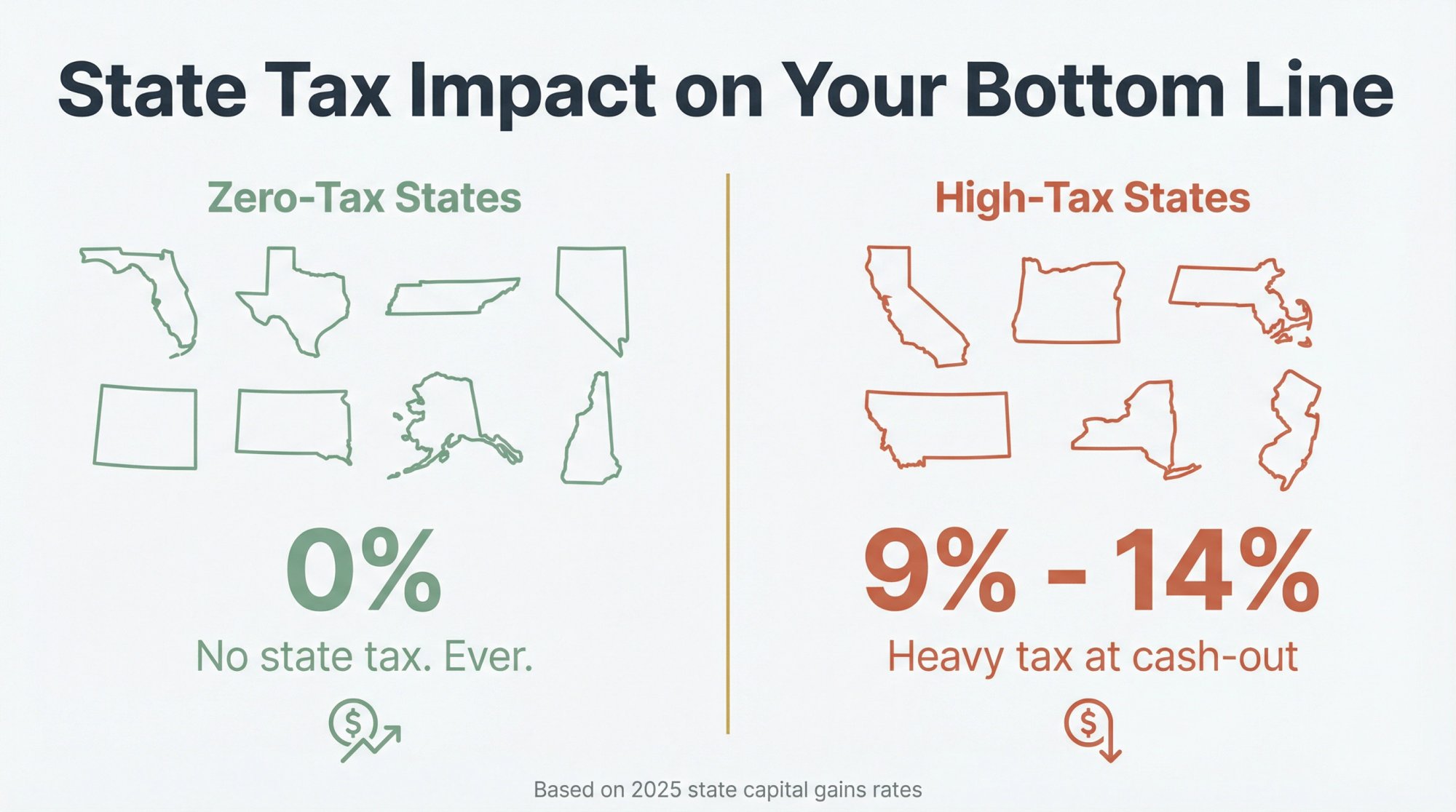
The bottom line: A 1031 exchange works in every state. But the best states let you defer more and potentially avoid state tax entirely. The worst ones will either tax you heavily at cash-out or follow you across state lines to collect later.
Best States for 1031 Exchanges: No-Tax and Low-Tax Options
From a tax perspective, the best states are those that impose little to no state tax on your real estate gains. These are also popular destinations for investors rolling long-term rentals into Airbnb properties.

No Income Tax States for 1031 Exchanges
Eight states have zero personal income tax on wages or investment income:
If your replacement property lands in one of these states, you won’t owe any state tax when you eventually sell. Not at the time of exchange. Not at final sale. Never.
Washington State deserves a note. It has no general income tax but recently enacted a capital gains tax on certain high-value stock sales. Real estate sales remain exempt. So for STR investors, Washington functions like a no-tax state.
The practical impact: When you finally break the 1031 chain and cash out, the only capital gains tax you’ll face is federal. That’s a significant advantage for wealth-building.
Florida: Zero State Tax and Strong STR Markets
Florida gets its own spotlight for good reason. With zero state income tax and a massive vacation rental market, it’s one of the most 1031-friendly states in the country.
An investor selling in New York or Illinois can exchange into a Florida beach rental and immediately eliminate state tax on future gains. The tourism infrastructure is already there. Theme parks, beaches, coastal towns, golf communities. Strong demand year-round.
In 2024, Florida was a top destination for investors exiting Pennsylvania, New Jersey, and New York. The combination of tax advantages and large property inventory makes it easier to identify replacement properties within the 45-day window.

Local STR regulations vary widely in Florida. Some counties welcome vacation rentals. Others restrict them heavily. Before you identify a property, check the local regulations to confirm you can actually operate it as intended.
Texas: No State Income Tax and Investor-Friendly Laws
Texas charges no state income tax, which means a final sale in Texas carries no state capital gains hit. Combined with its booming economy and population growth, it’s a prime destination for exchange investors.
The major metros (Austin, Dallas, Houston, San Antonio) and resort areas (Hill Country, Galveston, coastal regions) offer diverse investment options. Texas also tends to be landlord-friendly with plenty of inventory. Local rules to watch is Austin has some STR restrictions. Dallas has permit requirements. Always confirm local ordinances before buying a short-term rental.
Tennessee: No State Tax and Smoky Mountain Vacation Rentals
Tennessee phased out its tax on interest and dividends by 2021, making it effectively a zero-income-tax state. Combined with the wildly popular Great Smoky Mountains vacation market, it’s extremely attractive for 1031 exchanges.

Gatlinburg, Pigeon Forge, and Sevierville generate strong tourism-driven rental income. An investor can sell a rental in a high-tax state, swap into a Tennessee cabin, and defer all taxes. When they eventually sell that cabin, no state will tax the gain.
Tennessee ranked among the top destinations for investors leaving states like Oregon in 2024. Beyond tax benefits, the state offers moderate home prices and reasonable property taxes.
Other Low-Tax States for 1031 Investors
Even if a state isn’t completely tax-free, some have flat rates low enough to be compelling:
| State | Tax Rate | STR Market Highlights |
|---|---|---|
| Arizona | 2.5% flat | Scottsdale, Sedona, Phoenix |
| North Carolina | 4.75% (dropping to 3.99%) | Blue Ridge Mountains, Outer Banks |
| Pennsylvania | 3.07% flat | Poconos, Lake regions |
These states combine lower tax burdens with growing rental markets. They’re worth considering, especially if the no-tax states don’t have the property type or location you’re targeting.
Best States for 1031 Exchanges: Side-by-Side Comparison
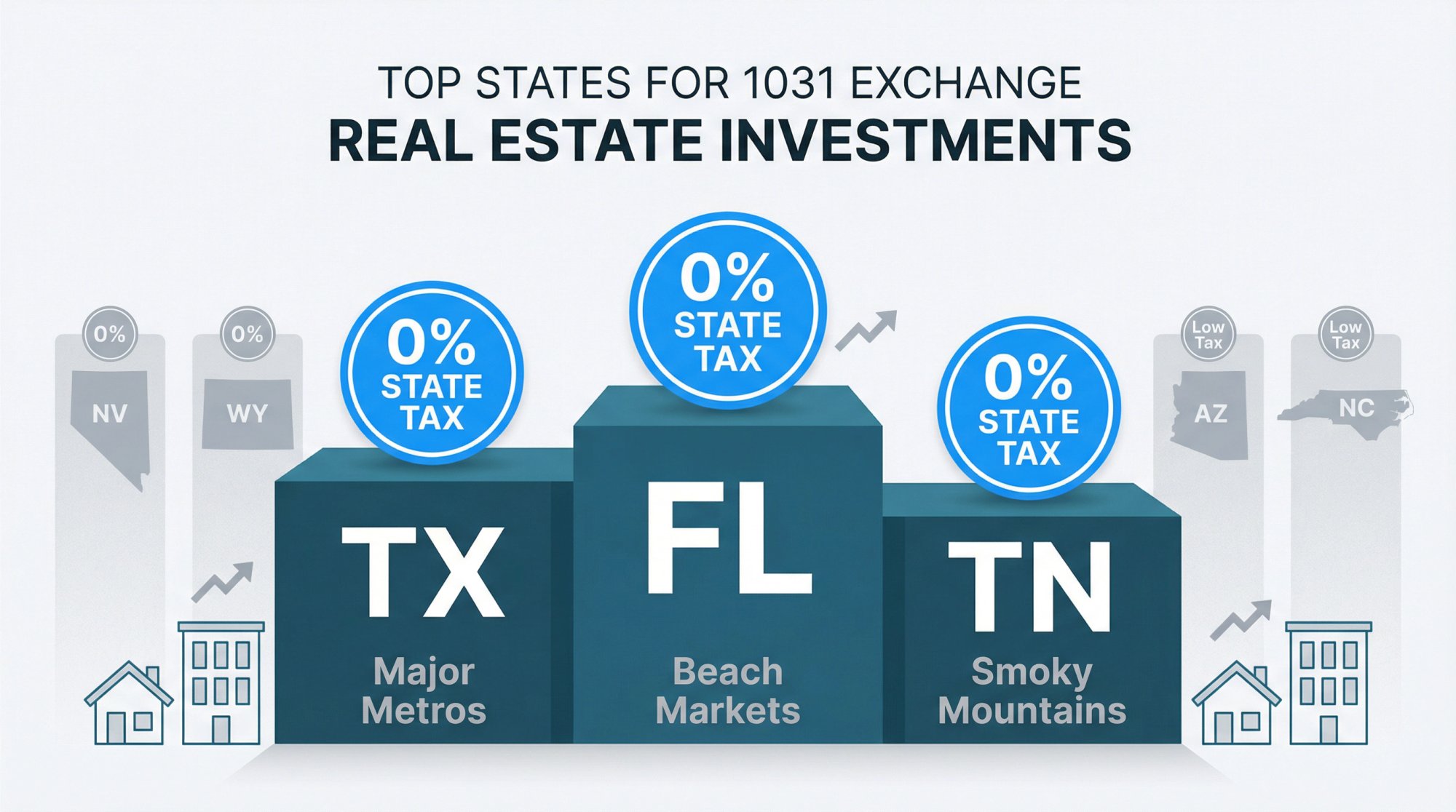
| State | Income Tax Rate | Clawback? | Annual Report? | Why Investors Choose It |
|---|---|---|---|---|
| Florida | 0% | No | No | Beach/theme park STR markets, high inventory |
| Texas | 0% | No | No | Major metros, landlord-friendly, population growth |
| Tennessee | 0% | No | No | Smoky Mountain vacation rentals, moderate prices |
| Nevada | 0% | No | No | Las Vegas, Lake Tahoe, proximity to CA |
| Wyoming | 0% | No | No | Ski resorts, ranch properties |
| South Dakota | 0% | No | No | Lower property prices |
| Arizona | 2.5% | No | No | Scottsdale, Sedona luxury markets |
| North Carolina | 4.75% | No | No | Mountain and coastal vacation rentals |
Worst States for 1031 Exchanges: High Taxes and Clawback Rules
No state forbids 1031 exchanges anymore. But “worst” here means states that hit you with high taxes or complicate your exchange with extra rules. If you’re selling or buying in these states, go in with eyes open.
California: Highest Taxes and Strict Clawback Rules
California earns its reputation as the least 1031-friendly state in the country.
It has the highest state income tax rate at 13.3%. If you ever cash out of a California investment without another exchange, that’s a significant hit.
Its clawback provision means you can’t escape by moving your investment out of state. Sell a California property and exchange into Nevada? California lets you defer its tax at the exchange. But when you later sell the Nevada property, California will “claw back” and charge you tax on the gain that originally accrued in CA.
California requires annual filings (Form FTB 3840) to track 1031 funds that leave the state.
The only way to completely avoid California’s tax? Keep exchanging until death (when heirs may get a step-up in basis, potentially wiping out the gain). Not exactly a simple strategy.
If you’re exiting California properties, work closely with a 1031-savvy CPA. And don’t miss those annual filings. Failure to file can void your deferral entirely.
Oregon: High Taxes and Clawback Provisions
Oregon mirrors California’s pitfalls. The state levies up to 9.9% tax on income and has a clawback rule.
If you exchange out of Oregon, you must file an annual report. Oregon will tax the deferred gain when you finally sell a future property outside the state.
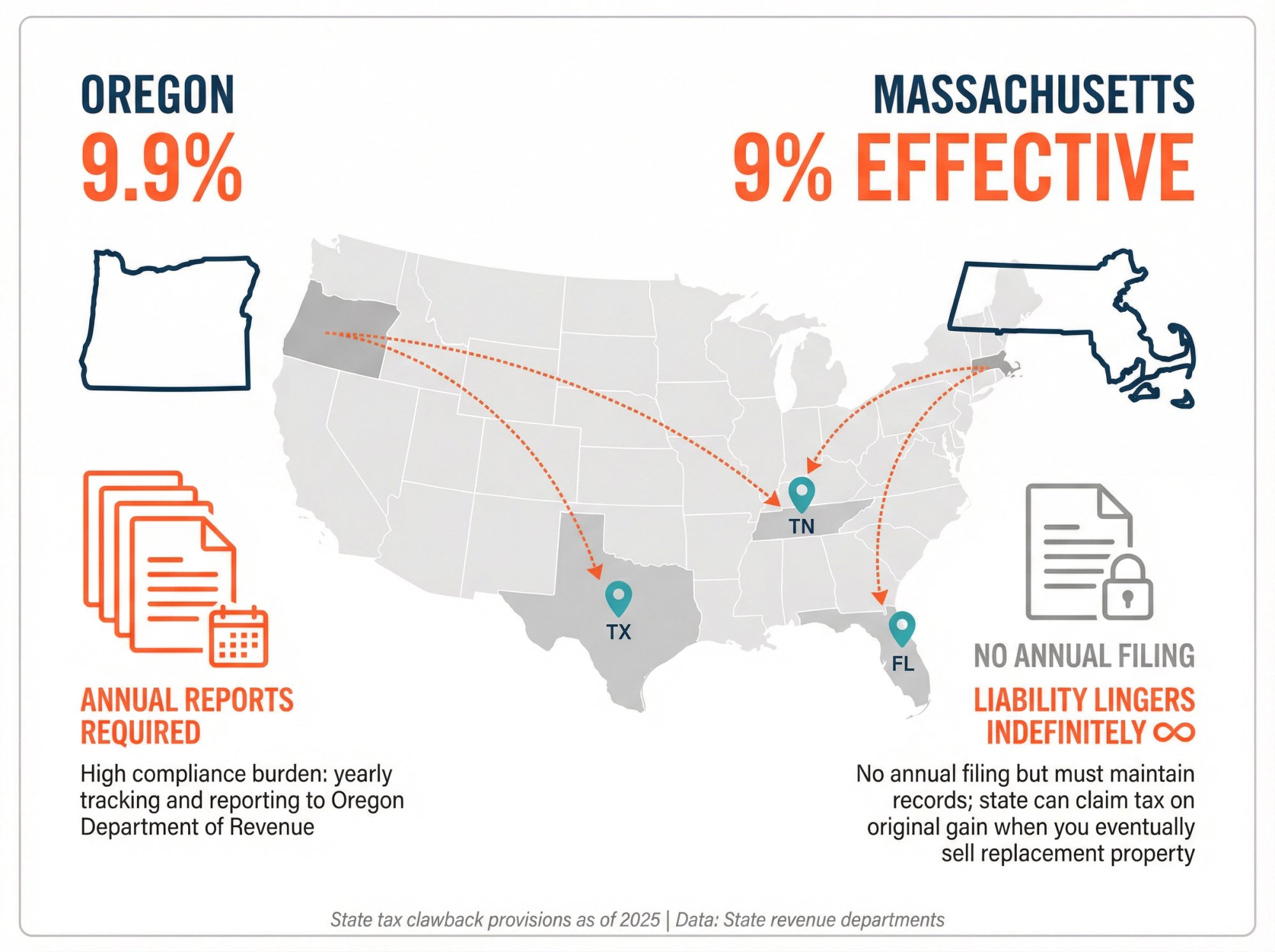
Oregon saw significant outbound 1031 activity recently, with investors trading Oregon properties for ones in Idaho, Texas, and Tennessee. The state is also known for strict tenant laws and local rental regulations (particularly in Portland), which add operational complexity.
Massachusetts: Clawback Rules and 9% Effective Tax Rate
Massachusetts has a 5% flat income tax on most income. In 2023, it added a 4% surtax on annual income over $1 million, making the effective tax on large gains 9%.
For 1031 exchangers, Massachusetts enforces a clawback provision. Selling Massachusetts property and buying elsewhere defers MA tax initially. But if you later sell the new asset, Massachusetts will still seek the tax on your original MA gain.
Unlike California and Oregon, Massachusetts doesn’t require annual filings. But you must keep records because the liability lingers indefinitely.
Swapping that Boston rental for a Florida beach house only postpones Massachusetts tax. One day when you sell the Florida property, Massachusetts comes knocking.
Montana: Lower Rates but Hidden Clawback Rules
Montana’s top income tax rate sits around 5.9%. Not extreme. But it does have a clawback.
If you exchange out of Montana, you’ll owe Montana’s tax on that original gain when you eventually sell the replacement property. There’s no yearly report required, but the deferred state tax remains your obligation.
Montana has a smaller real estate market (aside from vacation areas like Bozeman or Flathead Lake), so it may not be on most investors’ radar. But if you own property there, be aware. An exchange only defers Montana’s cut. It doesn’t forgive it.
New York and New Jersey: High Taxes Without Clawback
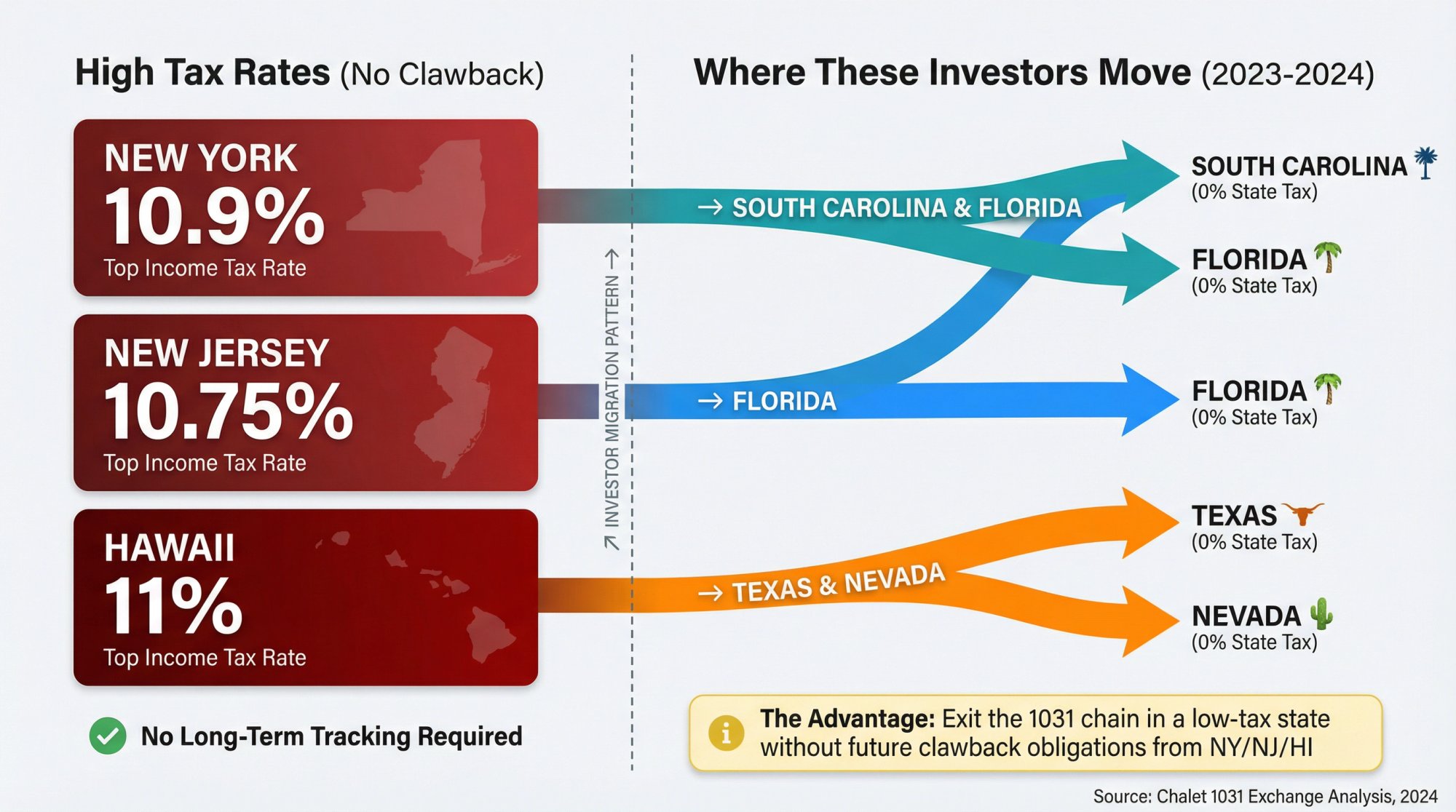
New York State’s income tax climbs to 10.9%. New Jersey hits 10.75%. Both rank among the highest in the country.
Neither state has a clawback provision. If you sell property in New York via 1031 and buy in another state, New York doesn’t pursue you for tax years later. Your future gains will be taxed by whatever state you eventually sell in.
When selling in these states, plan for logistics. New York requires non-resident sellers to pre-pay estimated tax unless it’s a 1031 deal. You must file the right exemption form to avoid withholding.
We’ve seen significant New York money flow into South Carolina and Florida rentals in recent years. Investors want to eventually exit the 1031 chain in a tax-friendly jurisdiction.
Other High-Tax States for 1031 Exchanges
- Hawaii: Taxes up to 11%. Honolulu has a withholding requirement for non-resident sellers (HARPTA), though 1031 exchanges are exempt with proper filing.
- District of Columbia: 10.75% top rate. Comparable to New Jersey.
Worst States for 1031 Exchanges: Side-by-Side Comparison
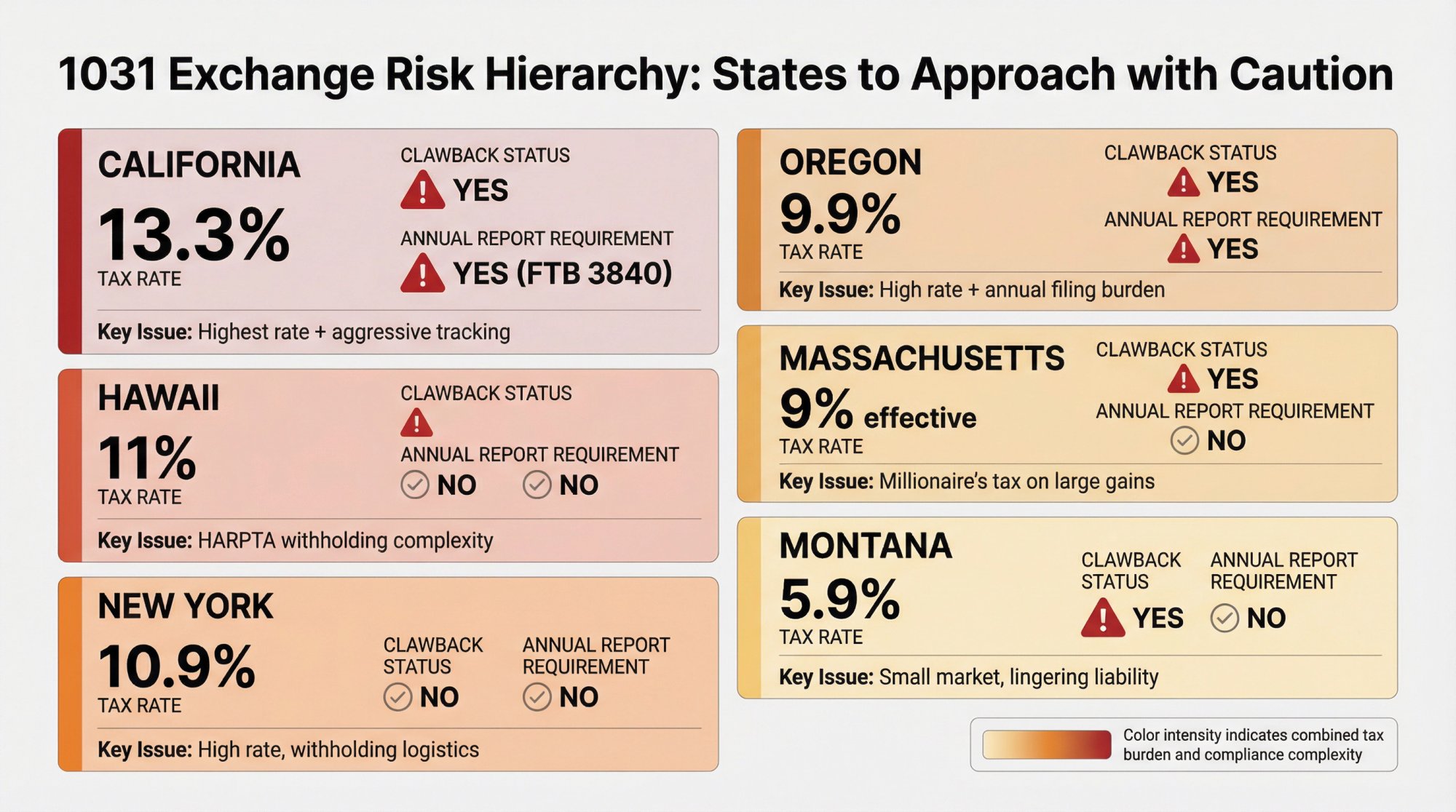
| State | Tax Rate | Clawback? | Annual Report? | Key Issues |
|---|---|---|---|---|
| California | 13.3% | Yes | Yes (FTB 3840) | Highest rate + aggressive tracking |
| Oregon | 9.9% | Yes | Yes | High rate + annual filing burden |
| Massachusetts | 9% effective | Yes | No | “Millionaire’s tax” on large gains |
| Montana | 5.9% | Yes | No | Small market, lingering liability |
| New York | 10.9% | No | No | High rate, withholding logistics |
| New Jersey | 10.75% | No | No | High rate |
| Hawaii | 11% | No | No | HARPTA withholding complexity |
How to Execute a 1031 Exchange Into Short-Term Rentals
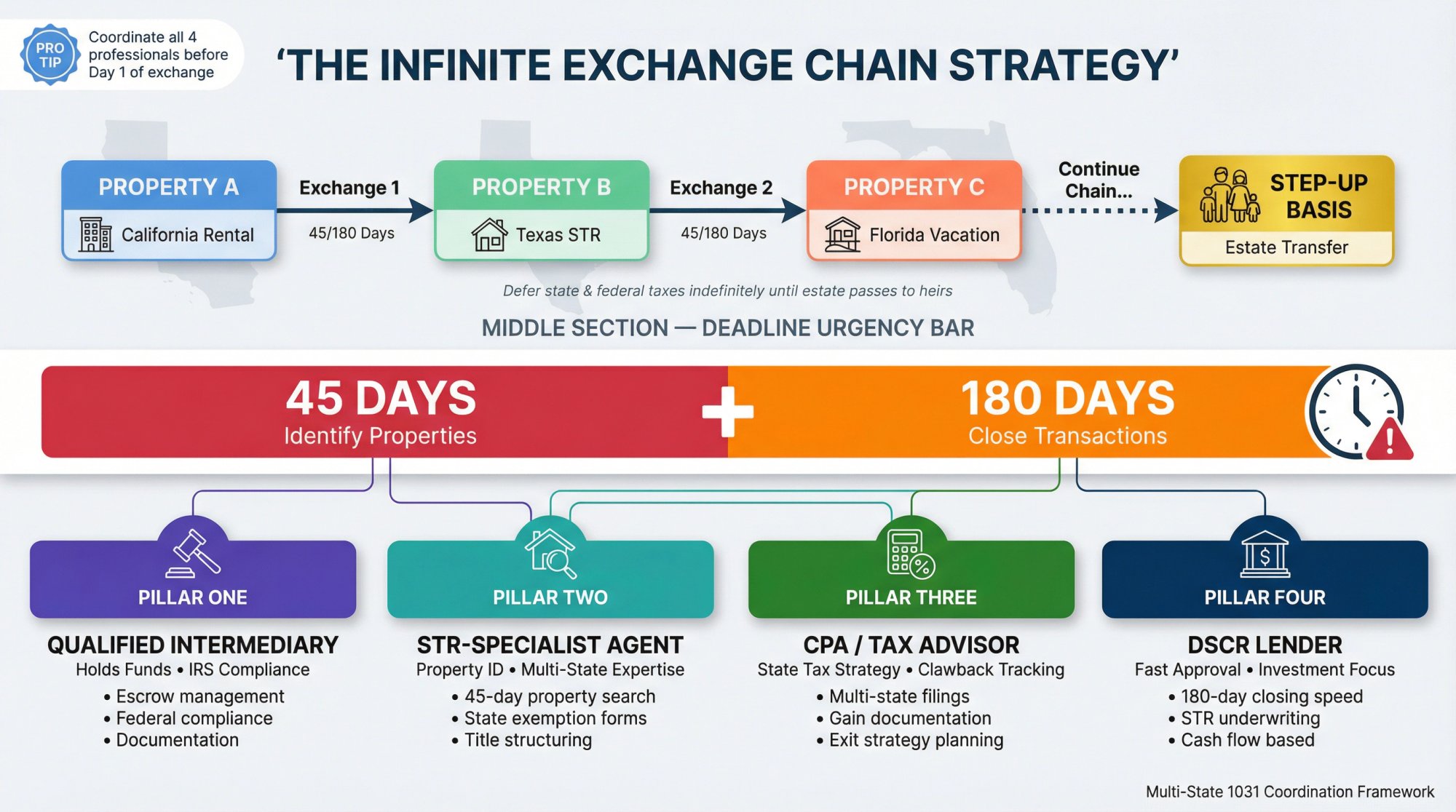
A 1031 exchange into short-term rentals involves tight deadlines and coordinating multiple professionals. You have 45 days to identify replacement properties and 180 days to close. That’s not much time to research markets, vet properties, line up financing, and confirm local regulations.
At Chalet, we’ve built a platform specifically for STR and Airbnb investors to streamline this process.
Free market analytics: You can analyze Airbnb markets across the country, comparing ADR, occupancy, cap rates, and revenue potential. All 100% free, no subscription required. When you’re evaluating whether to exchange into Tennessee vs. Florida vs. Texas, data should drive that decision.
1031-savvy agent network: We connect you with real estate agents who specialize in STR investments and understand 1031 timelines. They know which markets have strong vacation rental demand, which neighborhoods allow short-term rentals, and how to move fast when deadlines loom.
Vendor coordination: Beyond agents, you’ll need lenders, insurance, property management, and potentially cost segregation specialists. We maintain a vetted network across all these categories.
Ready to get started? Meet an Airbnb-friendly agent who can help you identify properties in 1031-friendly markets and close within your deadline.
Multi-State 1031 Exchange Strategies That Save You Taxes
If your 1031 journey spans different states, a bit of planning will maximize your benefits.
Moving Investments to No-Tax States
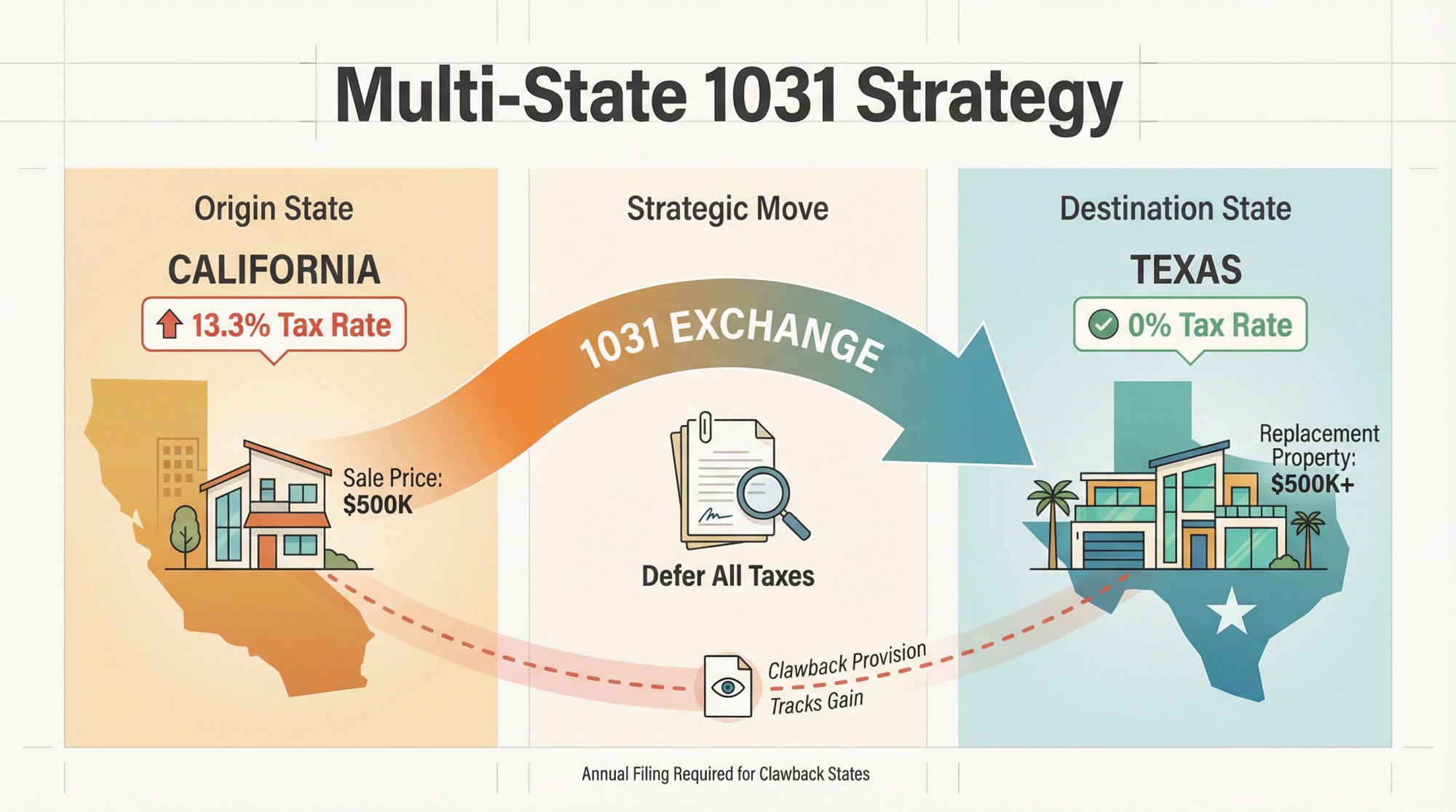
It’s perfectly legal to sell an investment in a high-tax state and buy a replacement in a no-tax state to reduce your eventual tax burden.
Sell in California. Buy in Texas. When you finally cash out in Texas, you’ll only pay federal capital gains tax.
But there’s a catch for clawback states. California will still want its cut from the original sale. This strategy works best if:
- Your original state doesn’t have a clawback (NY, NJ), or
- You plan to keep exchanging indefinitely, or
- You’ve already moved your basis out of clawback states in prior exchanges
Always consult a tax advisor before executing this. A misstep could accidentally trigger taxes.
Tracking Deferred Gains in Clawback States
If you perform a 1031 exchange selling in Massachusetts and buying in North Carolina, you’ve deferred Massachusetts tax, but that liability doesn’t vanish.
The burden is on you (or your accountant) to document:
- The amount of gain deferred
- Which state it originated in
- Which new property it attached to
Years later, when you sell without another exchange, you’ll need to file a Massachusetts return and settle up.
California and Oregon actively track via required annual filings. Don’t neglect those filings. Failure can void your deferral and make the tax due immediately.
Chaining 1031 Exchanges to Defer Taxes Indefinitely
One way savvy investors avoid ever paying state tax is to never break the chain.
Exchange property A for B. Then B for C. Then C for D. Continue until your estate passes to your heirs.
At death, the property’s tax basis gets stepped up to market value under current federal law. This potentially wipes out the accumulated capital gain for tax purposes. Neither federal nor state capital gains tax would apply.
It’s an advanced strategy that relies on tax laws not changing. But it explains why some investors are comfortable owning California real estate via 1031, knowing they can defer indefinitely.
If you go this route, make sure your heirs understand the situation. Tax laws could change.
Why Local STR Regulations Matter for 1031 Exchanges
State tax friendliness doesn’t automatically mean local rental friendliness.
Buying a vacation rental in Florida is great for taxes. But if that home is in a town that prohibits short-term rentals, your investment strategy falls apart.
Before you identify a replacement property, research the local rules. An “exchange-friendly” market should minimize taxes and let you operate legally.
Finding 1031-Savvy Real Estate Professionals
The clockwork timing (45 days to identify, 180 to close) means you can’t afford delays or mistakes, especially across multiple states.
Engage a qualified intermediary (QI) to hold funds and ensure IRS compliance. Work with a real estate agent experienced in 1031 exchanges. They’ll file the right state exemption forms, structure titles correctly, and line up suitable properties fast.
A good agent in your target state can have a list of properties ready that meet your criteria and timeline. At Chalet, we can introduce you to vetted agents who understand 1031 deadlines and the nuances of investing across state lines.
Next Steps to Maximize Your 1031 Exchange
Finding the best and worst states for 1031 exchanges comes down to balancing tax implications with investment potential.
Tax-friendly states like Florida, Texas, and Tennessee let you defer state taxes entirely. When you eventually sell, only federal tax applies. That’s a huge advantage for long-term wealth building.
High-tax or clawback states demand more careful planning. But even there, a 1031 exchange can save you tens of thousands in immediate taxes and give you more capital to reinvest. You just need to track obligations and plan your exit strategy.
- Consider where you ultimately want your profits to end up. A no-tax state can amplify your gains when you eventually sell.
- If you’re exiting a high-tax or clawback state, factor in lingering obligations so you’re not caught off guard years later.
- Use Chalet’s free analytics tools to compare short-term rental markets and identify promising areas for your exchange.
- Most importantly, get the right help. A seasoned agent who has handled 1031 deals will streamline your search and transactions within the tight deadlines.
Deferring taxes is a smart way to build your portfolio faster. Doing it in the right state is how you keep more of what you earn.
When you’re ready to find the ideal market and team for your 1031 exchange, meet an Airbnb-friendly agent and start your search in an investor-friendly market today.