
Furnishing an Airbnb rental sneaks up on you. You've closed on the property, you're excited about your first booking, and then reality hits: you need everything. Not just a bed and a couch. You need plates, towels, nightstands, lamps, a coffee maker, outdoor furniture, smart locks, and about a hundred other things you didn't realize guests would expect.
For a small one-bedroom short-term rental (STR), you might get away with $5,000 if you're incredibly frugal. Most hosts find they need closer to $12,000-$15,000 for a quality setup that actually gets good reviews. Scale up to a four-bedroom vacation home? You're looking at $28,000 to $44,000 for a proper guest-ready property that can compete in your market.
This guide breaks down realistic furnishing budgets by bedroom count using 2025 industry data. You can plan ahead and avoid the cash flow surprises that trip up new hosts.
What Factors Affect STR Furnishing Costs?
Several factors determine how much you'll spend to get your rental guest-ready:
Property size matters more than you think. Each additional bedroom adds roughly $7,000-$8,000 to your total furnishing cost. It's not just about beds. A four-bedroom home usually has multiple bathrooms, bigger common areas, outdoor spaces, and higher guest expectations for amenities. The study that tracked this found the cost distribution widened significantly with size. Larger properties show way more variation between basic and luxury setups.
Quality tier is your biggest decision. You're aiming for budget-friendly basics, mid-range comfort, or high-end luxury. This choice will multiply or divide your budget by 2-3x. A basic one-bedroom might cost $3,000 with second-hand furniture. A luxury version of the same unit could hit $20,000. Most successful hosts find the sweet spot in the middle: mixing affordable retailers with a few quality pieces that guests notice (like a great mattress and comfortable sofa).
Your location changes everything. A typical two-bedroom setup averages around $30,000 in Hawaii versus $15,000 in Kansas. That's not just about furniture prices. It includes shipping costs, labor rates, and what guests in your market expect. Resort markets demand higher-end decor. Urban markets need workspace setups. Rural markets can get away with simpler furnishings.
Housewares add up fast. About 20% of your budget goes to things that aren't furniture: kitchen gear, linens, towels, cleaning supplies, decor accents. Individually cheap, collectively expensive. Outfitting a kitchen with plates, utensils, cookware, and appliances can easily hit $500-$1,000. Quality bedding and towels for each bedroom run a few hundred dollars per room.
Labor costs are real. If you assemble everything yourself, you save money but invest serious time. Using a turnkey furnishing service adds roughly 15% to your budget for labor, delivery, and design fees. In high-cost cities or remote locations, these fees climb even higher.
Quick Budget Rule: Plan for 10-15% of your property's purchase price for furnishing if you're starting from scratch. A $300,000 two-bedroom might need $30,000-$45,000 to furnish properly.
Another quick estimate: plan for $3,000-$4,000 for a studio or one-bedroom base, then add $1,000-$2,000 per additional bedroom for basic setups.
These are just starting points. Your actual costs will depend on your market and quality goals. They help you ballpark whether a deal makes sense before you're too far down the road.
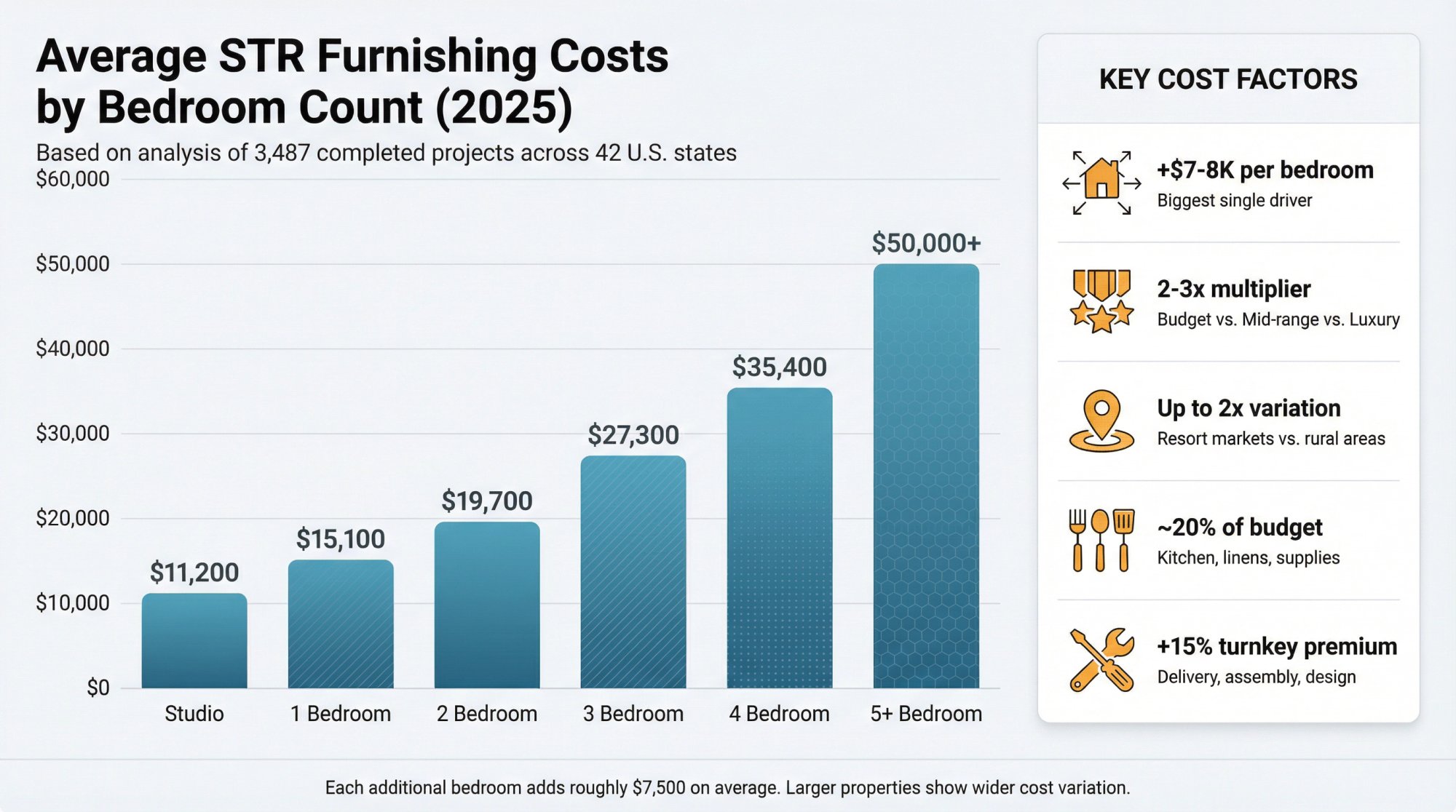
Average total furnishing costs by property size based on 2025 industry analysis of 3,487 completed STR projects. Each additional bedroom added roughly $7,500 in furnishing costs on average. Larger properties show wider variation.
How Much to Furnish a 1-Bedroom Airbnb
For a studio or one-bedroom property, you're furnishing the smallest viable STR footprint. "Small" doesn't mean cheap.
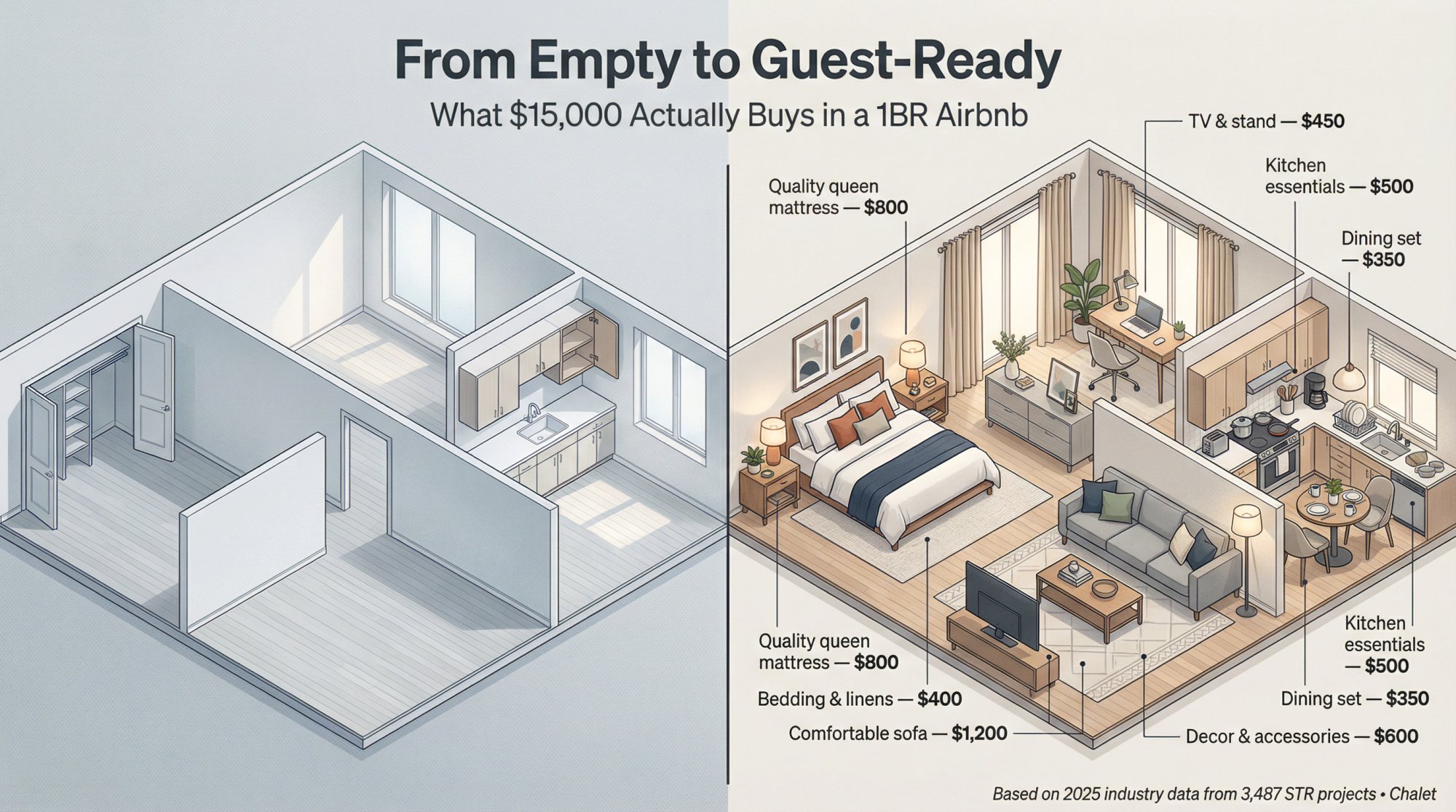
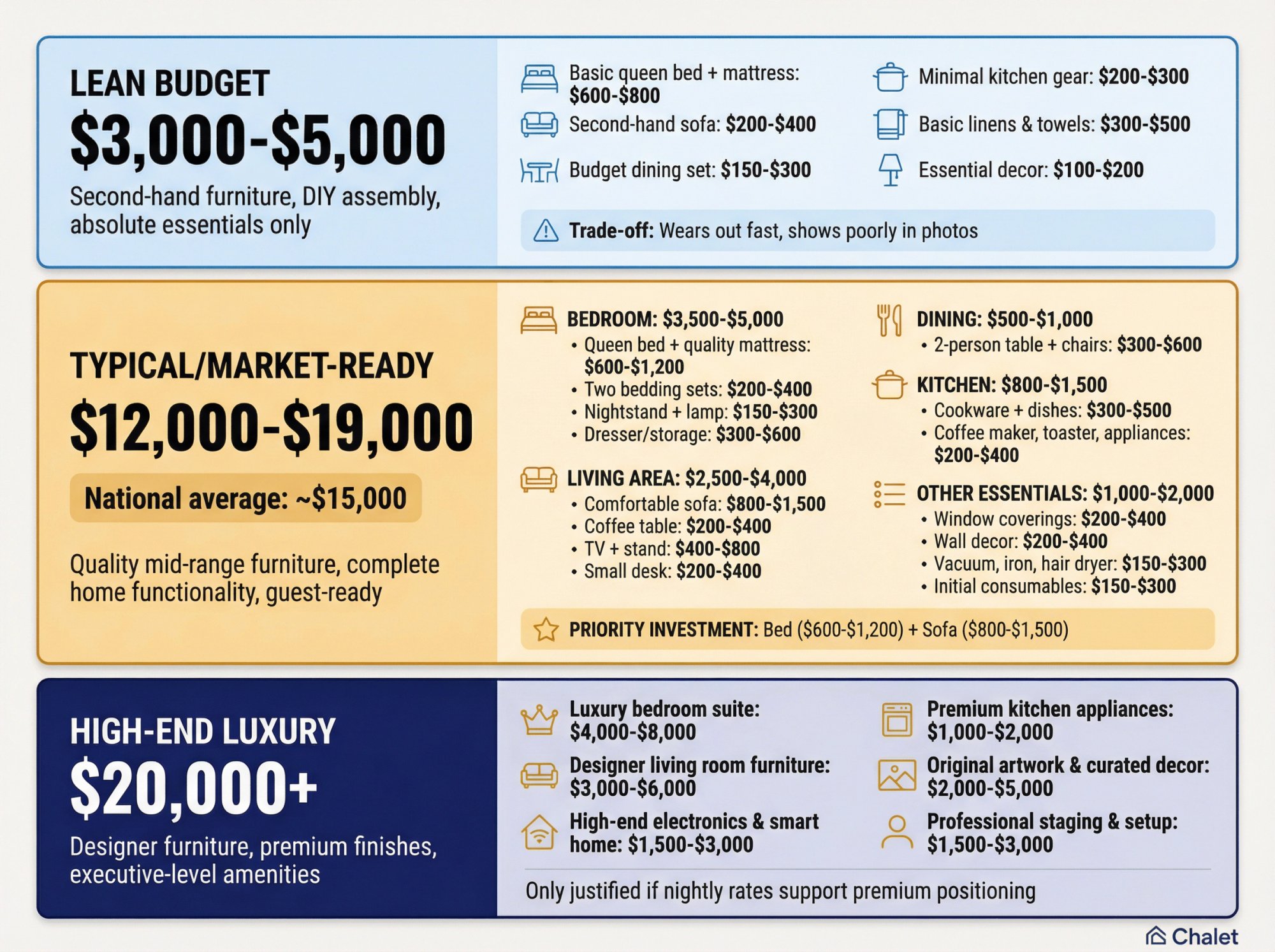
Typical range: $12,000-$19,000 is where most one-bedroom setups land in 2025. This gets you decent-quality furniture (good queen bed, comfortable sofa, dining table, TV) and all the essentials for 2-4 guests. The national average for one-bedrooms is around $15,000 total. Studios trend slightly lower at $10,000-$12,000 since there's less square footage to fill.
Lean budget: $3,000-$5,000 is possible if you're extremely cost-conscious. You'll be buying second-hand furniture, sticking to absolute essentials, and doing all assembly yourself. One host managed a basic one-bedroom for $2,000-$3,000 by shopping sales and skipping any decor upgrades.
Going too cheap backfires. Rock-bottom furniture wears out fast and shows poorly in photos. If your budget is this tight, prioritize the bed and sofa (places guests physically touch most), then upgrade other items as revenue comes in.
High-end: $20,000+ for luxury one-bedrooms in competitive markets. Designer furniture, premium mattress, original artwork, high-end electronics. A single luxury bedroom can cost $10,000-$20,000 by itself if you're targeting executive rentals or ultra-premium markets. Most hosts don't need this level of spend unless nightly rates support it.
What to Include
Even a small rental needs full home functionality:
Bedroom essentials:
• A queen bed with quality mattress ($600-$1,200 for a good one)
• Two full sets of bedding and pillows
• At least one nightstand with lamp
• Dresser or closet storage
Living area:
• Comfortable sofa (or sofa bed if you want extra capacity)
• Coffee table
• TV with stand or wall mount
• Small desk if targeting remote workers
Dining:
• Two-person table or breakfast bar with chairs
Kitchen:
• Complete cookware and dishes
• Coffee maker, toaster, basic appliances
• This alone can run $300-$500
Other necessities:
• Window coverings
• Wall decor (at least a few pieces)
• Vacuum, iron/board, hair dryer
• Initial stock of consumables (toiletries, coffee, paper goods)
Real-world example: A frugal host might furnish a one-bedroom for $4,000 using second-hand furniture and minimal kitchen gear. Most investors using professional setup services report spending $12,000-$18,000 by the time everything's in place and guest-ready.
How Much to Furnish a 2-Bedroom Airbnb
Two-bedroom properties are a sweet spot for STRs. Big enough for families or two couples, but not as expensive as larger houses.
Typical range: $16,000-$25,000 covers most two-bedroom setups. The 2025 average is around $19,700. This includes quality beds in each room, comfortable living room furniture, dining for 4-6, and complete kitchen and bath supplies. Many mid-range hosts land around $15,000-$20,000 for a nice setup.
Lean budget: $5,000-$8,000 is very tight but achievable. One investor furnished a 2-bed, 1-bath apartment (823 sq ft) for $5,000 total by hunting deals and opening a business account with a furniture outlet. At this level, you're providing functional basics with minimal style. Each bedroom gets a simple bed and mattress (~$500-$700), one nightstand, and not much else. Living room is a second-hand couch, budget dining set, essentials-only kitchen.
The trade-off: it works, but it won't be Instagram-worthy. Many hosts starting lean plan to reinvest early rental income into upgrades.
Higher-end: $25,000-$35,000+ for luxury two-bedrooms or larger units in expensive markets. Think high-rise condos in major cities or beachfront properties. Designer furniture, premium mattresses in both rooms, quality sleeper sofa, curated decor throughout. Location matters here too. That same two-bedroom setup that costs $30,000 in Hawaii might only need $15,000 in Midwest markets like Chicago.
What Changes at Two Bedrooms
You'll need everything from a one-bedroom, plus:
Second bedroom setup:
• Another bed (queen or two twins, depending on your market)
• Additional mattress, bedding, pillows
• Extra nightstand and lamp
• Dresser or closet solution
Scaled-up common areas:
• Living room seating for 4-6 people (bigger sectional or multiple sofas)
• Dining table that seats your full guest capacity
• More kitchen inventory (more plates, cutlery, cookware for larger groups)
Extra supplies:
• Way more linens and towels (plan for 2+ sets per bed)
• Additional bathroom supplies if you have two baths
These duplicated costs per bedroom are why each extra room adds thousands even with basic furnishing. One bedroom might need $1,500 worth of linens and towels. Two bedrooms need $3,000.
Real example: A careful DIY host might manage a two-bedroom for $8,000 by shopping sales. A fully turnkey furnished unit in a major city might come as a package deal around $20,000 from a furnishing company.
Most hosts find themselves in the middle, aiming for that $15,000-$18,000 range where the place looks inviting without overspending.
How Much to Furnish a 3-Bedroom Airbnb
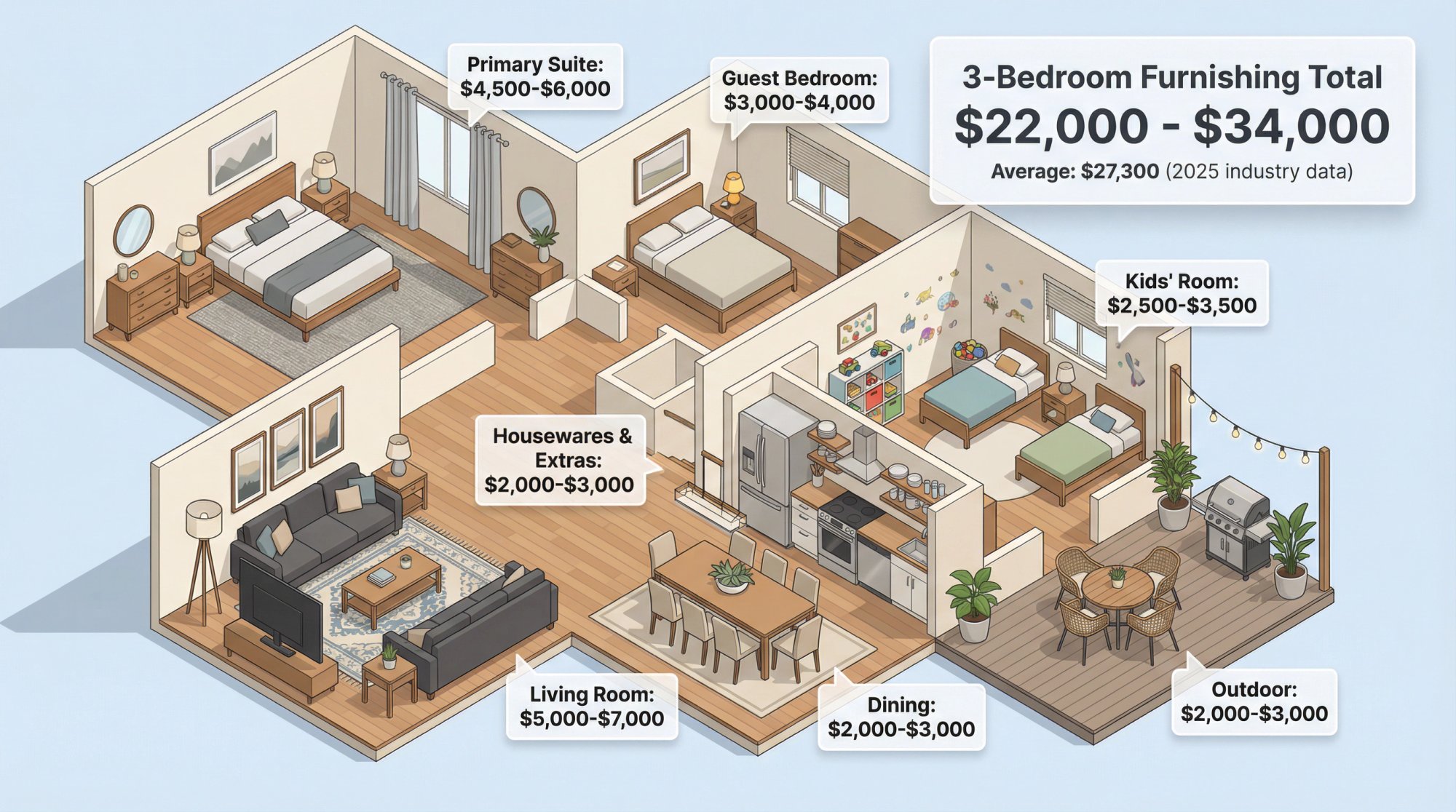
With three bedrooms, you're furnishing a full house that can host 6-8 guests. This is where costs start surprising new hosts.
Typical range: $22,000-$34,000 for a decent three-bedroom in 2025. The industry average is around $27,300. Professional STR designers often report spending in the mid-$20,000s for nicely furnished three-bedroom homes.
At this level, you're providing:
• Full bedroom suites (king or queen in primary, queens or twins in others)
• Well-furnished living room (sectional or multiple sofas for 6+ people)
• Dining for 6-8
• Smart TVs, artwork, possibly outdoor furniture
Around $20,000 is often a reasonable target for quality three-bedrooms in average markets. You might hit closer to $15,000 in cheaper areas or with smart shopping. High-cost markets or fancier tastes push toward $30,000.
Budget-conscious: $10,000-$15,000 can work if you're careful. One host furnished a 3-bed, 2-bath house (~2,300 sq ft) for about $10,000 by mixing high-end and low-end items, using Costco, IKEA, and Facebook Marketplace.
Achieving $10,000 means:
• Used furniture where possible
• Self-assembly of affordable pieces
• Prioritizing big pieces (beds, couch, dining table)
• Delaying or skipping nice-to-haves
You might furnish two bedrooms fully and keep the third minimal at first. Or skip patio furniture initially. The upside: you can start cash flowing. The downside: a sparse home might underwhelm vacation guests. Focus your limited budget on the essentials guests care most about (good beds and a welcoming living room).
High-end: $30,000-$45,000+ for luxury three-bedrooms in vacation markets. Ski chalets, beach houses, properties with multiple living spaces or themed bedrooms. If you have a formal living room and a family room, or a game room, costs climb. Premium projects can exceed $40,000. Many investors in these markets are 1031 exchange buyers selling long-term rentals to roll into higher-earning vacation properties.
Only spend at this level if your nightly rates truly demand it. The good news: a well-designed three-bedroom can command significantly higher rates, potentially paying back the investment within a year.
What Three Bedrooms Requires
Three bedroom suites:
• Usually one primary with larger bed (maybe en-suite bath)
• Two additional bedrooms (often one set up for kids with twins or bunks)
• Each needs full furniture: bed, mattress, nightstands, lamps, storage, decor
Living for crowds:
• Seating for 6+ (sectionals or multiple sofas are common)
• Dining table for 6-8
Outdoor matters:
• Three-bedroom homes often appeal to groups who use yards or decks
• Budget for grill, outdoor seating, or fire pit if that's a selling point
More of everything:
• Extra kitchenware (bigger groups need more dishes)
• Possibly a larger coffee maker
• Way more linens (three bedrooms worth)
• Entertainment amenities (game console, board games, maybe ping-pong if space allows)
Think of it as equipping an entire family home from scratch. Living room, dining room, 3 beds, possibly 3 bathrooms worth of towels and accessories. The cumulative total surprises people.
Three-bedroom ROI insight: Many professional setups in 2025 were recouping furnishing costs in about 8-15 months through rental income uplift. While $20,000-$25,000 feels like a lot upfront, if it lets you charge $100 more per night and boost occupancy, it often pencils out as a very solid investment.
Use Chalet's free calculator to model your specific property and see exactly how furnishing costs impact your payback timeline.
How Much to Furnish a 4-Bedroom Airbnb
Four-bedroom properties are big homes suitable for extended families, friend groups, or corporate retreats. Furnishing at this scale is a major project.
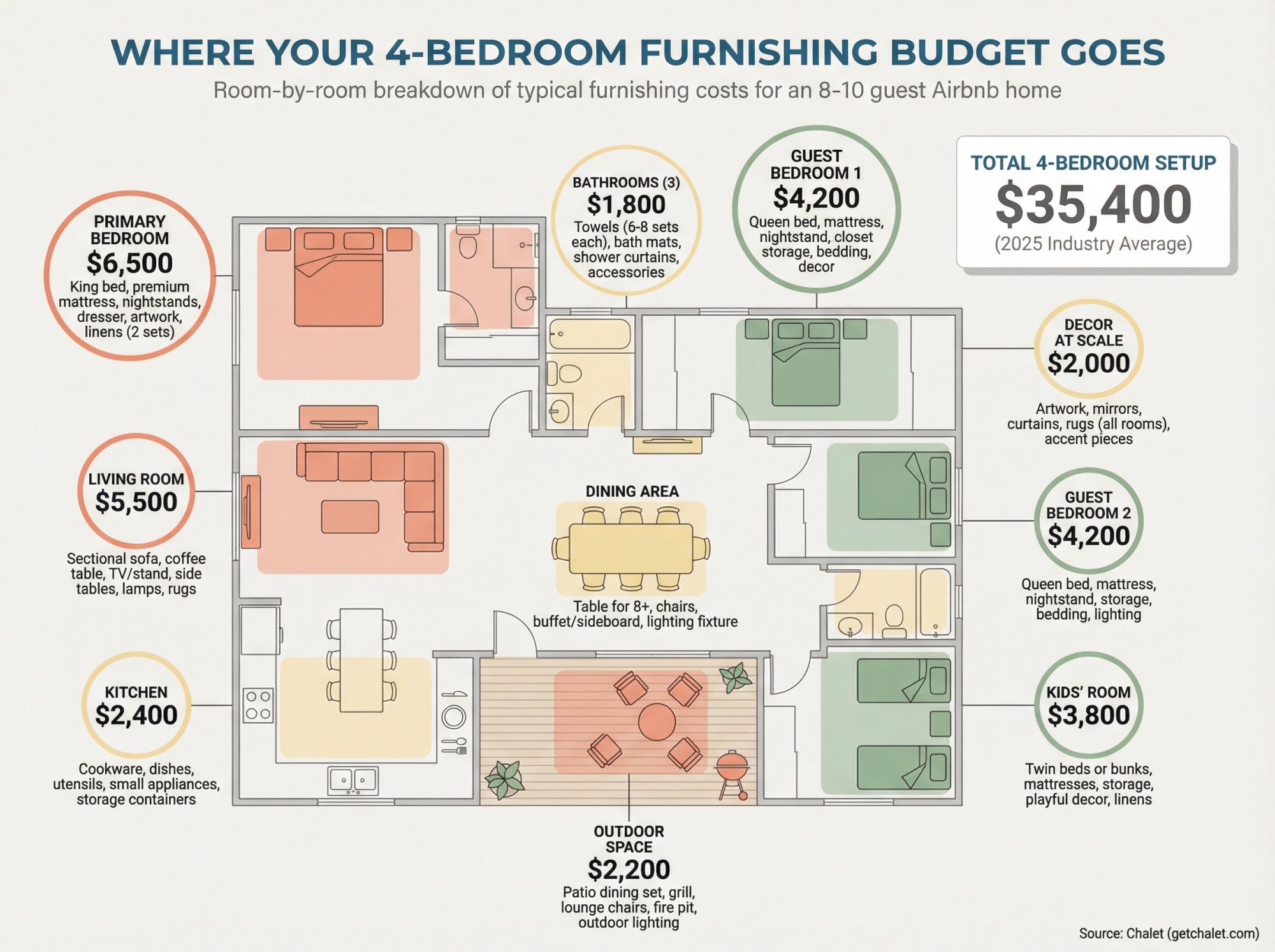
Typical range: $28,000-$44,000 is realistic for four-bedrooms in 2025. The average cost for four-bedroom projects is around $35,400. Many hosts report spending in the $30,000s for quality mid-range furniture.
Hitting $20,000 would be on the low end (probably requiring reused furniture or very economical choices). Reaching $40,000+ is common for polished, professionally-designed interiors. A lot depends on the home's size. Some four-bedroom houses have multiple living areas, a game room, two dining spaces. You're furnishing beyond just four bedrooms.
Lower-end budget: $15,000-$20,000 can furnish a four-bedroom if you're extremely thrifty. One experienced investor noted their four-bedroom, two-bath properties typically cost $12,000-$14,000 to furnish across their portfolio. That implies very efficient budgeting: roughly $3,000 per bedroom plus another $3,000 for living areas and supplies.
Achieving $15,000 for a four-bedroom means:
• Sourcing affordable bedroom sets
• Decent but not extravagant sofa and dining set
• Maybe skipping high-end decor
• Leveraging cheaper markets (IKEA, outlet stores exclusively)
You'll provide comfy beds, enough seating, and a stocked kitchen, but few luxury touches. It can work if your guests are value-focused. Be careful. Large empty houses eat money fast once you start filling them. It's easy to underestimate how many chairs, lamps, rugs, and art pieces go into multiple rooms.
High-end: $50,000-$80,000+ for luxury four-bedrooms or very large homes. If your four-bedroom is a luxury villa with expansive common spaces, it's easy to hit $50,000+. Multiple master suites furnished elegantly, high-end outdoor furniture around a pool, game room equipment, designer decor throughout.
Only invest at this level if the property's rental rates support it. A luxury cabin renting for $1,000/night might warrant $70,000 of furnishings. An average suburban four-bedroom renting for $300/night probably doesn't need a $50,000 budget. You could deliver a great experience around $30,000 and still crush it.
What Four Bedrooms Demands
Four sleeping spaces:
• Often one primary with king bed
• Multiple guest rooms
• Maybe one kids'/bunk room
• All the accessories multiply (mattress protectors, pillows, artwork in each room)
Seating for crowds:
• Four-bedrooms often host 8-10 guests
• Living room needs sofa space for everyone
• Dining table should seat 8+ (or use additional bar seating)
• Might need two dining tables if there's formal dining plus eat-in kitchen
Entertainment spaces:
• Second lounge, media room, foosball or pool table if you have the space
• These extras add cost but can increase booking rates
Outdoor living:
• Four-bedroom homes usually have yards or decks
• Plan for outdoor furniture (patio set and grill can be $1,000+ total)
Decor at scale:
• Wall art, mirrors, curtains, rugs for each room
• By the time you multiply these across four bedrooms, it adds thousands
At this scale, consider bulk deals or wholesale pricing from furnishing companies. Some vendors offer whole-home packages at a discount. Many investors also bring in professional designers or STR setup services. Full-service packages might charge $15,000-$45,000 for a complete house (including furniture within that price).
It can be worth it if you value turnkey solutions and design expertise. Getting a cohesive look in a big house is genuinely challenging.
How Much to Furnish a 5-Bedroom Airbnb or Larger
Properties with five or more bedrooms are mini-hotels. Furnishing budgets get substantial.
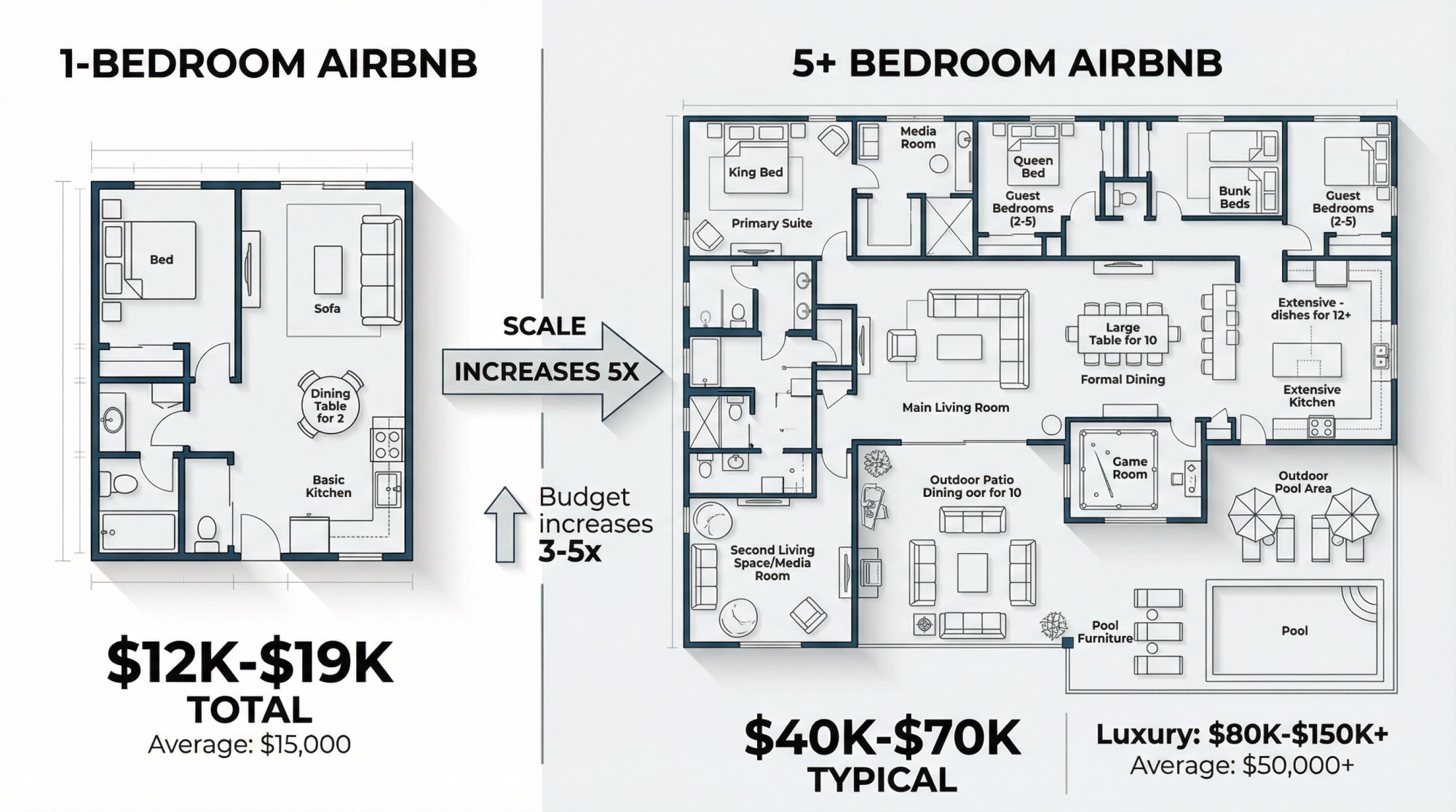
Starting point: $30,000-$50,000 is probably the minimum for a five-bedroom property in 2025. Even with cost-saving measures, you need at least mid-five-figures. One designer quoted $30,000 to furnish a 5-bedroom, 4.5-bath home (mid-range furnishings). Many hosts find they need closer to $50,000 to feel fully finished.
Typical range: $40,000-$70,000 is common for large five-plus bedroom STRs, especially in vacation destinations. Industry data shows five-bedroom or larger homes averaged over $50,000 in furnishing costs. This level of spend includes high-quality furnishings across the board:
• Five complete bedroom suites
• Two or more living/rec rooms
• Big dining table (or two)
• Outdoor furniture for crowds
• All the decor to make a large house feel inviting
Larger homes also have more labor and logistics costs. Just receiving and assembling 100+ pieces of furniture is significant work, often requiring hired help.
Ultra-luxury: $80,000-$150,000+ for top-end estates. Six, seven, ten-bedroom mansions furnished like luxury hotels. These projects easily cross into six figures once you include custom-made items, high-end appliances, and specialty amenities (grand pianos to arcade games).
The top 1% most expensive STR setups exceeded $100,000 in furnishing spend, often involving interior designers, high-value art, and every conceivable perk. These are outliers meant to create one-of-a-kind luxury stays (and they command thousands per night).
Most large STRs won't go that high. Don't assume you can furnish a 7-bedroom resort for $20,000. You'll need a very healthy budget to meet luxury guest expectations.
What Large Properties Require
Five or more bedrooms:
• Multiple king beds, multiple twin rooms, possibly bunks or specialty kids' rooms
• Sleeping capacity of 10-12+ guests
• All the dining seating, lounge seating, entertainment provisions that entails
Multiple common spaces:
• Often a second living room or media room
• Dedicated game room
• Other bonus spaces, each needing furniture
Outdoor amenities:
• Patio dining set for 10
• BBQ grill station
• Pool lounge chairs
• These can add thousands alone
Extensive kitchen:
• Enough dishes, cookware, gadgets to cook for large groups
• Possibly a second fridge or wine cooler
Storage and organization:
• Extra cabinets, buffet tables
• Lockable owner's closets
• Systems to organize supplies for so many guests
Thematic decor:
• Large homes attract groups for special occasions
• Each room might have a color scheme or artwork
• Possibly a mural or accent wall to stand out in photos
At this scale, strongly consider engaging a professional STR designer or at least consulting with one. They might save you money by knowing where to source furniture in bulk or which items give the best guest experience ROI.
Speaking of ROI: while the sticker price is high, these large homes generate high nightly rates in the right markets. Many owners find a well-furnished 5+ bedroom property dramatically outperforms a sparsely furnished one. It's not just looks. More amenities (extra beds, entertainment options) let you charge more. The upfront expense, while significant, often pencils out well when you run the numbers with market-specific data.
How Chalet Helps You Budget Smarter
At this point, you might be feeling a little overwhelmed. Furnishing a short-term rental is expensive, and the costs vary wildly based on bedroom count, location, and quality level.
This is exactly where Chalet makes a difference.
Use Chalet's free calculator to see how furnishing costs impact your actual ROI timeline based on market-specific data.
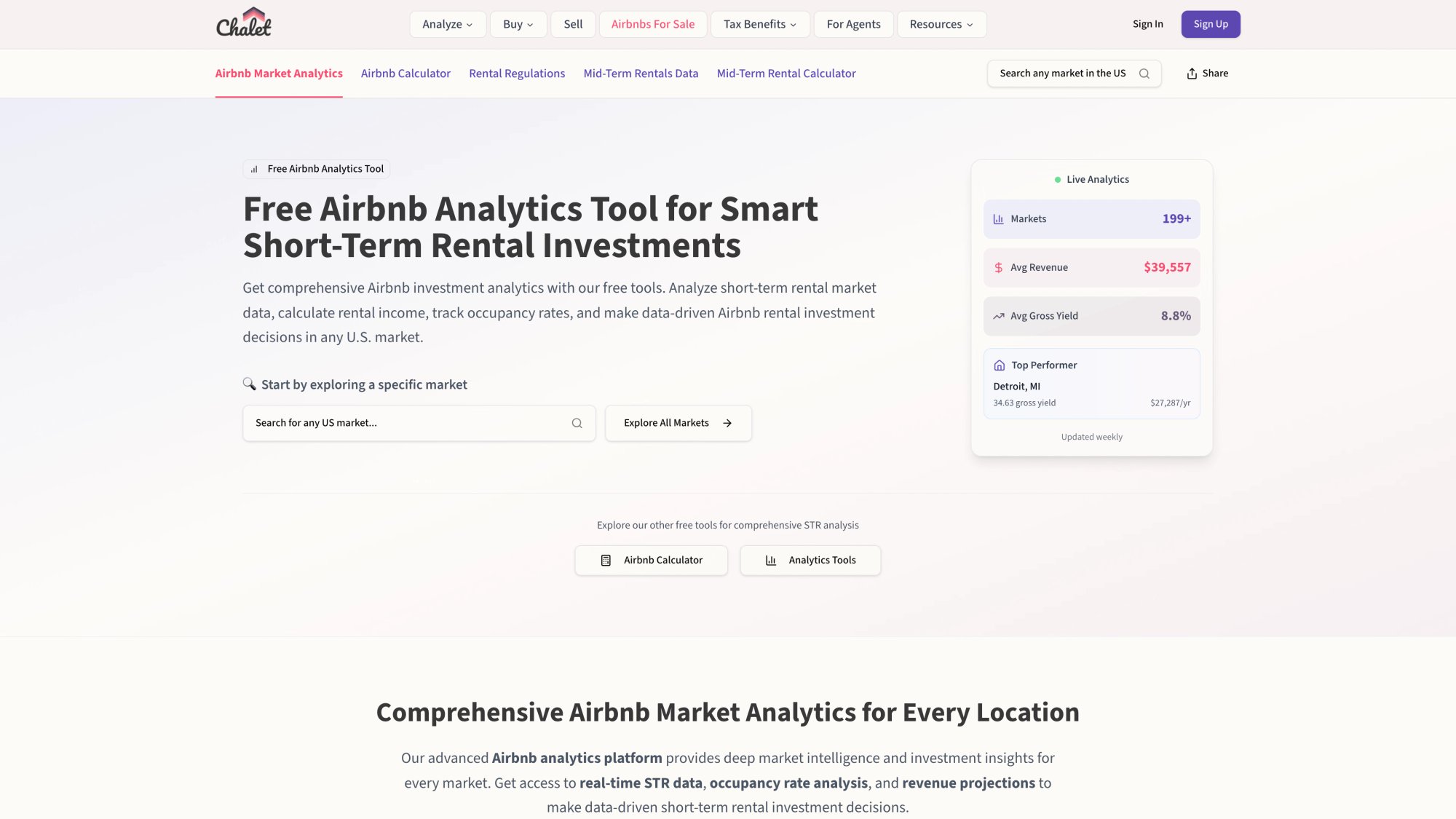
Real-time market data helps you validate whether your furnishing budget aligns with revenue potential in your target market.
Get Real ROI Numbers Before You Furnish
Before you spend $20,000 on furniture, you need to know if the investment makes sense. Our free Airbnb ROI calculator lets you model your specific property with accurate furnishing costs built in.
Here's what you can do:
→ Enter your property details and target market
→ Add your estimated furnishing budget as a line item
→ See how many months it takes to recoup your costs
→ Calculate expected cash flow with realistic occupancy rates
Calculator benefit: Our calculator uses real market data from your area, not generic national averages. You'll see whether a $15,000 setup pays back in 8 months or 18 months, based on actual comparable properties in your market.
Why this matters: A lot of hosts overspend on furnishings relative to their market's earning potential. Or they underspend and get crushed by competitors with better-furnished properties. Our calculator helps you find the sweet spot where your furnishing budget aligns with realistic revenue.
Connect with STR-Specific Furnishing Vendors
Furnishing a rental isn't the same as furnishing your home. You need:
→ Durable furniture that survives guest turnover
→ Photo-worthy styling that drives bookings
→ Quick setup so you can start earning
→ Fair pricing (not retail markups)
Through Chalet's STR Operations Directory, you can connect with vetted vendors who specialize in short-term rentals:
Interior designers who understand STR guest expectations and can create cohesive looks without overspending
Furnishing companies that offer whole-home packages with trade discounts (often 10-20% below retail)
Setup services that handle delivery, assembly, and installation so you don't spend weeks building IKEA furniture
Local vendors in your market who know what guests expect in your area
These aren't random contractors. We've vetted them for STR experience, pricing transparency, and reliability. Many offer bulk deals or turnkey packages specifically designed for Airbnb hosts.
Analyze Markets Before You Buy
If you haven't purchased a property yet, start with market research. Our free market analytics show you which markets support higher furnishing budgets.
You can compare:
→ Average nightly rates by bedroom count
→ Occupancy rates in different markets
→ Revenue potential that justifies your furnishing spend
→ Local competition and what they're offering
You might discover that three-bedroom homes in Market A can charge $400/night and support a $30,000 furnishing budget. In Market B, three-bedrooms only get $200/night, meaning you need to keep furnishing closer to $15,000 to hit your ROI targets.
This kind of analysis prevents expensive mistakes before they happen.
Work with STR-Friendly Agents
Many real estate agents don't understand short-term rental economics. They'll help you find a property, but they won't tell you if the furnishing costs and expected revenue make sense.
Our network of STR-specialist agents gets it. They can:
→ Help you estimate realistic furnishing costs for properties you're considering
→ Compare multiple properties based on total investment (purchase + furnishing + permits)
→ Connect you with local vendors before you close
→ Identify properties that already have furniture (or furniture that can be reused)
They understand that a $300,000 house needing $40,000 in furnishings might be a worse deal than a $320,000 house that's already furnished. Whether you're looking in Nashville, Austin, or Dallas, we'll help you see the full picture before you commit.
9 Ways to Reduce Furnishing Costs Without Hurting Reviews
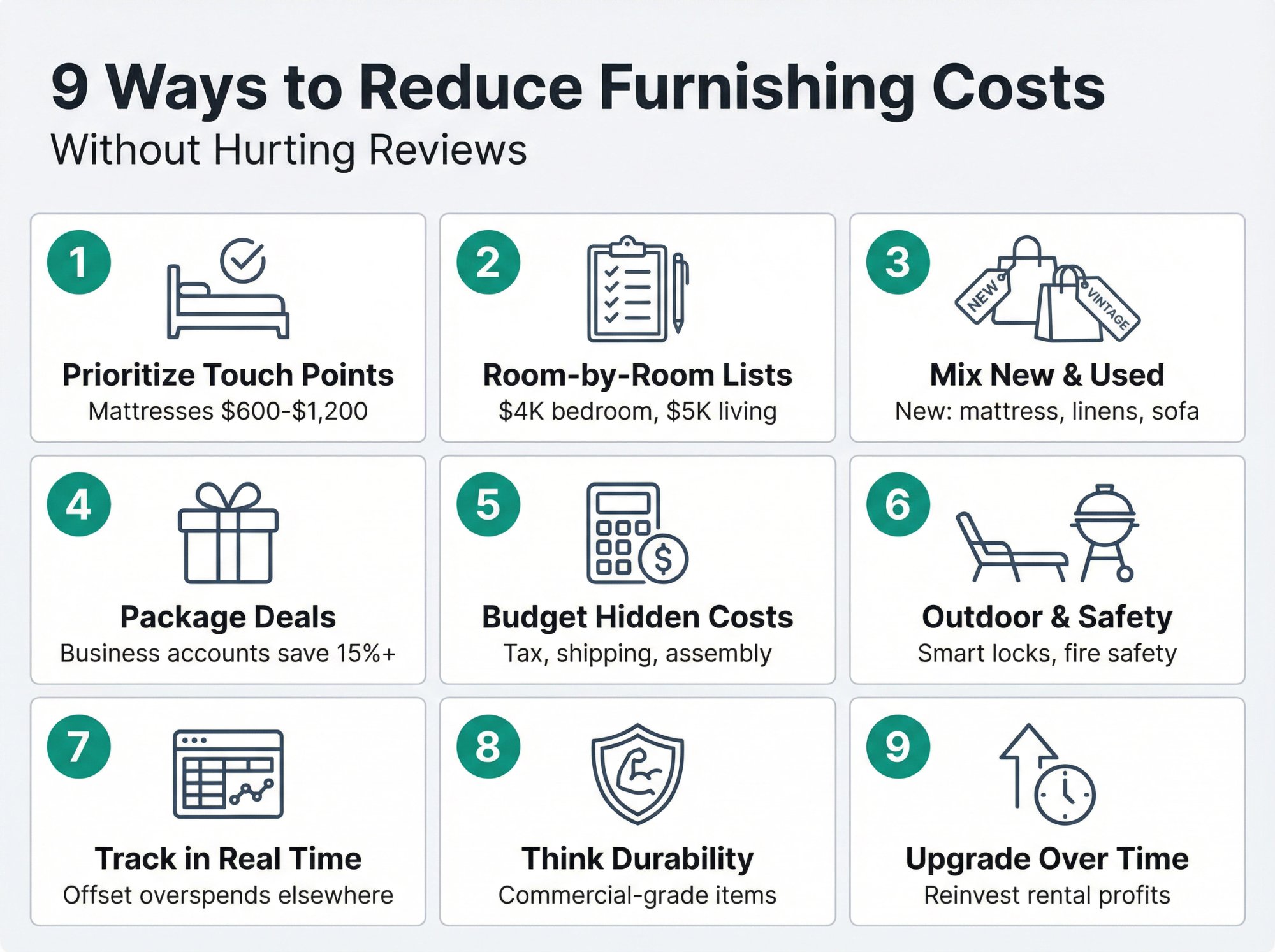
No matter your budget, you can spend smarter without sacrificing guest experience:
① Prioritize what guests actually touch. Invest in quality mattresses (plan $600-$1,200 per bed) and comfortable sofas. These directly impact reviews. Guests won't notice if you saved money on side tables or lamps, but they'll absolutely notice a bad mattress or lumpy couch.
② Use room-by-room checklists. Break down your budget by space: $4,000 per bedroom (including bed, mattress, linens, decor), $5,000 for living room, $2,000 for dining, $3,000 for kitchen supplies. This prevents overbought one area while forgetting another. It also highlights where you might cut costs (spend less in secondary bedrooms, more in the master suite).
③ Mix new and second-hand strategically. Buy new for things guests interact with closely: mattresses (always), bedding, towels, usually sofas. Buy used for dressers, side tables, decor, dining sets. Many hosts find unique decor pieces at thrift stores that add character without high cost. Just maintain a cohesive look. If you're not design-inclined, sticking to one store or furniture line helps everything match.
④ Leverage package deals. Furniture retailers often have bundle discounts (living room package with sofa, loveseat, coffee table). Some companies specialize in furnishing STR properties and quote flat prices per room. Compare these to individual purchases. Sign up for business accounts at Wayfair, Overstock, Lowe's. The discounts can be significant. Time purchases during holiday sales (Black Friday, Memorial Day) if you can wait.
⑤ Budget for the hidden stuff. Remember taxes, shipping fees, and installation costs. $20,000 in furniture might be $22,000 after delivery and sales tax. If you hire movers or handymen for assembly, get estimates upfront. If you're managing remotely, factor in property manager or setup service fees.
⑥ Don't forget outdoor and safety items. Hosts often focus so much on interiors they forget patio furniture, a grill, landscaping touches. Also budget for: smart locks, security cameras (if used), WiFi router, smoke/CO detectors, fire extinguishers, first aid kit. These are individually cheap but together add a few hundred dollars. Some cities require certain safety items for STR permits.
⑦ Track spending in real time. Keep a spreadsheet by category (beds, seating, decor, supplies). If you overspend in one area, find savings in another. Maybe you splurged on a $2,000 sectional versus the $1,000 you budgeted. Offset that with cheaper nightstands or simpler light fixtures.
⑧ Think durability, not just price. Sometimes spending more now saves later. Cheap dining chairs break after six months of guest use. Sturdier ones last years. In an Airbnb, furniture gets heavier wear than in a normal home. Choose commercial-grade or solidly built items for beds, sofas, dining chairs, outdoor furniture.
Durability insight: A budget mattress that sags quickly leads to bad reviews. Slightly pricier cookware that doesn't peel beats replacing cheap pans every few months.
⑨ Upgrade over time. You don't need every luxury on day one. Get essentials in place and meet baseline market expectations. Then add nice-to-haves with rental profits. Start without a hot tub or fancy espresso machine. If guests ask for something (more outdoor lighting, a hammock, a blender), reinvest earnings to add it. Keep some rental income earmarked for replacing linens periodically and refreshing decor every few years.
Comparing Your Budget to Industry Benchmarks
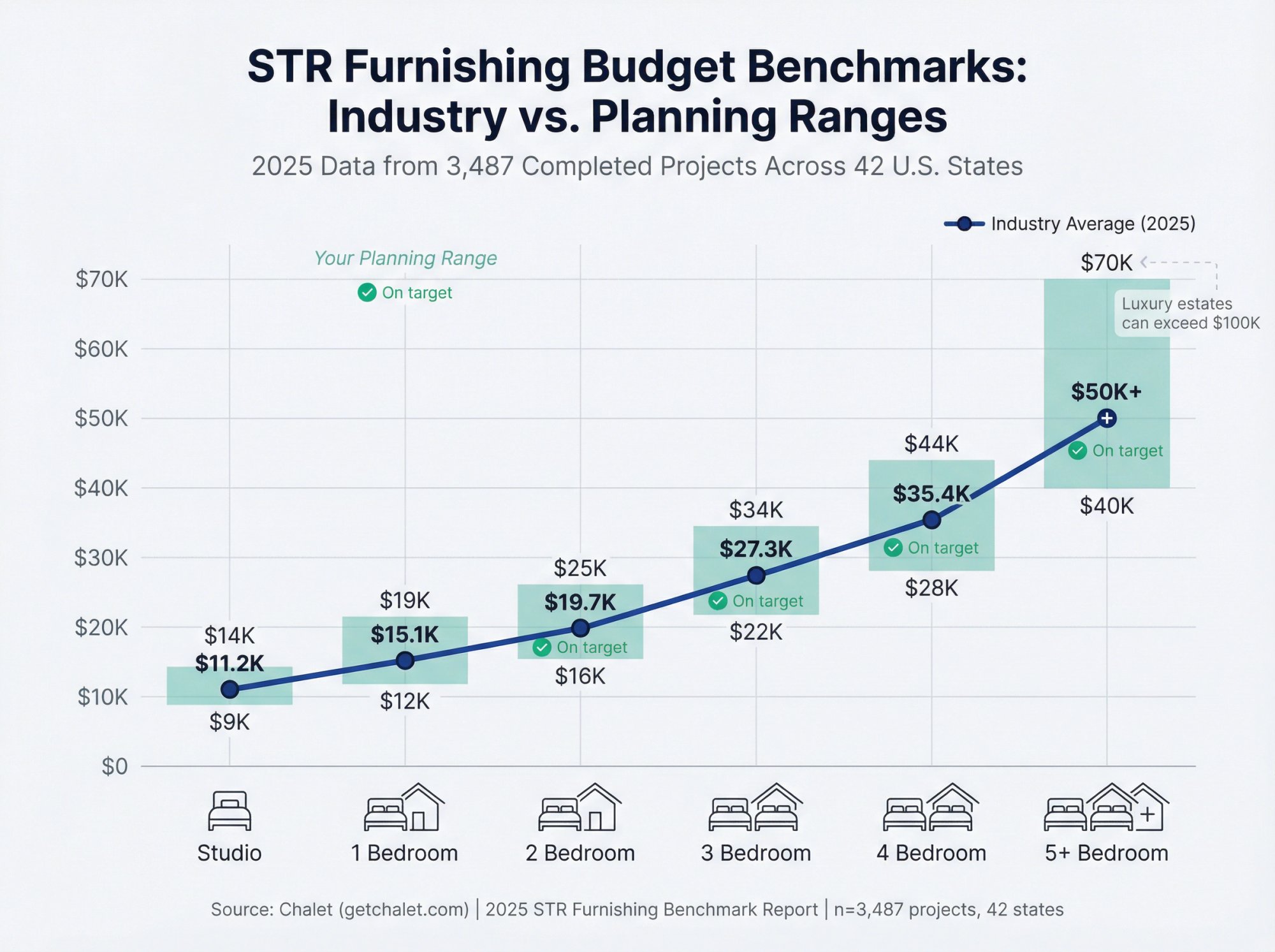
Here's how your planning numbers should compare to what's actually happening in the market:
| Bedroom Count | Your Planning Range | 2025 Industry Average | Variance Check |
|---|---|---|---|
| Studio | $9,000-$14,000 | $11,200 | On target |
| 1 Bedroom | $12,000-$19,000 | $15,100 | On target |
| 2 Bedroom | $16,000-$25,000 | $19,700 | On target |
| 3 Bedroom | $22,000-$34,000 | $27,300 | On target |
| 4 Bedroom | $28,000-$44,000 | $35,400 | On target |
| 5+ Bedroom | $40,000-$70,000 | $50,000+ | On target |
Source: 2025 STR Furnishing Benchmark Report analyzing 3,487 completed projects across 42 U.S. states
If your budget falls within the planning range for your bedroom count, you're probably on track. If you're significantly below the industry average (say, planning $10,000 for a three-bedroom when the average is $27,000), you might be underestimating costs or planning a very basic setup that could struggle to compete.
If you're way above the average, make sure your market supports premium pricing. Run the numbers with Chalet's calculator to confirm the extra investment pays back through higher nightly rates or occupancy.
Where Your Money Actually Goes
Understanding the cost breakdown helps you make trade-offs:
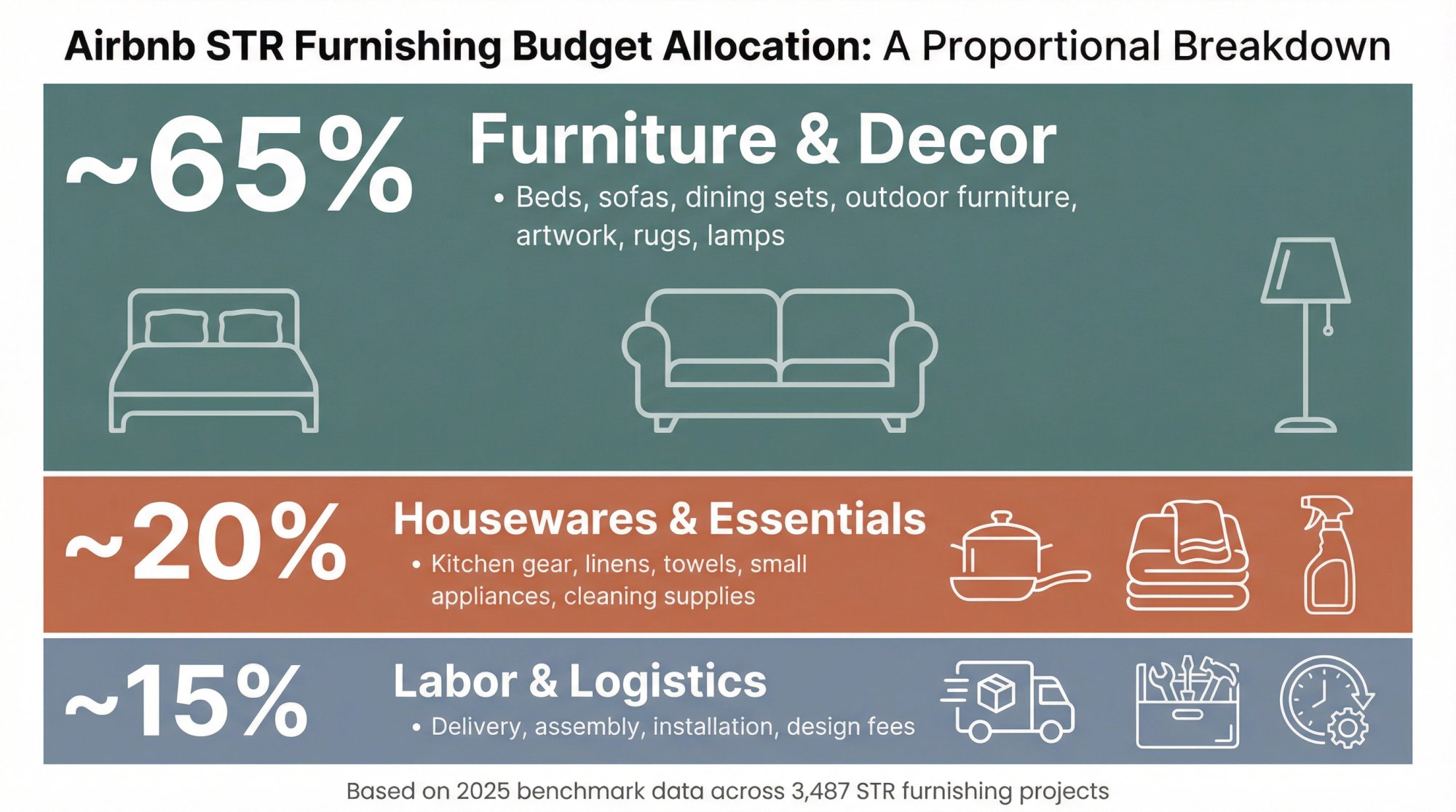
Understanding the cost breakdown helps you make trade-offs:
| Cost Category | Percentage of Total | What It Includes |
|---|---|---|
| Furniture & Decor | ~65% | Beds, sofas, dining sets, outdoor furniture, artwork, rugs, lamps |
| Housewares & Essentials | ~20% | Kitchen gear, linens, towels, small appliances, cleaning supplies |
| Labor & Logistics | ~15% | Delivery, assembly, installation, design fees |
Based on 2025 benchmark data across 3,487 STR furnishing projects
What this tells you:
If you're going full DIY, you're mainly trying to reduce that 15% labor bucket. The furniture and housewares still cost what they cost. You might save $3,000-$5,000 on labor, but you're not cutting the total in half.
Conversely, if time is more valuable than money, paying for professional setup is only adding 15% to your total. Many hosts find it worthwhile to avoid weeks of furniture assembly and shopping stress.
Common Mistakes That Blow Up Budgets
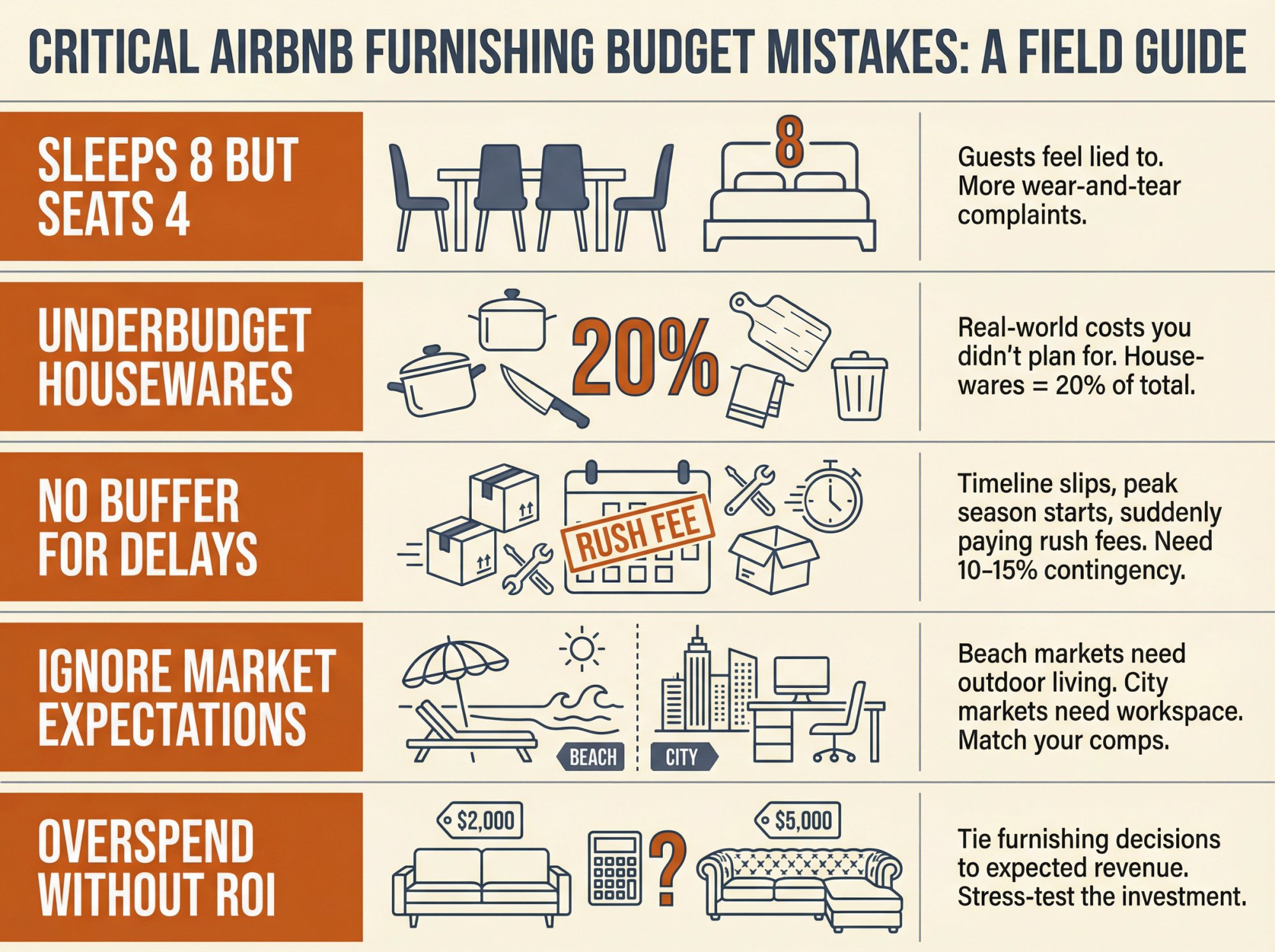
Listing "sleeps 8" but seating 4. Guests feel lied to. You'll also get more wear-and-tear and complaints. If you claim eight guests, make sure you can actually seat and serve eight people.
Underbudgeting housewares. People budget for sofas and forget pots, knives, cutting boards, trash cans, towels. Housewares are legitimately 20% of real-world costs. Don't treat them as afterthoughts.
No buffer for shipping, assembly, or replacements. Your timeline slips, peak season starts, suddenly you're paying rush fees. Build a 10-15% contingency into your budget.
Ignoring market expectations. A beach market may require outdoor living spaces. A city market may need real workspace setups. Look at what your comps are doing and match or exceed it.
Overspending without ROI validation. It's easy to get excited and buy the $5,000 sectional when a $2,000 one would work fine. Always tie your furnishing decisions back to expected revenue. Use our ROI calculator to stress-test whether premium furnishings actually pay back.
Frequently Asked Questions
How much does it cost to furnish a 1-bedroom Airbnb?
Most 1-bedroom Airbnbs cost $12,000-$19,000 to furnish completely. The 2025 industry average is around $15,000 for a quality setup that includes furniture, housewares, linens, kitchen gear, and initial supplies. You can go as low as $3,000-$5,000 with extreme budgeting (second-hand furniture, minimal decor), but expect trade-offs in guest appeal and durability.
What's the fastest way to estimate furnishing costs for any property?
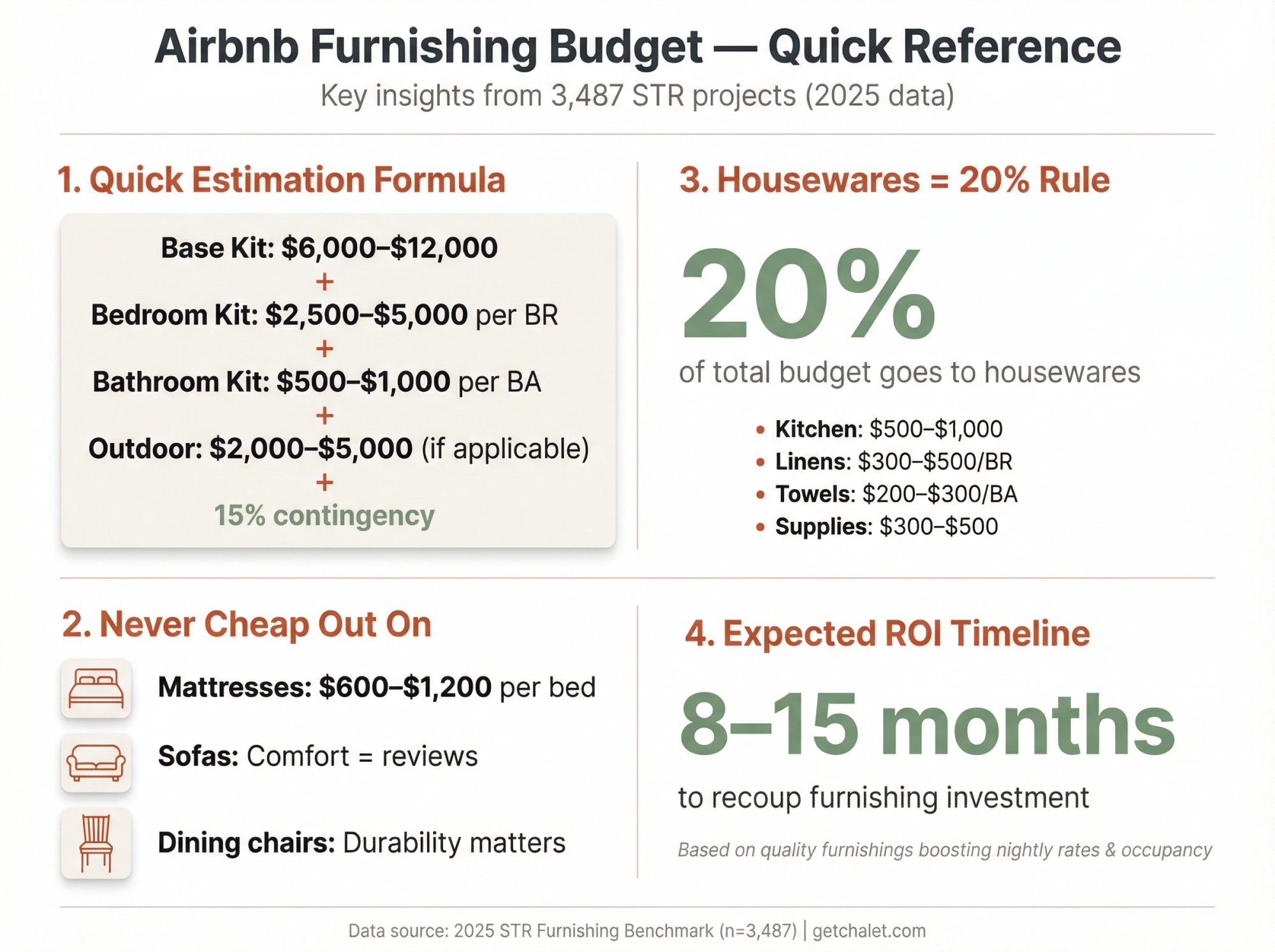
Use this formula: Base Kit ($6,000-$12,000) + Bedroom Kit ($2,500-$5,000 per bedroom) + Bathroom Kit ($500-$1,000 per bathroom) + Outdoor ($2,000-$5,000 if applicable) + 15% contingency. This gives you a defendable range based on room count rather than guessing.
Should I buy furniture or use a turnkey service?
DIY buying saves you roughly 15% in labor and logistics costs, but requires significant time investment. Expect to spend weeks shopping, coordinating deliveries, and assembling furniture.
Turnkey services add about 15% to your total but handle everything: design, purchasing, delivery, assembly, staging. Worth it if you value time over money or if you're furnishing remotely.
Most hosts find a middle ground: buy big furniture items themselves (beds, sofas) where they can save meaningful money, but hire help for assembly and final staging.
How does location affect furnishing costs?
Location can double or triple your costs. A two-bedroom setup averaging $30,000 in Hawaii might cost $15,000 in Kansas due to shipping costs and local market expectations. Coastal resort areas and major cities typically need higher-end furnishings to compete, while rural or small-town markets can get away with simpler setups. Always research comparable properties in your specific market to understand what guests expect.
What furniture should I never cheap out on?
Mattresses are non-negotiable. Budget at least $600-$1,200 per bed for quality mattresses that won't sag. Bad sleep destroys reviews faster than anything else.
Sofas are second priority since guests spend significant time there. A comfortable, durable sofa is worth the investment.
Dining chairs should be sturdy (not flimsy plastic) since they get heavy use and guests notice wobbly seating.
Blackout curtains in bedrooms might seem minor but significantly impact sleep quality, especially in urban areas or properties with outdoor lighting.
How do I budget for housewares and supplies?
Plan for housewares to be roughly 20% of your total furnishing budget. For a $20,000 total budget, allocate $4,000 for:
• Kitchen: $500-$1,000 (cookware, dishes, utensils, small appliances)
• Linens: $300-$500 per bedroom (2 sheet sets, pillows, blankets per bed)
• Towels: $200-$300 per bathroom (6-8 towel sets per bath)
• Initial supplies: $300-$500 (toiletries, cleaning supplies, paper goods, coffee/tea)
Don't underestimate this category. It adds up fast and guests absolutely notice if you skimp here.
Can I recoup my furnishing investment through rental income?
Yes, most well-furnished STRs recoup their furnishing costs within 8-15 months through increased nightly rates and occupancy. Industry data shows that quality furnishings can boost average daily rates significantly and improve reviews, leading to better visibility on platforms like Airbnb.
The key is matching your investment to your market. Use Chalet's ROI calculator to model your specific property and see realistic payback timelines based on local market data.
What's the difference between starter, market-ready, and premium furnishing?
Starter setup: Bare essentials, lots of budget furniture, minimal decor. Gets you operational but might not compete well in most markets. Often relies on second-hand items and DIY assembly. Appropriate for extremely cost-conscious hosts or very low-rate markets.
Market-ready setup: Quality mid-range furniture that photographs well and earns good reviews. This is where most successful hosts land. Mix of affordable retailers (IKEA, Wayfair) with a few standout pieces. Meets or slightly exceeds competitor standards.
Premium setup: Designer furniture, high-end finishes, professional staging, luxury amenities. Only makes sense in high-rate markets where guests expect and pay for luxury experiences. Often involves hiring interior designers.
How much should I spend on outdoor furniture?
Budget $2,000-$5,000 for basic outdoor setups (patio furniture, grill, basic landscaping touches). Larger properties or vacation homes where outdoor space is a major selling point might need $5,000-$10,000+ for:
• Outdoor dining set sized for your occupancy
• Lounge seating (sectional or multiple chairs)
• Quality grill and cooking setup
• Possibly fire pit, hammock, outdoor lighting
In resort markets, outdoor spaces can be as important as indoor spaces. Budget accordingly.
Should I furnish all bedrooms equally?
No. Most successful hosts invest more in the primary bedroom (king bed, premium mattress, better nightstands, en-suite focus) and somewhat less in additional bedrooms. Secondary bedrooms can have quality but simpler furnishings (queen or twin beds, basic nightstands, streamlined decor).
This lets you create a clear premium bedroom while keeping costs reasonable overall. Just ensure all rooms meet baseline comfort standards. Guests will notice if any room feels neglected.
How do I compare furnishing costs when analyzing multiple properties?
Create a simple spreadsheet:
Property A: 3BR × $3,000/room + Base $8,000 + Outdoor $3,000 = $20,000 estimated
Property B: 2BR × $3,000/room + Base $8,000 + No outdoor = $14,000 estimated
Then run both through Chalet's ROI calculator with their respective furnishing costs as line items. Compare cash flow after furnishing to see which actually performs better financially. You can also browse actual listings to see what's available in different markets.
Sometimes the smaller property with lower furnishing costs wins. Sometimes the larger property's higher revenue more than compensates for higher setup costs. The calculator helps you see this clearly.
Plan Your Furnishing Budget with Real Data

Furnishing an Airbnb is one of the biggest upfront investments you'll make, but it's also one of the most impactful. A well-furnished property doesn't just attract bookings. It commands higher rates and earns better reviews, creating a positive cycle that pays back your investment within a year.
The key is matching your furnishing budget to your market reality. Spend too little and you'll struggle to compete. Spend too much and your ROI timeline stretches uncomfortably long.
Your next steps:
→ Run the numbers for your property – See how different furnishing budgets impact your ROI timeline and cash flow with our free calculator
→ Compare markets before you buy – Explore our free market dashboards to see which areas support higher furnishing investments
→ Connect with STR-friendly agents – Work with agents who understand total investment (purchase + furnishing + permits) and can help you find properties that make financial sense
→ Find vetted furnishing vendors – Access our directory of STR-specialist interior designers, furniture providers, and setup services with transparent pricing
→ Browse properties for sale – See listings that might already be furnished or close to guest-ready
At Chalet, we're not just another data platform. We combine free analytics with an actual vendor network so you can research, buy, and set up your rental in one place. No subscription fees. No paywalls. Just the tools and connections you need to make smart decisions.
Furnishing a rental is expensive enough. You shouldn't have to pay for the information that helps you do it right.