




This guide covers Traverse City, Michigan (inside city limits). Nearby markets with separate STR rules include:
- Acme Township: Just north of Traverse City, with its own STR licensing and caps.
- Long Lake Township: West of the city, operates a distinct STR ordinance and enforcement.
- Elmwood Township: Borders Traverse City to the northwest, with separate STR rules.
- Garfield Township: Immediately south and west of city limits, has its own STR program and zoning.
Legality Verdict
Short-term rentals are legal in Traverse City, but require a city license and are subject to zoning restrictions and an 11% total lodging tax. No citywide cap exists, but most whole-home STRs are limited to commercial/mixed-use zones.
- Legality Status: 2/5
- License Availability: 4/5
- Compliance Cost (% revenue): 3/5
- Regulatory Stability: 3/5
- Enforcement Climate: 4/5
TL;DR
Traverse City defines STRs as “Vacation Home Rentals” (whole-home, under 30 days) and requires a $200 city license plus $200 annual renewal. The total lodging tax is 11% (6% state, 5% local assessment). Most whole-home STRs are only allowed in commercial/mixed-use zones. The biggest investor risk: zoning restrictions sharply limit where unhosted STRs are legal, and pending state legislation could add new local taxes.
Quick Facts
| Item | Detail |
|---|---|
| STR Definition | “Vacation Home Rental”: whole-home, under 30 days City of Traverse City |
| Registration Required | Yes — city Vacation Home Rental License City of Traverse City |
| Permit Cost | $200 application fee City of Traverse City |
| Annual Renewal | $200, expires December 31 City of Traverse City |
| License Cap | Not codified — no citywide cap identified in sources reviewed City of Traverse City Code of Ordinances (Chapter 870) |
| Permitted Zones | Not codified — see zoning code; most VHRs limited to commercial/mixed-use Traverse City Code of Ordinances |
| Prohibited Zones | Not codified — most single-family zones prohibit whole-home VHRs Traverse City Code of Ordinances |
| Inspection Requirement | City inspection required before license; re-inspection every 3 years The Crane Group |
| Local Contact Requirement | Not codified — no 24/7 local contact rule in city code Traverse City Code of Ordinances |
| Owner-Occupancy Rule | Not codified — no owner-occupancy for VHRs in city code Traverse City Code of Ordinances |
| HOA/Condo Override | Not codified — but state Supreme Court allows HOAs to prohibit STRs Makower Abbate Guerra Wegner Vollmer PLLC |
| State Sales/Use Tax | 6% Michigan Department of Treasury |
| Local Lodging Assessment | 5% (Traverse City Tourism) Bridge Michigan |
| County Lodging Tax | Not codified — Grand Traverse County does not levy a countywide hotel tax UpNorthLive News |
| Total Effective Lodging Tax | 11% (6% state + 5% local assessment) Bridge Michigan |
| Enforcement Penalties | Not codified — no specific fine schedule in city code Traverse City Code of Ordinances |
| Transferability | Licenses may be transferred if not terminated; must transfer within 90 days of closing City of Traverse City Office of the City Clerk |
| Primary Regulator | City Clerk’s Office, 400 Boardman Ave, (231) 922-4480 City of Traverse City |
| Last Updated | May 21, 2026 |
Regulatory Impact Snapshot
Underwriters should model compliance costs at 11.1% of gross revenue, with median Traverse City, MI STRs earning $34,726 at an average daily rate of $237 and 21% occupancy. The binding constraint is zoning: most whole-home STRs are only legal in commercial or mixed-use districts, not in single-family neighborhoods. The annual cost stack includes $200 for the city license, $200 for renewal, and 11% in combined state and local lodging taxes. Pending state legislation could add a new 3% local excise tax if approved by voters. Run this market in our Airbnb Calculator →
Top 500 US Airbnb Rental Markets - 2026
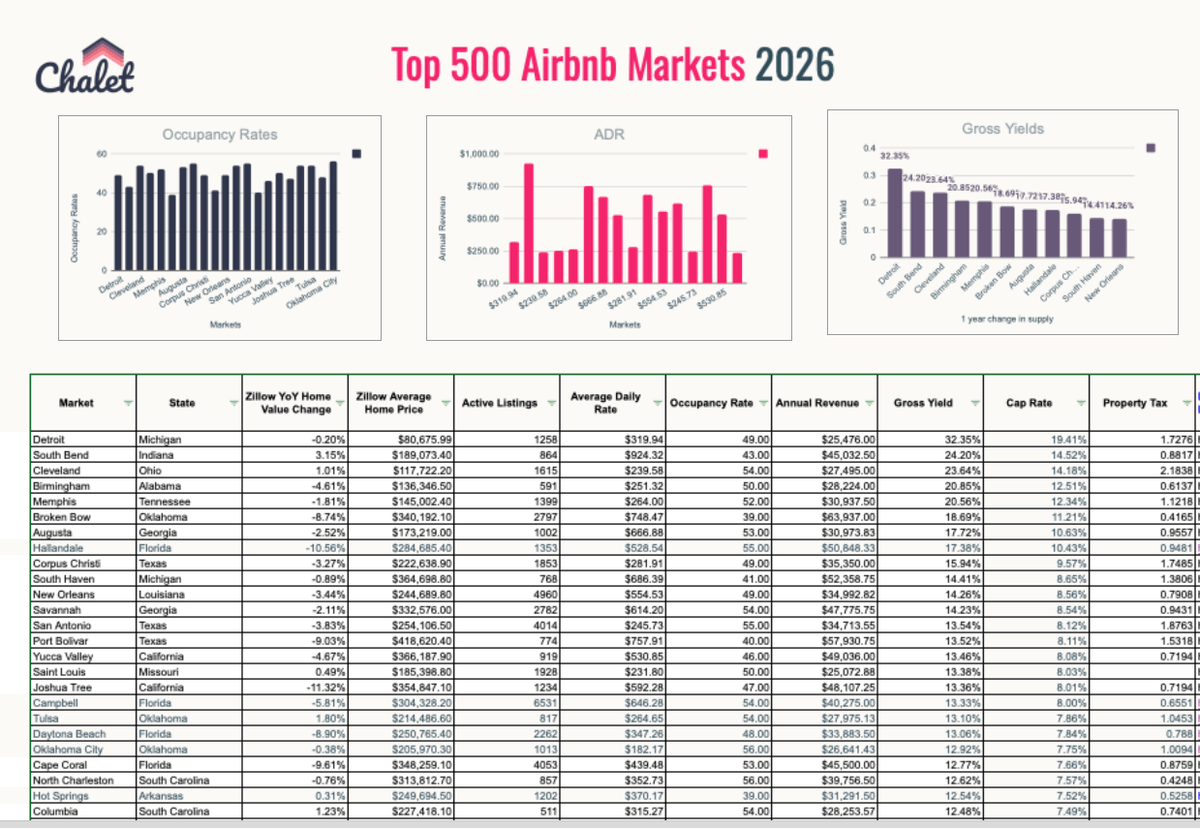
Instantly compare top 500 short-term (Airbnb) rental markets in the US
Frequently Asked Questions
Basics
What is considered a short-term rental in Traverse City?
A “Vacation Home Rental” is a whole-home rental for stays under 30 days, requiring a city license City of Traverse City.
Are short-term rentals legal in Traverse City?
Yes, but only with a city license and in permitted zoning districts Traverse City Code of Ordinances.
How do Traverse City rules differ from nearby townships?
Traverse City has its own licensing and zoning; neighboring townships like Acme and Garfield have separate STR ordinances Grand Traverse Short-Term Rental Basics | 49684 Guide.
Licensing
Is a license required to operate an STR in Traverse City?
Yes, a Vacation Home Rental License is mandatory City of Traverse City.
How much does the STR license cost?
The application fee is $200, with a $200 annual renewal City of Traverse City.
Is there a cap on the number of STR licenses?
No citywide cap is codified in available sources City of Traverse City Code of Ordinances (Chapter 870).
Can STR licenses be transferred to new owners?
Yes, if the license is in good standing and transfer occurs within 90 days of closing City of Traverse City Office of the City Clerk.
Taxes
What taxes apply to Traverse City STRs?
A 6% state use tax and a 5% local lodging assessment, totaling 11% Bridge Michigan.
Does Airbnb collect taxes for hosts?
Airbnb collects and remits the 6% state use tax, but not the 5% local assessment Airbnb Help Center.
Do hosts need to register for tax remittance?
Hosts must remit the 5% local assessment to Traverse City Tourism; registration may be required if not handled by the platform Bridge Michigan.
Operations
Where are STRs allowed in Traverse City?
Whole-home STRs are generally limited to commercial and mixed-use zones; most single-family neighborhoods prohibit them Traverse City Code of Ordinances.
Is an inspection required?
Yes, before a new license is issued and every three years thereafter The Crane Group.
Are there owner-occupancy or local contact requirements?
No owner-occupancy or 24/7 local contact rule is codified for Vacation Home Rentals Traverse City Code of Ordinances.
Can HOAs prohibit STRs?
Yes, the Michigan Supreme Court allows HOAs to enforce covenants prohibiting STRs Makower Abbate Guerra Wegner Vollmer PLLC.
Enforcement
What are the penalties for violating STR rules?
No specific fine schedule is codified in city ordinances; state or county penalties may apply Traverse City Code of Ordinances.
How is enforcement handled?
Enforcement is primarily ordinance-driven by city staff; no evidence of platform monitoring or recent crackdowns Traverse City Code of Ordinances.
Are there pending changes to STR taxes or rules?
Yes, state legislation could allow a new 3% local excise tax if approved by voters The Ticker (Traverse City).
Permit Process
Operating a short-term rental in Traverse City requires obtaining a Vacation Home Rental License from the City Clerk’s Office. The process begins with submitting an application and a $200 fee, followed by a city inspection of the property. Licenses expire annually on December 31 and require a $200 renewal. Transfers to new owners are permitted if the license is in good standing and the transfer is completed within 90 days of property closing. There is no citywide cap on the number of licenses, but applicants must ensure their property is in a permitted zoning district. The city does not codify late penalties or a specific timeline for approval, so investors should contact the City Clerk’s Office for current processing times. City of Traverse City
Zoning
Zoning is the primary constraint for STR investors in Traverse City. Whole-home Vacation Home Rentals are generally only permitted in commercial and mixed-use districts, while most single-family residential zones prohibit unhosted STRs. The city code does not separately codify a list of permitted or prohibited zones, so applicants must consult the zoning map or contact the Planning Department for confirmation. Hosted “Tourist Homes” (owner-occupied) may be allowed in more areas, but whole-home STRs face significant geographic restrictions. There are no codified density caps, minimum night stays, or parking requirements for STRs in the city code. This zoning landscape means that legal STR inventory is limited, and compliance risk is high for properties outside approved districts. Traverse City Code of Ordinances
Taxes and Remittance
Traverse City STRs are subject to an 11% total lodging tax: 6% Michigan state use (sales) tax and a 5% local lodging assessment collected by Traverse City Tourism. Airbnb collects and remits the state tax for bookings under 30 days, but hosts are responsible for remitting the local assessment directly. There is no separate city or county accommodations tax as of May 2026, but pending state legislation could allow a new 3% local excise tax if approved by voters. Hosts should ensure compliance with both state and local tax remittance requirements, as failure to remit the local assessment can result in penalties. No separate state accommodations license is required, but hosts may need to register with the Michigan Department of Treasury if their platform does not handle tax collection. Bridge Michigan
Enforcement and Recent Actions
Enforcement of STR rules in Traverse City is primarily handled by city staff through ordinance-driven processes. There is no evidence of active platform monitoring or recent large-scale crackdowns. The city code does not specify a fine schedule for violations, but state or county penalties may apply by default. Violations can result in suspension or revocation of the license, and each day of noncompliance may be treated as a separate offense. The city requires inspections before issuing a new license and every three years for ongoing operations. HOAs and condo associations retain the right to prohibit STRs through private covenants, as affirmed by the Michigan Supreme Court in 2025. Traverse City Code of Ordinances
Recent Changes and Pending Legislation
While Traverse City’s core STR ordinance has remained stable, statewide discussions about STR taxation and regulation have intensified. In late 2025, Michigan legislators introduced bills to allow local governments to impose a voter-approved 3% excise tax on short-term accommodations, including STRs. Traverse City’s mayor and local organizations have publicly supported these proposals, but as of May 2026, no new local tax has been enacted. The city remains actively engaged in shaping state policy, and investors should monitor for future changes that could impact the tax stack or operational requirements. The Michigan Supreme Court’s 2025 decision also reinforced the ability of HOAs to prohibit STRs via deed restrictions. The Ticker (Traverse City)
Comparable Markets
- Acme Township, MI: Consider if you want a nearby market with its own STR caps and licensing.
- Garfield Township, MI: Consider for different zoning and enforcement climate just outside city limits.
- Petoskey, MI: Consider for a northern Michigan market with a distinct STR ordinance and tax stack.
- Grand Rapids, MI: Consider for a larger city with more permissive STR zoning and higher inventory.
Sources
- City of Traverse City
- City of Traverse City Office of the City Clerk
- Traverse City Code of Ordinances
- Traverse City Code of Ordinances (Chapter 870)
- Michigan Department of Treasury
- Bridge Michigan
- UpNorthLive News
- The Ticker (Traverse City)
- Makower Abbate Guerra Wegner Vollmer PLLC
- Airbnb Help Center
- Grand Traverse Short-Term Rental Basics | 49684 Guide
- The Crane Group
- Avalara MyLodgeTax
This page is research, not legal advice. Consult local counsel before acquiring or operating a short-term rental in City of Traverse City, Grand Traverse County, Michigan.
Ready to evaluate Traverse City as an STR market?
- See Traverse City revenue data → — Get up-to-date STR performance and occupancy trends.
- Run this deal in our calculator → — Model cash flow, taxes, and compliance costs for any Traverse City property.
- Match with a Traverse City STR agent → — Connect with a local expert for on-the-ground insights.