




This guide covers Dallas, Texas only. Neighboring cities often have different STR rules. For clarity, here are commonly confused sibling markets:
- Irving: Separate STR registration and enforcement; not governed by Dallas city ordinances.
- Richardson: Distinct STR zoning and licensing; outside Dallas city limits.
- Plano: Has its own STR regulations and enforcement; not subject to Dallas rules.
- Garland: STRs regulated independently; Dallas ordinances do not apply.
Legality Verdict
Short-term rentals are currently legal in Dallas, Texas, with registration and tax requirements. The city’s 2023 STR ban remains unenforceable due to a court injunction, but regulatory risk is elevated pending Texas Supreme Court review. Investors should monitor for rapid changes.
- Legality Status: 3/5
- License Availability: 4/5
- Compliance Cost (% revenue): 3/5
- Regulatory Stability: 2/5
- Enforcement Climate: 3/5
TL;DR
Dallas defines STRs as residential rentals under 30 days. All operators must register and pay a $150 annual permit fee. The total lodging tax is 13% (7% city, 6% state). Minimum stay is two nights, and occupancy is capped at two guests per bedroom plus two. The biggest risk: the city is actively seeking to reinstate its 2023 STR ban, which could sharply restrict operations if the court injunction is lifted City of Dallas Planning & Development.
Quick Facts
| Item | Detail |
|---|---|
| STR Definition | Any residential property or part thereof rented for less than 30 days, including homes, garage apartments, or backyard cottages City of Dallas Financial Transparency |
| Registration Required | Yes, via MUNIRevs portal Dallas City Code of Ordinances, Chapter 42B |
| Permit Cost | $150 per year Awning |
| Annual Renewal | Yes, $150 per year Awning |
| Permit Transferable | No; new owner must reapply Krissy Mireles Team Blog |
| License Cap | No citywide cap as of May 2026 Truvi |
| Permitted Zones | All zones pending litigation; 2023 ban on STRs in single-family zones is unenforceable as of May 2026 Dallas City Planning & Development |
| Prohibited Zones | None currently enforced; see above Dallas City Planning & Development |
| Minimum Stay | 2 nights Dallas Code of Ordinances, SEC. 42B-12 |
| Occupancy Cap | 2 guests per bedroom plus 2 additional guests per property Safely |
| Parking Requirement | Guest vehicles limited to available off-street spaces Dallas Code of Ordinances, SEC. 42B-12 |
| Local Contact Requirement | Yes, 24/7 local emergency contact required Safely |
| State Hotel Occupancy Tax | 6% Texas Hotel & Lodging Association |
| City Hotel Occupancy Tax | 7% City of Dallas Controller’s Office |
| County Hotel Occupancy Tax | Not imposed within Dallas city limits Texas Comptroller |
| Total Effective Lodging Tax | 13% (6% state + 7% city) City of Dallas Controller’s Office |
| Tax Filing Frequency | Monthly (city and state) City of Dallas Controller’s Office |
| Airbnb Tax Collection | Airbnb collects/remits 6% state tax only; hosts must remit 7% city tax directly Airbnb Help Center |
| Minimum Stay for Tax Exemption | 30+ consecutive days (with guest notice) City of Dallas Controller’s Office |
| Enforcement Penalties | Up to $500 per violation for unregistered operation Truvi |
| Primary Regulator | City of Dallas Permit Center; (214) 948-4480 CityApplications.com |
| Last Updated | May 21, 2026 |
Regulatory Impact Snapshot
Underwriters should model compliance costs at 13.9% of gross revenue, with median Dallas, TX STRs earning $34,289 at an average daily rate of $155 and 54% occupancy. The binding constraint is the ongoing legal battle over the city’s 2023 STR ban: while registration and a $150 annual permit are required, the 13% lodging tax (7% city, 6% state) is the largest recurring cost. Airbnb collects only the state portion, so hosts must remit the city tax directly. The biggest risk is regulatory: if the Texas Supreme Court allows Dallas to enforce its STR ban, many properties could become ineligible overnight. Run this market in our Airbnb Calculator →
Top 500 US Airbnb Rental Markets - 2026
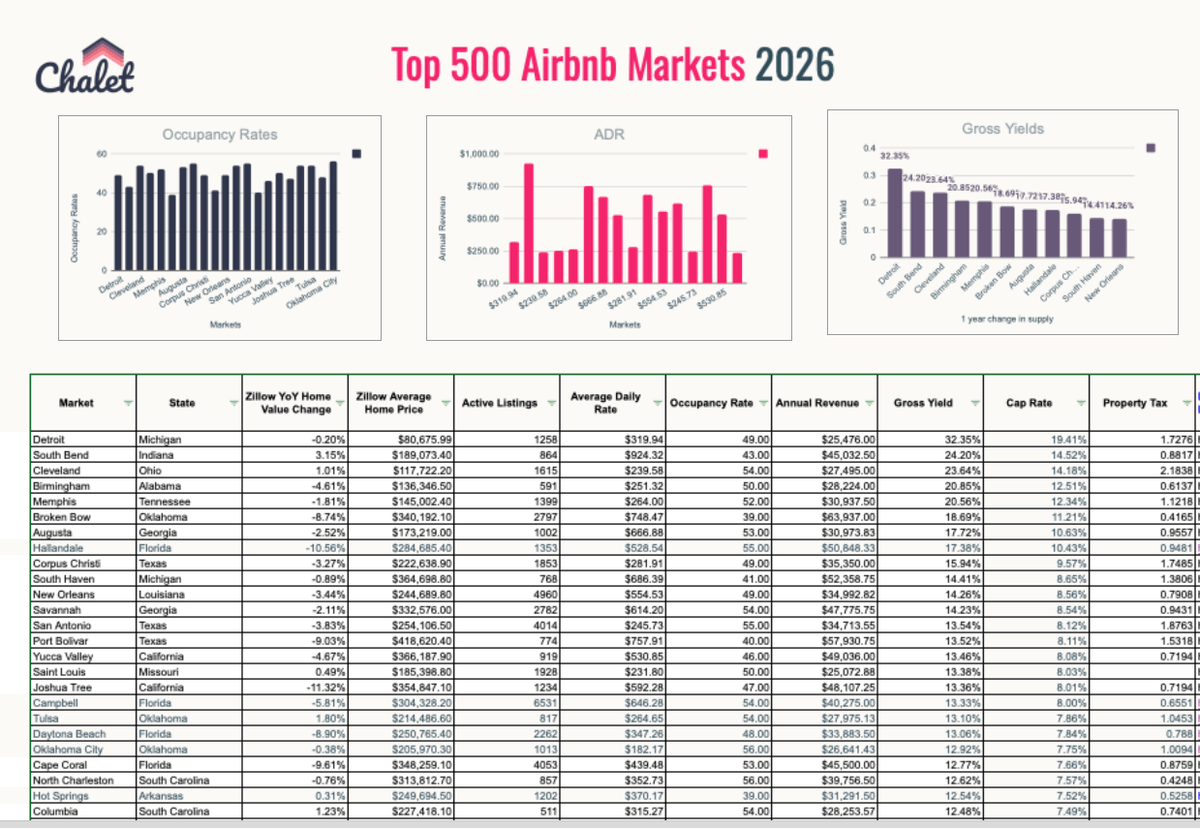
Instantly compare top 500 short-term (Airbnb) rental markets in the US
Frequently Asked Questions
Basics
What is considered a short-term rental in Dallas?
A short-term rental is any residential property or part thereof rented for less than 30 days, including homes, garage apartments, or backyard cottages City of Dallas Financial Transparency.
Are STRs currently legal in Dallas?
Yes, STRs are legal and must be registered, but the city’s 2023 ban is blocked by a court injunction as of May 2026 Dallas City Planning & Development.
Can I operate an STR in any Dallas neighborhood?
Currently, yes. The city’s attempt to ban STRs in single-family zones is unenforceable pending litigation Dallas City Planning & Development.
Licensing
Is a permit required to operate an STR in Dallas?
Yes, all STR operators must obtain a Short-Term Rental Certificate of Registration via the city’s MUNIRevs portal Dallas City Code of Ordinances, Chapter 42B.
How much does the STR permit cost?
The permit costs $150 per year, with annual renewal required Awning.
Is the STR permit transferable if I sell my property?
No, permits are not transferable; new owners must apply for a new registration Krissy Mireles Team Blog.
Is there a cap on the number of STR permits in Dallas?
No, there is no citywide cap on STR permits as of May 2026 Truvi.
Taxes
What taxes apply to Dallas STRs?
A 7% city hotel occupancy tax and a 6% state hotel occupancy tax apply, totaling 13% City of Dallas Controller’s Office.
How often must I file hotel occupancy tax returns?
Both city and state hotel occupancy taxes must be reported and remitted monthly City of Dallas Controller’s Office.
Does Airbnb collect and remit Dallas city hotel tax?
No, Airbnb only collects/remits the 6% state tax. Hosts must remit the 7% city tax directly Airbnb Help Center.
Are stays of 30+ days exempt from hotel taxes?
Yes, if the guest notifies the operator of intent to stay 30+ days, both city and state hotel taxes are waived City of Dallas Controller’s Office.
Operations
What is the minimum stay for STRs in Dallas?
The minimum allowable rental period is two nights Dallas Code of Ordinances, SEC. 42B-12.
What is the occupancy limit for STRs?
No more than two people per bedroom, plus two additional guests per property Safely.
Are there parking requirements for STRs?
Yes, guest vehicles are limited to the number of available off-street parking spaces at the property Dallas Code of Ordinances, SEC. 42B-12.
Is a local contact required?
Yes, a local emergency contact must be available 24/7 Safely.
Do I need to display my registration number?
Yes, all public listings must include the City of Dallas STR registration number Dallas Code of Ordinances, SEC. 42B-12.
Enforcement
What are the penalties for operating without a permit?
Fines can be up to $500 per violation Truvi.
How is STR enforcement handled in Dallas?
Enforcement is currently complaint-driven and focused on property standards, noise, and nuisance, with data from booking platforms and public reports Safely.
Is the city actively trying to reinstate the STR ban?
Yes, Dallas has petitioned the Texas Supreme Court to lift the injunction and reinstate the 2023 STR ban before the 2026 FIFA World Cup KERA News.
Are there any recent changes to STR rules?
No new amendments have been enacted since 2023; all major changes remain stayed by court order as of May 2026 Rent Responsibly.
Permit Process
All short-term rental operators in Dallas must obtain a Short-Term Rental Certificate of Registration before listing or operating their property. The application is completed online through the city’s MUNIRevs portal, requiring details such as the rental address, tax account number, and business information. The annual permit fee is $150, and renewal is required each year at the same cost. Permits are not transferable; if a property is sold, the new owner must apply for a new registration. Failure to register can result in fines of up to $500 per violation. The City of Dallas Permit Center is the primary point of contact for licensing questions and support Awning, Truvi, CityApplications.com.
Zoning
Dallas defines short-term rentals as any residential property rented for less than 30 days, including accessory units. In June 2023, the city council approved amendments to create a new “short-term rental lodging” use and sought to ban non-owner-occupied STRs in single-family residential zones (R-1 to R-7.5). However, as of May 2026, these zoning restrictions are unenforceable due to a court injunction. STRs are currently allowed in all zones, but this could change rapidly if the injunction is lifted. Operational rules include a minimum two-night stay, occupancy limits (two guests per bedroom plus two), and parking restrictions (guest vehicles limited to available off-street spaces). All listings must display the city registration number, and a local emergency contact must be available 24/7 City of Dallas Planning & Development, Safely.
Taxes and Remittance
Dallas STR operators are subject to a combined 13% lodging tax: 7% city hotel occupancy tax and 6% Texas state hotel occupancy tax. Dallas County does not impose an additional tax within city limits. Both taxes must be collected from guests and remitted monthly. Airbnb collects and remits only the state portion; hosts are responsible for the city tax. Operators must register for hotel occupancy tax collection with both the city and the Texas Comptroller, which requires obtaining a Texas Sales and Use Tax Permit. Stays of 30 consecutive days or more are exempt from both taxes if the guest provides advance notice. Failure to comply with tax remittance can result in penalties and jeopardize permit status City of Dallas Controller’s Office, Airbnb Help Center.
Enforcement and Recent Actions
Enforcement of Dallas’s 2023 STR ban and related zoning restrictions is currently blocked by a court injunction, upheld by the Texas Court of Appeals in August 2025. The city continues to enforce existing ordinances on property standards, noise, and nuisance, with fines up to $500 per violation for unregistered operation. Enforcement is primarily complaint-driven, but the city uses data from booking platforms and public reports to identify violations. Dallas officials are actively seeking to overturn the injunction and reinstate the STR ban, especially ahead of the 2026 FIFA World Cup. If the Texas Supreme Court lifts the injunction, enforcement could become much more aggressive, with significant operational and financial risks for STR owners Rent Responsibly, KERA News.
Recent Changes and Pending Legislation
The most significant recent change was the Dallas City Council’s 2023 passage of ordinances banning STRs in single-family zones and tightening operational rules. However, these ordinances remain unenforceable due to ongoing litigation and a court injunction. The city has petitioned the Texas Supreme Court to lift the injunction, aiming to reinstate the ban before the 2026 FIFA World Cup. No new amendments or enforcement changes have been enacted since 2023; all major changes are stayed by court order as of May 2026. The regulatory environment remains highly uncertain, and investors should monitor legal developments closely, as a court decision could rapidly alter the legality and viability of STR operations in Dallas WFAA, Spectrum Local News.
Comparable Markets
- Austin, TX: Consider if you want a large Texas city with a mature STR ordinance and active enforcement.
- San Antonio, TX: Consider for a stable regulatory climate and lower compliance costs.
- Houston, TX: Consider for a major metro with no citywide STR cap and strong demand.
- Fort Worth, TX: Consider if you want a DFW-area market with distinct STR rules and less legal volatility.
Sources
- City of Dallas Code of Ordinances, Chapter 42B: https://codelibrary.amlegal.com/codes/dallas/latest/dallas_tx/0-0-0-130547
- City of Dallas Code of Ordinances, SEC. 42B-12: https://codelibrary.amlegal.com/codes/dallas/latest/dallas_tx/0-0-0-130667
- City of Dallas Controller’s Office: https://dallascityhall.com/departments/controllersoffice/DCH%20Documents/pdf/PDF-Hotel%20Occupancy%20Tax.pdf
- City of Dallas Financial Transparency – Short-Term Rentals: https://dallascityhall.com/departments/budget/financialtransparency/Pages/Short-Term-Rentals.aspx
- City of Dallas Planning & Development – Short Term Rentals: https://dallascityhall.com/departments/pnv/Pages/Short-Term-Rentals.aspx
- Texas Hotel & Lodging Association: https://texaslodging.com/what-is-hotel-occupancy-tax/
- Texas Comptroller (Hotel Occupancy Tax FAQs): https://comptroller.texas.gov/taxes/hotel/faq.php
- CityApplications.com: http://www.cityapplications.com/business-licenses/TX-Texas/biz-Dallas.html
- Awning: https://awning.com/post/texas-short-term-rental-laws
- Truvi: https://truvi.com/blog/dallas-airbnb-regulations/
- Krissy Mireles Team Blog: https://krissym.com/blog/dallas-shortterm-rental-rules-what-hosts-should-know
- Safely: https://safely.com/articles/what-to-know-about-dallas-short-term-rental-laws/
- Airbnb Help Center: https://www.airbnb.com/help/article/2331
- Rent Responsibly: https://www.rentresponsibly.org/appeals-court-upholds-injunction-on-dallass-str-ban/
- KERA News: https://www.keranews.org/business-economy/2025-10-22/dallas-wants-scotx-to-lift-a-block-on-its-short-term-rentals-ban-before-2026-fifa-world-cup
- WFAA: https://www.wfaa.com/article/news/local/dallas-county/dallas-seeking-to-enforce-short-term-rental-ban-2026-fifa-world-cup/287-d1f55744-2797-4f30-919b-66ed27c398eb
- Spectrum Local News: https://spectrumlocalnews.com/tx/austin/news/2025/11/17/dallas-short-term-rental-battle-
- GoWithSurge: https://www.gowithsurge.com/blog/short-term-rental-laws-in-dallas-tx
- GoWithSurge (Texas HOT): https://www.gowithsurge.com/blog/texas-hotel-occupancy-tax-strs
- Dallas County Unincorporated Area Services: https://www.dallascounty.org/departments/duas/
- Minut: https://www.minut.com/blog/texas-short-term-rental-laws
This page is research, not legal advice. Consult local counsel before acquiring or operating a short-term rental in City of Dallas, Dallas County, Texas.
Ready to evaluate Dallas as an STR market?
- See Dallas revenue data → — Get up-to-date STR performance and occupancy trends.
- Run this deal in our calculator → — Model cash flow and compliance costs for any Dallas property.
- Match with a Dallas STR agent → — Connect with vetted local agents specializing in STR investments.