



This guide covers short-term rental rules for the City of New York (Manhattan). Neighboring markets often confused with NYC in STR research include:
- Brooklyn: Separate borough of NYC with similar but not identical enforcement and zoning.
- Queens: Another NYC borough; STR rules are enforced by the city but local context may differ.
- Bronx: NYC borough with citywide STR rules, but local housing stock and enforcement can vary.
- Jersey City & Hoboken: Separate New Jersey cities across the Hudson River, each with their own STR ordinances and registration requirements.
Legality Verdict
Short-term rentals in New York City are legal only as host-present, primary residence stays for up to two guests, with mandatory OSE registration and strict enforcement. Entire-unit rentals under 30 days are prohibited. Investor risk is high due to aggressive enforcement and pending legislation.
- Legality Status: 2/5
- License Availability: 4/5
- Compliance Cost (% revenue): 3/5
- Regulatory Stability: 2/5
- Enforcement Climate: 2/5
TL;DR
NYC defines STRs as rentals under 30 days. All hosts must register with the Office of Special Enforcement ($145 fee), and only host-present, primary residence rentals for up to two guests are legal. The total lodging tax stack is 11.4% plus $1.50/night. Entire-unit STRs are banned. The single biggest gotcha: OSE aggressively fines illegal operators up to $5,000/day or triple illegal revenue.
Quick Facts
| Item | Detail |
|---|---|
| STR Definition | Rental of a dwelling unit for less than 30 consecutive days Checkmate Rentals Blog |
| Registration Required | Yes, with Office of Special Enforcement (OSE) NYC311 |
| Permit Cost | $145 application fee Checkmate Rentals Blog |
| Annual Renewal | Not codified — no explicit annual renewal fee in available sources NYC311 |
| Registration Authority | Mayor’s Office of Special Enforcement (OSE) NYC311 |
| License Cap | Not codified — no explicit cap on total STR registrations NYC Rules |
| Transferable on Sale | Not codified — no explicit rule on transferability NYC Rules |
| Permitted Units | Only host-present, primary residence units; max 2 guests Apartments.com |
| Prohibited Units | Entire units, NYCHA, rent-controlled/stabilized, SROs NYC311 |
| Occupancy Cap | 2 guests per unit Apartments.com |
| Minimum Night Stay | Not codified — but unhosted rentals <30 days are banned RedAwning |
| Parking Requirement | Not codified — no separate city rule NYC Zoning Resolution |
| Density Limit | Not codified — no citywide density cap NYC Zoning Resolution |
| Local Contact Requirement | Not codified — no explicit 24/7 contact rule NYC Zoning Resolution |
| HOA/Condo Override | Not codified — building rules may further restrict NYC Zoning Resolution |
| Inspection Requirement | Not codified — no routine inspection rule NYC Zoning Resolution |
| State Sales Tax | 4% NY Dept. of Taxation |
| NYC Hotel Room Occupancy Tax | 5.875% NYC311 |
| NYC Hotel Unit Fee | $1.50 per unit per day NY Dept. of Taxation |
| Total Effective Lodging Tax | 11.4% plus $1.50/night NYC Dept. of Finance |
| Marketplace Remittance | Airbnb/Vrbo collect/remit all taxes/fees StaySTRA.com |
| Enforcement Penalties | Up to $5,000/day or 3× illegal revenue Proper Insurance |
| Enforcement Agency | Office of Special Enforcement (OSE) NYC311 |
| Last Updated | June 11, 2026 |
Regulatory Impact Snapshot
Underwriters should model compliance costs at 11.7% of gross revenue, with median New York, NY STRs earning $36,492 at an average daily rate of $219 and 33% occupancy. The binding constraint is the host-present, primary residence rule: only owner-occupied or tenant-occupied units (with host present) may legally operate, and only for up to two guests at a time. Entire-unit STRs are banned. OSE registration is mandatory, and enforcement is aggressive, with platforms blocking unregistered listings and fines up to $5,000/day. Run this market in our Airbnb Calculator →
Top 500 US Airbnb Rental Markets - 2026
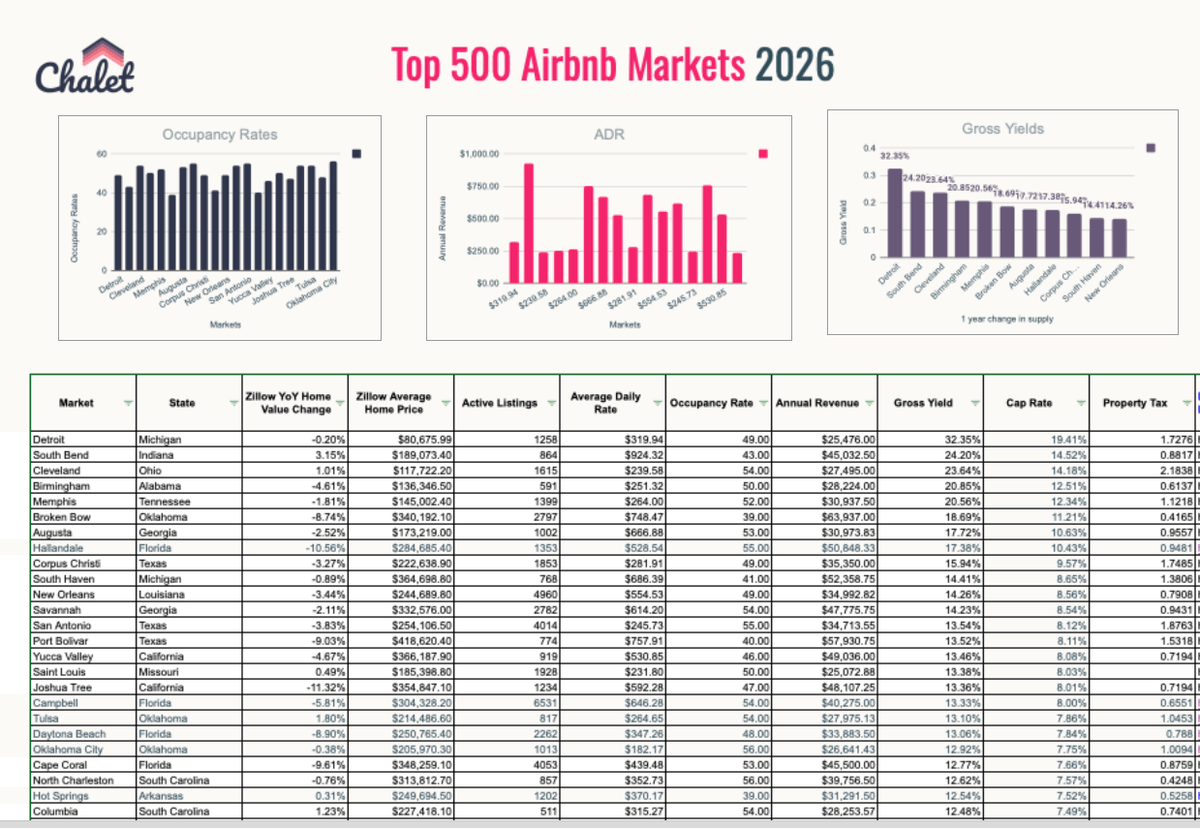
Instantly compare top 500 short-term (Airbnb) rental markets in the US
Frequently Asked Questions
Basics
What is considered a short-term rental in New York City?
A short-term rental is any rental of a dwelling unit for less than 30 consecutive days Checkmate Rentals Blog.
Are short-term rentals legal in Manhattan?
Yes, but only as host-present, primary residence rentals for up to two guests. Entire-unit rentals under 30 days are prohibited Apartments.com.
Can I rent my entire apartment on Airbnb in NYC?
No. Entire-unit rentals for fewer than 30 days are banned unless the property is a Class B multiple dwelling RedAwning.
Licensing
Do I need a permit to operate an STR in NYC?
Yes, all hosts must register with the Office of Special Enforcement (OSE) NYC311.
How much does STR registration cost?
The application fee is $145 Checkmate Rentals Blog.
Is there an annual renewal fee?
Not codified — no explicit annual renewal fee is stated in available sources NYC311.
Can I transfer my STR registration if I sell my property?
Not codified — no explicit rule on transferability in city rules NYC Rules.
Taxes
What taxes apply to NYC short-term rentals?
STRs are subject to 4% NY State sales tax, 5.875% NYC Hotel Room Occupancy Tax, and a $1.50/night Hotel Unit Fee NYC Dept. of Finance.
Do Airbnb and Vrbo collect taxes for me?
Yes, both platforms collect and remit all required taxes and fees on bookings they facilitate StaySTRA.com.
Do I need to collect taxes if I take direct bookings?
Yes, you must register as a sales tax vendor and remit all applicable taxes and fees yourself NY Dept. of Taxation.
Operations
How many guests can I host at once?
No more than two guests per unit at a time Apartments.com.
Do I have to be present during guest stays?
Yes, the host must be present for the entire stay in a primary residence Apartments.com.
Are there any zoning restrictions?
STRs are only allowed in legal primary residences and not in buildings on the prohibited list; specific zoning questions should be confirmed with the Department of City Planning Apartments.com.
Is there a minimum night stay?
Not codified — but unhosted rentals under 30 days are banned RedAwning.
Enforcement
Who enforces STR rules in NYC?
The Mayor’s Office of Special Enforcement (OSE) is the primary enforcement agency NYC311.
What are the penalties for illegal STRs?
Fines can reach up to $5,000 per day or three times the illegal revenue, whichever is greater Proper Insurance.
How does the city detect illegal rentals?
OSE uses lawsuits, platform monitoring, and registration verification to identify violations NYC Mayor’s Office of Criminal Justice.
Are there pending changes to STR laws?
Yes, a pending City Council bill could allow more flexible STRs in one- and two-family homes, but its future is uncertain Gothamist.
Permit Process
All short-term rental hosts in New York City must register with the Mayor’s Office of Special Enforcement (OSE) under Local Law 18. The application fee is $145, and registration is required before listing on any platform. Platforms like Airbnb and Vrbo are prohibited from processing bookings for unregistered rentals NYC311.
Registration is not allowed for NYCHA, rent-controlled, rent-stabilized, or SRO units. Class B multiple dwellings and rentals of 30 days or more are exempt from registration. No explicit annual renewal fee or transferability rule is codified NYC311.
Zoning
STRs are only permitted in host-present, primary residence units. Entire-unit rentals under 30 days are banned unless the property is a Class B multiple dwelling. No more than two guests are allowed at a time. All properties must be in an allowable zoning district and not on the prohibited building list Apartments.com.
No separate city rules exist for parking, density, or 24/7 local contact requirements. Building and HOA rules may further restrict STRs NYC Zoning Resolution.
Taxes and Remittance
NYC STRs are subject to a 4% NY State sales tax, 5.875% NYC Hotel Room Occupancy Tax, and a $1.50 per unit per day Hotel Unit Fee. Airbnb and Vrbo collect and remit all taxes and fees for bookings they facilitate. Hosts taking direct bookings must register as sales tax vendors and remit all applicable taxes themselves NYC Dept. of Finance.
Permanent residents (180+ days) are exempt from these taxes. The total effective lodging tax is 11.4% plus $1.50/night NYC311.
Enforcement and Recent Actions
OSE aggressively enforces STR rules using lawsuits, platform monitoring, and registration verification. Fines can reach $5,000 per day or three times illegal revenue. In 2026, OSE found 27% of approved listings were operating illegally, mainly by offering entire homes or exceeding guest limits Skift.
OSE has sued landlords and operators for illegal STRs, including those using fraudulent profiles or converting entire buildings NYC Office of Special Enforcement.
Recent Changes and Pending Legislation
Local Law 18, effective September 2023, created the current registration and enforcement regime. In 2025, New York State passed laws requiring counties to establish STR registries, but NYC’s system remains independent NYSAC.
A pending City Council bill could allow owners of one- and two-family homes to rent to up to four adults without being present, but its passage is uncertain Gothamist.
Comparable Markets
- Jersey City, NJ: Consider if seeking a nearby market with more flexible STR rules.
- Philadelphia, PA: Consider for a large Northeast city with a permit regime but less aggressive enforcement.
- Boston, MA: Consider for a major city with a capped but open STR registration system.
- Miami, FL: Consider for a large city with high STR demand and a different regulatory climate.
Sources
- NYC311 – Short-Term Rental Registration: https://portal.311.nyc.gov/article/?kanumber=KA-03559
- NYC311 – NYC.gov: https://portal.311.nyc.gov/article/?kanumber=KA-02794
- NYC Department of Finance: https://www.nyc.gov/site/finance/business/business-hotel-room-occupancy-tax.page
- NYC Office of Special Enforcement: https://www.nyc.gov/site/specialenforcement/news/NYC%20Sues%20Landlord%20for%20Illegal%20Short-Term%20Rentals.page
- NYC Mayor’s Office of Criminal Justice: https://criminaljustice.cityofnewyork.us/press-release/new-york-city-sues-landlord-for-turning-entire-buildings-into-illegal-short-term-rentals/
- NYC Zoning Resolution (official): https://zoningresolution.planning.nyc.gov/
- New York State Department of Taxation and Finance: https://www.tax.ny.gov/pubs_and_bulls/publications/sales/short-term-rental.htm
- Registration and Requirements for Short-Term Rentals – NYC Rules: https://rules.cityofnewyork.us/rule/registration-and-requirements-for-short-term-rentals/
- New York State Association of Counties (NYSAC): https://www.nysac.org/issues/short-term-rentals/
- Apartments.com: Short-Term Rental Laws in New York, NY: https://www.apartments.com/rental-manager/resources/short-term-rental-laws-new-york
- RedAwning: New York Airbnb and Short Term Rental Regulations (2026 Update): https://www.redawning.com/pm/post/new-york-state-short-term-rental-laws
- Proper Insurance: https://www.proper.insure/regulations/new-york-airbnb-laws/
- Skift: https://skift.com/2026/04/21/nyc-27-percent-approved-short-term-rental-listings-converted-illegal-stays/
- StaySTRA.com: https://staystra.com/new-york-short-term-rental-tax-2026-statewide-str-sales-tax/
- Gallet Dreyer & Berkey, LLP: https://www.gdblaw.com/blog/impact-new-york-citys-short-term-rental-law-two-years
- Minut: https://www.minut.com/blog/new-york-short-term-rental-laws
- Gothamist: https://gothamist.com/news/future-unclear-for-range-of-housing-bills-in-nyc-council-including-looser-airbnb-rules
- Whiteman Osterman & Hanna LLP: https://www.woh.com/blog/260/The-2025-Amendments-to-the-Real-Property-and-Tax-Laws-Impact-on-Local-Governments-Regulation-of-Short-Term-Rental-Units-/
- Checkmate Rentals Blog: https://www.checkmaterentals.com/blog/short-term-rental-laws-new-york
- Truvi: https://truvi.com/blog/new-york-airbnb-ban/
This page is research, not legal advice. Consult local counsel before acquiring or operating a short-term rental in City of New York (Manhattan); Office of Special Enforcement; New York State.
Ready to evaluate New York as an STR market?
- See New York revenue data → — Get up-to-date STR performance and occupancy trends.
- Run this deal in our calculator → — Model cash flow and compliance costs for any NYC property.
- Match with a New York STR agent → — Connect with vetted local experts for your acquisition.