



This guide covers Surfside Beach, South Carolina only. Neighboring markets often have different STR rules and are frequently confused with Surfside Beach:
- Myrtle Beach: Large city just north, with its own distinct STR licensing and zoning rules.
- North Myrtle Beach: Separate city north of Myrtle Beach, also with unique STR regulations.
- Garden City Beach: Unincorporated area south of Surfside Beach, governed by Horry or Georgetown County, not a municipality.
- Murrells Inlet: Unincorporated area further south, often confused due to proximity and similar vacation rental activity.
Legality Verdict
Short-term rentals are legal in Surfside Beach, SC, but only in R3 and C3 zoning districts. A business license is required, and the total tax burden is 8.5%. Enforcement is low and stable, with no recent regulatory changes.
- Legality Status: 5/5
- License Availability: 4/5
- Compliance Cost (% revenue): 4/5
- Regulatory Stability: 4/5
- Enforcement Climate: 5/5
TL;DR
Short-term rentals in Surfside Beach are defined as stays under 30 days and are only allowed in R3 and C3 zones. A Town business license is required before operating. The total tax burden is 8.5% (state and local). Key operational rules include occupancy and parking limits. The biggest gotcha: STRs are not permitted in most residential zones—zoning is the binding constraint for investors.
Quick Facts
| Item | Detail |
|---|---|
| STR Definition | Rental for less than 30 days Surfside Beach Code of Ordinances |
| Registration Required | Yes, Town business license [Business Licensing |
| Permit Cost | needs verification — call Business License Office at 843-913-6342 or see official site |
| Annual Renewal | Yes, due by April 30 each year [Business Licensing |
| Late Penalty | Not codified — general municipal penalties apply [Business Licensing |
| State Sales Tax | 5% South Carolina Department of Revenue |
| State Accommodations Tax | 2% South Carolina Department of Revenue |
| Local Accommodations Tax | 0.5% Town of Surfside Beach |
| Hospitality Tax | 1% Town of Surfside Beach |
| Total Effective Lodging Tax | 2.5% (accommodations-specific) Town of Surfside Beach |
| Total Tax Burden (all taxes) | 8.5% Town of Surfside Beach |
| Airbnb/Platform Tax Collection | Airbnb collects state taxes only; hosts must remit local taxes Airbnb Help Center |
| License Cap | Not codified — no cap in available sources [Business Licensing |
| Transferability | Not codified — defaults apply [Business Licensing |
| Permitted Zones | R3 and C3 only Surfside Beach Code of Ordinances |
| Prohibited Zones | All others (not R3 or C3) Surfside Beach Code of Ordinances |
| Occupancy Cap | 2 persons/bedroom + 2, excluding minors RedAwning |
| Parking Requirement | Minimum 2 spaces per property RedAwning |
| Local Contact Requirement | Yes, emergency contact must be available at all times RedAwning |
| Inspection Requirement | May require safety inspection with 24-hour notice RedAwning |
| HOA/Condo Override | Not codified — check private covenants [Business Licensing |
| Enforcement Penalties | Up to $500 per violation or 30 days jail Surfside Beach Code of Ordinances |
| Last Updated | August 4, 2026 |
Regulatory Impact Snapshot
Surfside Beach’s STR regime is defined by strict zoning—only R3 and C3 districts allow short-term rentals, and a business license is mandatory. The total tax burden is 8.5%, with local taxes not collected by platforms, so hosts must remit directly. Investors should underwrite for , but note that compliance costs (including licensing and taxes) will total annually. The binding constraint is zoning: most residential areas are off-limits. Run this market in our Airbnb Calculator →
Top 500 US Airbnb Rental Markets - 2026
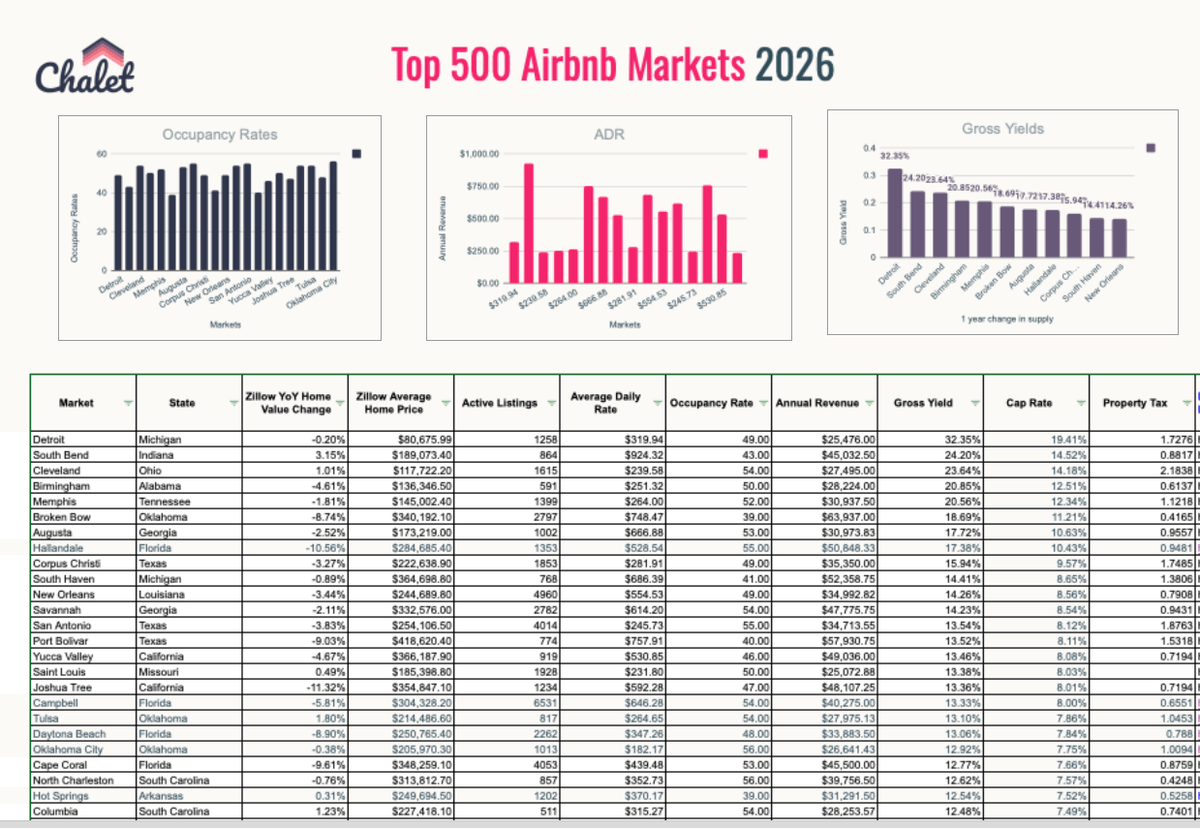
Instantly compare top 500 short-term (Airbnb) rental markets in the US
Frequently Asked Questions
Basics
Are short-term rentals legal in Surfside Beach, SC?
Yes, STRs are legal but only in R3 and C3 zoning districts Surfside Beach Code of Ordinances.
What is considered a short-term rental in Surfside Beach?
A rental for less than 30 days or a calendar month is considered a short-term rental Surfside Beach Code of Ordinances.
Can I operate an STR in any part of Surfside Beach?
No, only properties in R3 and C3 zones are eligible Surfside Beach Code of Ordinances.
Licensing
Is a business license required for STRs?
Yes, a Town of Surfside Beach business license is required before operating Business Licensing | Surfside Beach, SC.
How long does it take to get a business license?
Allow 7–10 business days for processing Business Licensing | Surfside Beach, SC.
Is there a cap on the number of STR licenses?
No cap is codified in available sources Business Licensing | Surfside Beach, SC.
Are STR licenses transferable on sale?
Not codified—defaults apply Business Licensing | Surfside Beach, SC.
Taxes
What is the total tax burden for STRs?
The total tax burden is 8.5% (5% state sales, 2% state accommodations, 0.5% local accommodations, 1% hospitality) Town of Surfside Beach.
Does Airbnb collect all required taxes?
No, Airbnb collects state taxes only; hosts must remit local taxes directly Airbnb Help Center.
Do I need a state retail license?
Yes, a South Carolina Retail License is required to remit state taxes South Carolina Department of Revenue.
Operations
What is the occupancy limit for STRs?
Maximum occupancy is two persons per bedroom plus two additional persons, excluding minors RedAwning.
Is there a parking requirement?
Yes, at least two parking spaces must be available RedAwning.
Do I need a local contact?
Yes, an emergency contact must be available at all times RedAwning.
Are safety inspections required?
Properties may be subject to safety inspections with 24-hour notice RedAwning.
Do I need to notify neighbors?
Yes, adjacent households and neighborhood associations must be notified RedAwning.
Enforcement
What are the penalties for violations?
Up to $500 per violation or 30 days in jail Surfside Beach Code of Ordinances.
How is enforcement handled?
Enforcement is low and primarily citation-based; no evidence of aggressive monitoring HostReady.
Have there been recent regulatory changes?
No significant amendments or pending bills affecting STRs from 2024–2026 HostReady.
Permit Process
A Town of Surfside Beach business license is required before operating any short-term rental. The application can be submitted online or in person, and processing typically takes 7–10 business days. Renewals are due by April 30 each year Business Licensing | Surfside Beach, SC.
Each STR unit must have its own license. There is no codified cap on the number of licenses, and transferability is not specified in available sources. A South Carolina Retail License is also required to remit state taxes Property Owners Association of South Carolina.
Zoning
Short-term rentals are only permitted in R3 and C3 zoning districts in Surfside Beach. All other zones prohibit STRs. Zoning compliance is strictly enforced, and no building or land may be used for STRs unless expressly permitted by the zoning ordinance Surfside Beach Code of Ordinances.
Operational requirements include a maximum occupancy of two persons per bedroom plus two, a minimum of two parking spaces, and notification to adjacent households and neighborhood associations RedAwning.
Taxes and Remittance
The total tax burden for STRs in Surfside Beach is 8.5%, including 5% state sales tax, 2% state accommodations tax, 0.5% local accommodations tax, and 1% hospitality tax Town of Surfside Beach.
Airbnb collects and remits only the state-level taxes. Hosts are responsible for remitting the local accommodation and hospitality taxes directly to the Town. A South Carolina Retail License is required for tax remittance South Carolina Department of Revenue.
Enforcement and Recent Actions
Enforcement of STR regulations in Surfside Beach is described as low and primarily citation-based. The maximum penalty for violations is $500 per offense or up to 30 days in jail HostReady.
There is no evidence of aggressive enforcement methods such as platform monitoring or patrols. Most enforcement actions are complaint-driven, and the market is considered low risk for investors HostReady.
Recent Changes and Pending Legislation
No significant amendments or pending bills affecting Surfside Beach STR regulations have been documented from 2024 to 2026. The regulatory environment is stable, with no major changes anticipated in the near term HostReady.
South Carolina state law preempts local bans on STRs but allows local regulation and permitting 2023-2024 Bill 3253.
Comparable Markets
- Myrtle Beach, SC — Consider if you want a larger, year-round tourism market with stricter licensing.
- North Myrtle Beach, SC — Consider for more flexible zoning and a family-oriented beach scene.
- Garden City Beach, SC — Consider if you prefer unincorporated areas with county-level rules.
- Murrells Inlet, SC — Consider for a quieter, less regulated STR environment.
Sources
- Town of Surfside Beach, South Carolina (official agenda): https://www.surfsidebeach.org/AgendaCenter/ViewFile/Item/1039?fileID=5741
- Surfside Beach Code of Ordinances (Municode): https://library.municode.com/sc/surfside_beach/codes/code_of_ordinances?nodeId=VOII_CH17ZO_ARTIIIDIUSRE_DIV11USRE
- Code of Ordinances | Surfside Beach, SC – Municode Library: https://library.municode.com/sc/surfside_beach/codes/code_of_ordinances?nodeId=VOII_CH17ZO_ARTIIIDIUSRE_DIV1DIGE_S17-303DISUDIDEST
- Business Licensing | Surfside Beach, SC: https://www.surfsidebeach.org/180/Business-Licensing
- Town of Surfside Beach – Hospitality & Accommodations Tax: https://www.surfsidebeach.org/181/Hospitality-Accommodations-Tax
- South Carolina Department of Revenue – Accommodations: https://dor.sc.gov/sales-use-tax-index/accommodations
- 2023-2024 Bill 3253: Short-term rentals – South Carolina Legislature Online: https://www.scstatehouse.gov/sess125_2023-2024/bills/3253.htm
- Property Owners Association of South Carolina: https://propertyownerssc.org/regulations/
- Airbnb Help Center – Occupancy tax collection and remittance by Airbnb in South Carolina: https://www.airbnb.com/help/article/2328
- HostReady (citing Surfside Beach ordinance and enforcement posture): https://www.hostready.ai/markets/surfside-beach-sc
- RedAwning (STR market overview for Surfside Beach, SC): https://www.redawning.com/property-management/market-overview/surfside-beach-south-carolina
This page is research, not legal advice. Consult local counsel before acquiring or operating a short-term rental in Town of Surfside Beach, Horry County, South Carolina.
Ready to evaluate Surfside Beach as an STR market?
- See Surfside Beach revenue data → — Get up-to-date ADR, occupancy, and revenue trends for underwriting.
- Run this deal in our calculator → — Model cash flow, taxes, and compliance costs for any property.
- Match with a Surfside Beach STR agent → — Connect with a local expert for on-the-ground insights.