



This guide covers Palm Springs, California only. Neighboring cities have separate STR rules and are often confused with Palm Springs:
- Cathedral City: Distinct STR caps and permit rules; stricter enforcement since 2023.
- Rancho Mirage: Separate licensing and occupancy limits; some STR bans in effect.
- Palm Desert: Own permit system and night limits; not governed by Palm Springs rules.
- Desert Hot Springs: Unique STR registration and zoning requirements; different enforcement priorities.
Legality Verdict
Short-term rentals are legal in Palm Springs with a required Vacation Rental Registration Certificate, subject to strict density caps, contract limits, and aggressive enforcement. The city’s rules are among the most detailed in California.
- Legality Status: 4/5
- License Availability: 3/5
- Compliance Cost (% revenue): 1/5
- Regulatory Stability: 3/5
- Enforcement Climate: 2/5
TL;DR
Palm Springs defines STRs as rentals of 28 days or less and requires a Vacation Rental Registration Certificate, business license, and monthly 11.5% Transient Occupancy Tax (TOT) plus 7.25% state sales tax. A 20% neighborhood density cap and annual contract limits apply. Total tax burden is 18.75%. The city is known for aggressive enforcement and uses monitoring tools. The biggest gotcha: three violations in 12 months can trigger multi-year permit suspension.
Quick Facts
| Item | Detail |
|---|---|
| STR Definition | Rental of 28 consecutive days or less City of Palm Springs Ordinance (Granicus) |
| Registration Required | Yes — Vacation Rental Registration Certificate City of Palm Springs |
| Permit Cost | [needs verification — call Department of Special Program Compliance at (760) 322-8382 or https://www.palmspringsca.gov/government/departments/special-program-compliance/vacation-rentals-1098] |
| Annual Renewal | [needs verification — call Department of Special Program Compliance at (760) 322-8382 or https://www.palmspringsca.gov/government/departments/special-program-compliance/vacation-rentals-1098] |
| Business License Required | Yes City of Palm Springs – Business License |
| State Sales Tax | 7.25% Avalara MyLodgeTax |
| Local Accommodations Tax (TOT) | 11.5% City of Palm Springs |
| County/District Tax | Not codified — no additional Riverside County accommodations tax for incorporated Palm Springs Airbnb Help Center |
| Total Effective Lodging Tax | 11.5% (TOT only) City of Palm Springs |
| Total Tax Burden (all taxes) | 18.75% (11.5% TOT + 7.25% sales tax) Avalara MyLodgeTax |
| Permit Transferable on Sale | [needs verification — call Department of Special Program Compliance at (760) 322-8382 or https://www.palmspringsca.gov/government/departments/special-program-compliance/vacation-rentals-1098] |
| Occupancy Cap | Based on bedrooms; 2 children under 12 may be added City of Palm Springs |
| Parking Requirement | Based on bedrooms City of Palm Springs |
| License Cap | Yes — 20% neighborhood density cap Minut |
| Annual Contract Limit | 36 (legacy permits); 26 (permits after Nov 2022) The Palm Springs Post |
| Permitted Zones | Single-family and multifamily residential, as ancillary use City of Palm Springs Code |
| Prohibited Zones | Not codified — see city code for exceptions City of Palm Springs Code |
| HOA/Condo Override | Not codified — check HOA rules No separate city rule on HOA override identified in sources reviewed |
| Local Contact Requirement | Yes — 24/7, must respond in person within 45 minutes City of Palm Springs Ordinance (Granicus) |
| Inspection Requirement | Not codified — see application process No separate city rule on inspection identified in sources reviewed |
| Enforcement Penalties | $5,000 fine and permanent ineligibility for unlicensed operation; escalating fines for violations Airbnb Help Center |
| Enforcement Climate | Aggressive; complaint-based and monitoring tools SBEMP |
| Last Updated | June 11, 2026 |
Regulatory Impact Snapshot
Underwriters should model compliance costs at 19.5% of gross revenue, with median Palm Springs, CA STRs earning $54,927 at an average daily rate of $484 and 25% occupancy. The binding constraint is the combined 18.75% tax stack (11.5% TOT plus 7.25% state sales tax), which is among the highest in California. Permit and renewal fees are not codified in public sources and should be confirmed with the city. Aggressive enforcement, density caps, and annual contract limits are the primary operational risks. Run this market in our Airbnb Calculator →
Top 500 US Airbnb Rental Markets - 2026
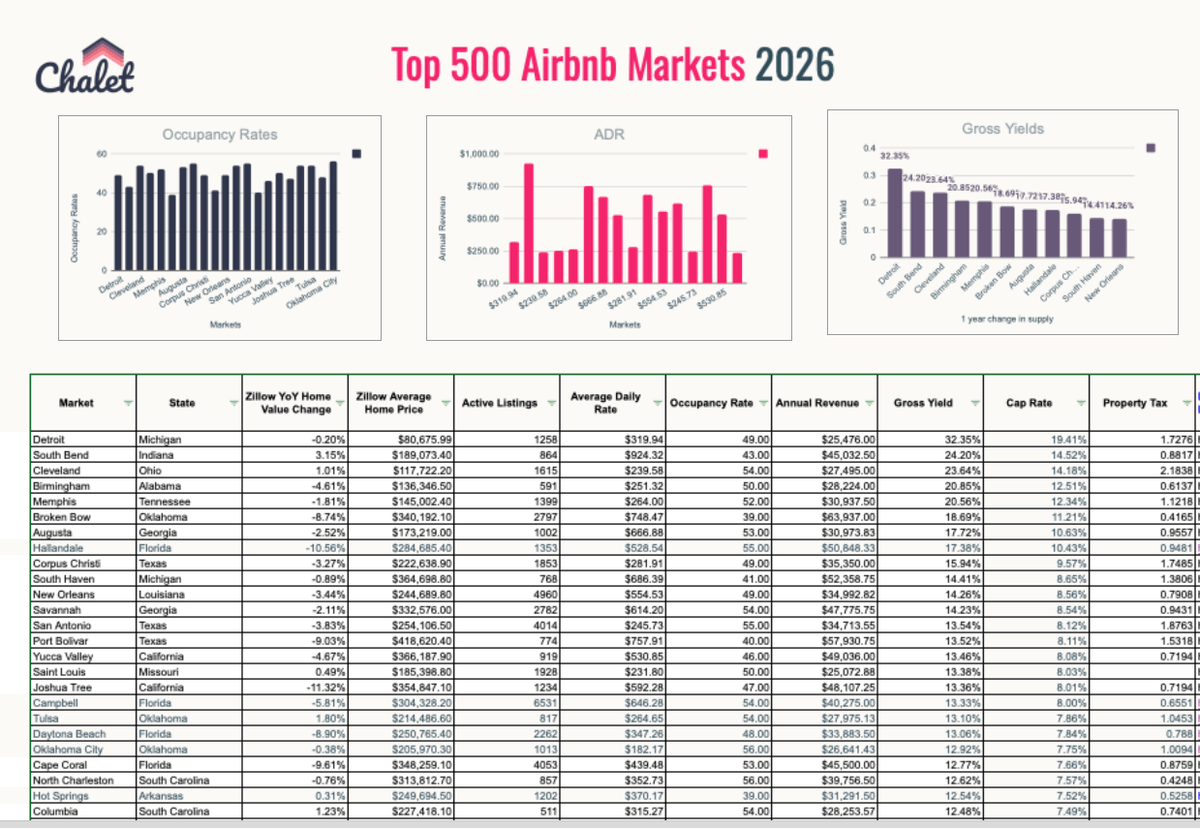
Instantly compare top 500 short-term (Airbnb) rental markets in the US
Frequently Asked Questions
Basics
What is considered a short-term rental in Palm Springs?
A short-term rental is any rental of a residential property for 28 consecutive days or less City of Palm Springs Ordinance (Granicus).
Are STRs legal in Palm Springs?
Yes, STRs are legal with a valid Vacation Rental Registration Certificate and compliance with city rules City of Palm Springs.
Do Palm Springs rules apply in Cathedral City or Rancho Mirage?
No, each city has its own STR regulations Minut.
Licensing
What licenses are required to operate an STR in Palm Springs?
You need a Vacation Rental Registration Certificate, a business license, and a TOT permit Airbnb Help Center.
How do I apply for a Vacation Rental Registration Certificate?
Applications are processed online via GovOS as of February 2024 City of Palm Springs.
Is annual renewal required?
[needs verification — call Department of Special Program Compliance at (760) 322-8382 or https://www.palmspringsca.gov/government/departments/special-program-compliance/vacation-rentals-1098]
Are permits transferable when selling the property?
[needs verification — call Department of Special Program Compliance at (760) 322-8382 or https://www.palmspringsca.gov/government/departments/special-program-compliance/vacation-rentals-1098]
Taxes
What is the Transient Occupancy Tax (TOT) rate?
The TOT rate is 11.5% for vacation rentals City of Palm Springs.
Does state sales tax apply to STRs?
Yes, the California state sales tax of 7.25% applies Avalara MyLodgeTax.
Are there any additional county or district taxes?
No, there are no additional Riverside County accommodations taxes for incorporated Palm Springs Airbnb Help Center.
How often must TOT returns be filed?
TOT returns must be filed monthly, even if the property was not rented City of Palm Springs.
Operations
What are the occupancy limits for STRs?
Occupancy is based on the number of bedrooms, plus two children under 12 City of Palm Springs.
Is a local contact required?
Yes, a local contact must be available 24/7 and able to respond in person within 45 minutes City of Palm Springs Ordinance (Granicus).
Are there density or contract caps?
Yes, a 20% neighborhood density cap applies, and annual contract limits are 36 (legacy) or 26 (new permits) Minut.
What zones allow STRs?
STRs are allowed in single-family and multifamily residential zones as an ancillary use City of Palm Springs Code.
Enforcement
What are the penalties for operating without a permit?
A $5,000 fine and permanent ineligibility for future STR permits Airbnb Help Center.
How is enforcement carried out?
The city uses complaint-based enforcement and monitoring tools, including sound meters SBEMP.
What happens after repeated violations?
Three violations in 12 months can trigger multi-year suspension of the STR certificate Minut.
Are there pending changes to enforcement or fines?
Yes, increased fines and new property management rules are pending City Council review The Palm Springs Post.
Permit Process
Palm Springs requires a Vacation Rental Registration Certificate, a business license, and a TOT permit for all STRs. Applications are processed online via GovOS. The Department of Special Program Compliance manages the process and enforces annual caps and contract limits. Permit and renewal fees are not published and must be confirmed with the city City of Palm Springs.
Zoning
STRs are permitted as an ancillary and secondary use in single-family and multifamily residential zones. The city’s code and a 2022 court decision confirm this right. However, a 20% neighborhood density cap applies, and new permits are waitlisted once this threshold is reached City of Palm Springs Code; Minut.
Taxes and Remittance
Palm Springs imposes an 11.5% Transient Occupancy Tax (TOT) and the California state sales tax of 7.25% on STRs, for a total tax burden of 18.75%. Hosts must file TOT returns monthly, regardless of rental activity. Some platforms may remit TOT, but hosts remain responsible for compliance City of Palm Springs; Avalara MyLodgeTax.
Enforcement and Recent Actions
Palm Springs is known for aggressive enforcement, using complaint-driven investigations and monitoring tools like sound meters. Fines escalate with repeated violations, and three violations in 12 months can result in multi-year permit suspension. Unlicensed operation triggers a $5,000 fine and permanent ineligibility SBEMP; Minut.
Recent Changes and Pending Legislation
In October 2025, the city council maintained the 36-contract cap for legacy permits and 26 for new ones. The Administrative Appeals Board has recommended higher fines and new property management rules, pending council review. A proposed PSTID 1 tax is under legal scrutiny as of April 2026 The Palm Springs Post; NBC Palm Springs.
Comparable Markets
- Cathedral City, CA — Consider if you want stricter caps and enforcement.
- Palm Desert, CA — Consider for different permit system and night limits.
- Rancho Mirage, CA — Consider if you need alternative licensing and occupancy rules.
Sources
- City of Palm Springs: https://www.palmspringsca.gov/government/departments/special-program-compliance/vacation-rentals-1098
- City of Palm Springs – Vacation Rental Certificate Application: https://www.palmspringsca.gov/government/departments/special-program-compliance/vacation-rentals/vacation-rental-certificate
- City of Palm Springs – Business License: https://www.palmspringsca.gov/business/business-license
- City of Palm Springs – Transient Occupancy Tax: https://www.palmspringsca.gov/government/departments/finance-treasury/transient-occupancy-tax-tot
- City of Palm Springs Code of Ordinances: https://ecode360.com/42991918
- City of Palm Springs Ordinance (Granicus): https://palmsprings.granicus.com/MetaViewer.php?clip_id=1799&meta_id=180209
- The Palm Springs Post: https://thepalmspringspost.com/with-rental-numbers-falling-city-council-keeps-36-contract-cap-for-older-vacation-rental-permits/
- The Palm Springs Post: https://thepalmspringspost.com/board-recommends-new-education-programs-property-management-rules-for-vacation-rentals/
- NBC Palm Springs: https://www.nbcpalmsprings.com/therogginreport/2026/04/14/palm-springs-faces-pushback-over-proposed-pstid-tax-as-shortterm-rental-owners-raise-legal-concerns
- Remy Moose Manley: https://www.rmmenvirolaw.com/protect-our-neighborhoods-palm-springs/
- Minut: https://www.minut.com/blog/palm-springs-short-term-rental-laws
- SBEMP Attorneys LLP: https://sbemp.com/short-term-rental-laws-in-palm-springs-what-airbnb-hosts-need-to-know/
- Airbnb Help Center: https://www.airbnb.com/help/article/907
- Airbnb Help Center: https://www.airbnb.com/help/article/2297
- Avalara MyLodgeTax: https://www.avalara.com/mylodgetax/en/resources/vacation-rental-tax-guides/california.html
- Host Tools: https://hosttools.com/blog/short-term-rental-tips/what-is-transient-occupancy-tax/
- PermitByState.com: https://www.permitbystate.com/short-term-rental-rules-california
- Key Data Dashboard: https://www.keydatadashboard.com/markets/palm-springs-california
- Medium: https://medium.com/@ElrodVilla/the-basics-of-vacation-rental-regulations-in-palm-springs-414b833f9c96
This page is research, not legal advice. Consult local counsel before acquiring or operating a short-term rental in City of Palm Springs, Riverside County, California.
Ready to evaluate Palm Springs as an STR market?
- See Palm Springs revenue data → — Get up-to-date STR performance and occupancy trends.
- Run this deal in our calculator → — Model cash flow and compliance costs for any Palm Springs property.
- Match with a Palm Springs STR agent → — Connect with local experts for buying or selling STRs.