



This guide covers short-term rental rules for the City of Detroit, Michigan. Neighboring markets often confused with Detroit in STR research include:
- Dearborn: Separate city with its own STR ordinances and enforcement.
- Hamtramck: Enclave city surrounded by Detroit, with distinct local rules.
- Highland Park: Another enclave city within Detroit, governed by its own municipal code.
- Southfield: Suburban city northwest of Detroit, with different STR regulations.
Legality Verdict
Short-term rentals are legal in Detroit with a $500 annual license, 90-day cap, and mandatory inspections. No citywide license cap, but enforcement is increasingly proactive. Local zoning and compliance are binding constraints for investors.
- Legality Status: 4/5
- License Availability: 4/5
- Compliance Cost (% revenue): 4/5
- Regulatory Stability: 3/5
- Enforcement Climate: 3/5
TL;DR
Detroit defines STRs as rentals of 30 nights or less. A $500 annual license from BSEED is required, plus inspection and Certificate of Compliance. The total lodging tax is 6% (state use tax). Rentals are capped at 90 days per year per property. Enforcement is active, with increased inspections and fines. The biggest gotcha: strict 90-day annual rental limit sharply constrains revenue potential.
Quick Facts
| Item | Detail |
|---|---|
| STR Definition | Rental of a dwelling for 30 nights or less Airbnb Help Center |
| Registration Required | Yes — BSEED short-term rental license Steadily |
| Permit Cost | $500/year Checkmate Rentals |
| Annual Renewal | [needs verification — no primary source found] |
| State Sales/Use Tax | 6% Airbnb Help Center |
| Local Accommodations Tax | Not codified — no separate city lodging tax for STRs City of Detroit |
| County/District Tax | Not codified — Wayne County tax applies only to hotels with 81+ rooms Michigan Dept. of Treasury |
| Total Effective Lodging Tax | 6% (state use tax only) Airbnb Help Center |
| Occupancy Cap | Not codified — no explicit city cap Municode Library |
| Rental Days Cap | 90 days per year Checkmate Rentals |
| Minimum Night Stay | Not codified — no explicit city rule Municode Library |
| Parking Requirement | Not codified — general residential parking rules apply Zoneomics |
| Inspection Requirement | Yes — rental inspection and lead clearance (if pre-1978) Detroit Rental Ordinance |
| Certificate of Compliance | Required before operation Detroit Rental Ordinance |
| License Cap | No citywide cap Steadily |
| Transferability | Not transferable — new owner must reapply Steadily |
| Primary Residence Rule | Not codified — no explicit owner-occupancy requirement Municode Library |
| HOA/Condo Override | Not codified — no explicit city rule Municode Library |
| Enforcement Penalties | Fines, license revocation, and Certificate of Compliance suspension for violations Checkmate Rentals |
| Fine Schedule | [needs verification — no primary source found] |
| Permitted Zones | [needs verification — no primary source found] |
| Prohibited Zones | [needs verification — no primary source found] |
| Primary Regulator | Buildings, Safety Engineering & Environmental Department (BSEED) City of Detroit |
| Last Updated | 2026-06-11 |
Regulatory Impact Snapshot
Underwriters should model compliance costs at 9.3% of gross revenue, with median Detroit, MI STRs earning $24,083 at an average daily rate of $165 and 36% occupancy. The binding constraint is the 90-day annual rental cap, which sharply limits revenue potential compared to unrestricted markets. The $500 annual license, required inspections, and 6% state use tax are the primary compliance costs. Investors must also budget for inspection and lead clearance if the property was built before 1978. Enforcement is active, with penalties for non-compliance. Run this market in our Airbnb Calculator →
Top 500 US Airbnb Rental Markets - 2026
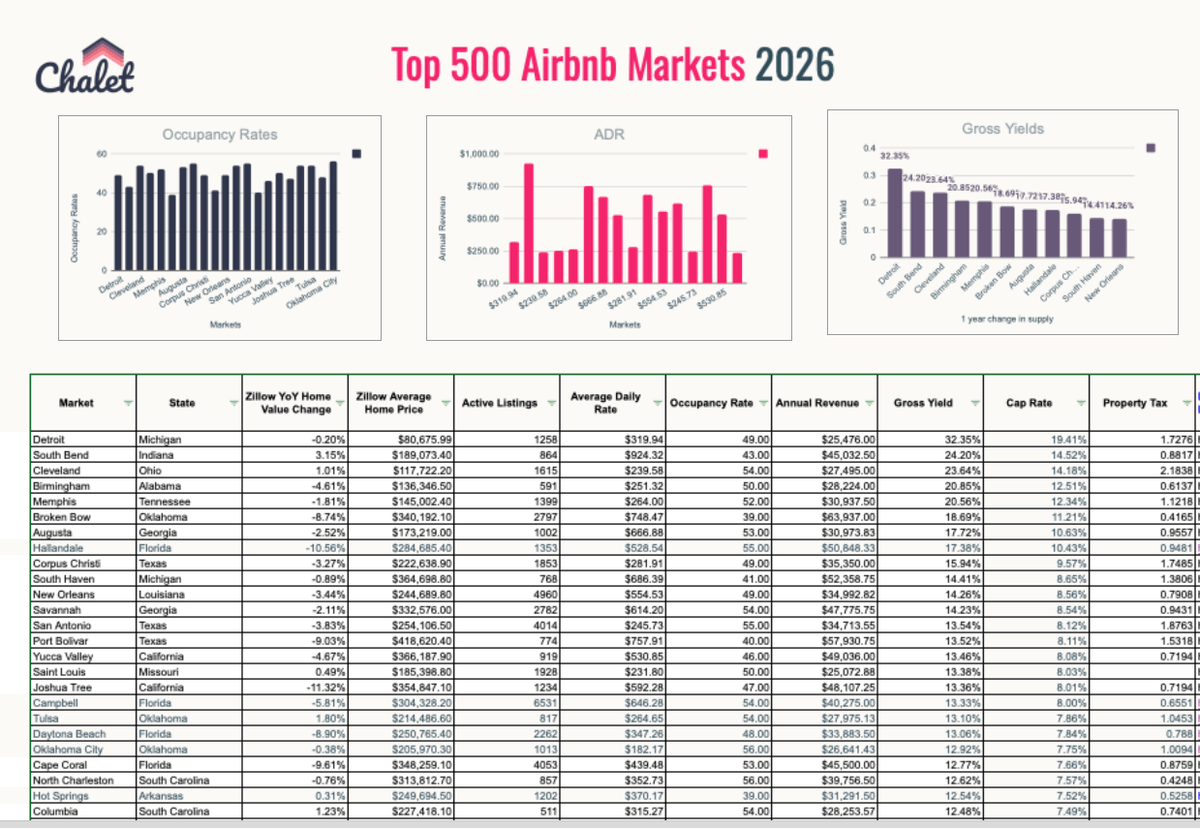
Instantly compare top 500 short-term (Airbnb) rental markets in the US
Frequently Asked Questions
Basics
What is considered a short-term rental in Detroit?
A short-term rental in Detroit is defined as the rental of a dwelling for 30 nights or less Airbnb Help Center.
Are short-term rentals legal in Detroit?
Yes, short-term rentals are legal with a valid license and compliance with city regulations Steadily.
Does Detroit have a citywide ban or moratorium on STRs?
No, Detroit allows STRs but imposes a 90-day annual rental cap per property Checkmate Rentals.
Licensing
Is a license required to operate an STR in Detroit?
Yes, a $500 annual short-term rental license from BSEED is required Checkmate Rentals.
How do I apply for a Detroit STR license?
Apply through the Buildings, Safety Engineering & Environmental Department (BSEED) City of Detroit.
Is there a cap on the number of STR licenses in Detroit?
No, there is no citywide cap on STR licenses Steadily.
Are STR licenses transferable if I sell my property?
No, licenses are not transferable; new owners must apply for a new license Steadily.
Taxes
What taxes apply to Detroit short-term rentals?
A 6% Michigan state use tax applies to all STRs; no separate city or county lodging tax for properties under 81 rooms Airbnb Help Center.
Does Airbnb collect and remit taxes for Detroit hosts?
Yes, Airbnb collects and remits the 6% state use tax for stays of 30 nights or less Airbnb Help Center.
Are there any local Detroit lodging taxes for STRs?
No, Detroit does not impose a separate city lodging tax for STRs City of Detroit.
Operations
Is there a limit on how many days I can rent my property short-term?
Yes, STRs are capped at 90 rental days per year per property Checkmate Rentals.
Are inspections required for Detroit STRs?
Yes, all rental properties must pass inspection and obtain a Certificate of Compliance Detroit Rental Ordinance.
Is lead clearance required for STRs?
Yes, if the property was built before 1978, lead clearance is required before a Certificate of Compliance is issued Detroit Rental Ordinance.
Are there minimum night stay or maximum occupancy rules?
No, Detroit does not separately codify minimum night stay or maximum occupancy for STRs Municode Library.
Enforcement
How is STR compliance enforced in Detroit?
Detroit enforces STR rules through licensing, inspections, and code enforcement, with penalties for violations Checkmate Rentals.
What are the penalties for operating without a license?
Penalties include fines, license revocation, and suspension of the Certificate of Compliance Checkmate Rentals.
Has Detroit increased enforcement recently?
Yes, Detroit has increased inspections and fines, and has taken action against non-compliant operators BridgeDetroit.
How can I check if my zone allows STRs?
[needs verification — no primary source found]
Permit Process
Detroit requires all STR operators to obtain a $500 annual license from the Buildings, Safety Engineering & Environmental Department (BSEED). The application process includes property registration, a rental inspection, and lead clearance for properties built before 1978. A Certificate of Compliance is mandatory before legally operating an STR. Licenses are not transferable; new owners must reapply if the property is sold Checkmate Rentals.
Zoning
Detroit’s zoning code divides the city into residential, commercial, and industrial districts, each with specific permitted uses. STRs must comply with the underlying zoning, but the city does not separately codify which districts allow or prohibit STRs in available sources. All rental properties must be registered and inspected, regardless of zone Zoneomics.
Taxes and Remittance
Detroit STRs are subject to a 6% Michigan state use tax on accommodations for stays of 30 nights or less. There is no separate city or county lodging tax for properties under 81 rooms. Airbnb collects and remits the state tax for hosts, but operators must ensure compliance with any other applicable taxes Airbnb Help Center.
Enforcement and Recent Actions
Detroit’s enforcement climate is increasingly proactive. The city has boosted inspections, increased fines, and taken action against non-compliant operators. Joint inspections by BSEED and the Health Department, court-enforced consent agreements, and property liens are used to ensure compliance. Operating without a valid license or Certificate of Compliance can result in penalties, including suspension of rental privileges BridgeDetroit.
Recent Changes and Pending Legislation
In 2024, Detroit overhauled its rental ordinance, increasing fines and expanding inspections. No state law preempts local STR regulation; local governments retain zoning authority. Investors should monitor for further amendments, as Detroit’s City Council continues to review STR policy LegalClarity.
Comparable Markets
- Grand Rapids, MI: Consider if you want a Michigan market with a more flexible annual rental cap.
- Cleveland, OH: Consider for a Midwest city with a different STR enforcement climate.
- Chicago, IL: Consider for a large urban market with robust STR licensing and enforcement.
- Columbus, OH: Consider for a Midwest city with a moderate regulatory environment.
Sources
- City of Detroit Landlord Rental Requirements: https://detroitmi.gov/departments/buildings-safety-engineering-and-environmental-department-bseed/bseed-divisions/property-maintenance/tenant-rental-property/landlord-rental
- City of Detroit Register Rental Property: https://detroitmi.gov/how-do-i/file-information-or-documents/register-rental-property
- DETROIT RENTAL ORDINANCE: https://detroitmi.gov/sites/detroitmi.localhost/files/2021-08/Landlord%20Guide.pdf
- City of Detroit official lodging tax information page: https://detroitmi.gov/document/2019-10-23-information-regarding-state-lodging-tax
- Michigan Department of Treasury · State Convention Facility Development Tax Return Instructions: https://www.michigan.gov/-/media/Project/Websites/taxes/Forms/Misc/Convention-Facility-Development/406.pdf?rev=b391ab56f9ab49ffb2907ba33f262caa
- Michigan Department of Treasury · Sales and Use Taxes: https://www.michigan.gov/taxes/business-taxes/sales-use-tax/use-tax-1
- Code of Ordinances | Detroit, MI | Municode Library: https://library.municode.com/mi/detroit/codes/code_of_ordinances
- Detroit, MI Zoning Ordinance | Zoneomics: https://www.zoneomics.com/code/detroit-MI/chapter_14
- Checkmate Rentals Blog: https://www.checkmaterentals.com/blog/michigan-short-term-rental-regulations
- Steadily (Airbnb & short-term rental laws in Detroit – 2026): https://www.steadily.com/blog/airbnb-short-term-rental-laws-regulations-detroit
- Residential Zoning Laws and Regulations Detroit, MI in 2026 (Zoneomics summary of Municode): https://www.steadily.com/blog/residential-zoning-laws-regulations-detroit
- Airbnb Help Center: Occupancy tax collection and remittance by Airbnb in Michigan: https://www.airbnb.com/help/article/2310
- BridgeDetroit: https://www.bridgedetroit.com/detroit-to-crack-down-on-61-apartments-with-maintenance-issues/
- LegalClarity: https://legalclarity.org/michigan-house-bill-4722-short-term-rental-regulations/
- Mika Meyers: https://www.mikameyers.com/new-developments-for-short-term-rentals/
- RedAwning: https://www.redawning.com/pm/post/michigan-short-term-rental-laws
This page is research, not legal advice. Consult local counsel before acquiring or operating a short-term rental in City of Detroit, Wayne County, Michigan.
Ready to evaluate Detroit as an STR market?
- See Detroit revenue data → — Get up-to-date STR performance and occupancy trends.
- Run this deal in our calculator → — Model cash flow and compliance costs for your property.
- Match with a Detroit STR agent → — Connect with local experts for acquisition and compliance.