

This guide covers short-term rental rules for the City of Charlotte only. Neighboring markets often confused with Charlotte include:
- Matthews: Separate town with its own STR rules and enforcement.
- Huntersville: Distinct municipality north of Charlotte, different zoning and permitting.
- Pineville: Small town bordering Charlotte to the south, has its own STR ordinances.
- Mint Hill: Eastern suburb with independent local government and STR regulations.
Legality Verdict
Short-term rentals are legal in Charlotte with a required business license and annual STR registration. Zoning and compliance checks apply, but no citywide cap or moratorium exists. The main investor risk is the high tax stack.
- Legality Status: 4/5
- License Availability: 4/5
- Compliance Cost (% revenue): 3/5
- Regulatory Stability: 4/5
- Enforcement Climate: 4/5
TL;DR
Charlotte defines STRs as rentals under 90 days. Operators must obtain a business license and a $75/year STR registration. The total tax burden is 12.75% (4.75% state sales tax + 8% county occupancy tax). No owner-occupancy or density limits, but zoning and code compliance are enforced. The biggest gotcha: Charlotte’s tax stack is the highest in North Carolina, materially impacting net returns.
Quick Facts
| Item | Detail |
|---|---|
| STR Definition | Rental of a dwelling for less than 90 days (Checkmate Rentals) |
| Registration Required | Yes (PropertyZoned.com) |
| Permit Cost | $75/year (PropertyZoned.com) |
| Annual Renewal | Yes, $75 (PropertyZoned.com) |
| Business License Required | Yes (Steadily) |
| State Sales Tax | 4.75% (NCDOR) |
| County Occupancy Tax | 8% (NCRLA) |
| Total Effective Lodging Tax | 8% (NCRLA) |
| Total Tax Burden (all taxes) | 12.75% (NCRLA) |
| Marketplace Tax Collection | Airbnb/VRBO collect and remit all required taxes (Airbnb) |
| Direct Booking Tax Filing | Host must register and remit (NCDOR) |
| Permit Transferable | [needs verification — no primary source found] |
| License Cap | Not codified — no citywide cap identified (PropertyZoned.com) |
| Permitted Zones | Not codified — requirements depend on zoning district (Checkmate Rentals) |
| Prohibited Zones | Not codified — requirements depend on zoning district (Checkmate Rentals) |
| Owner-Occupancy Requirement | Not codified — no owner-occupancy required (PropertyZoned.com) |
| Occupancy Cap | Not codified — no citywide cap (Municode) |
| Minimum Night Stay | Not codified — no citywide minimum (Municode) |
| Parking Requirement | Not codified — no citywide rule (Municode) |
| Local Contact Requirement | Not codified — no citywide rule (Municode) |
| Density Limits | Not codified — no citywide rule (Municode) |
| Inspection Requirement | Housing and fire code compliance required (PropertyZoned.com) |
| Enforcement Penalties | Escalating fines, daily penalties for repeat violations (Minut) |
| Last Updated | June 11, 2026 |
Regulatory Impact Snapshot
Charlotte’s STR regime requires both a business license and a $75 annual registration, with strict compliance to zoning and safety codes. The total tax burden is 12.75% (4.75% state sales tax + 8% county occupancy tax), the highest in North Carolina. Underwriters should model compliance costs at 2.7% of gross revenue, with median Charlotte, NC STRs earning $36,442 at an average daily rate of $187 and 49% occupancy. The binding constraint is the high tax stack, which materially reduces net yield compared to peer markets. Run this market in our Airbnb Calculator →
Top 500 US Airbnb Rental Markets - 2026
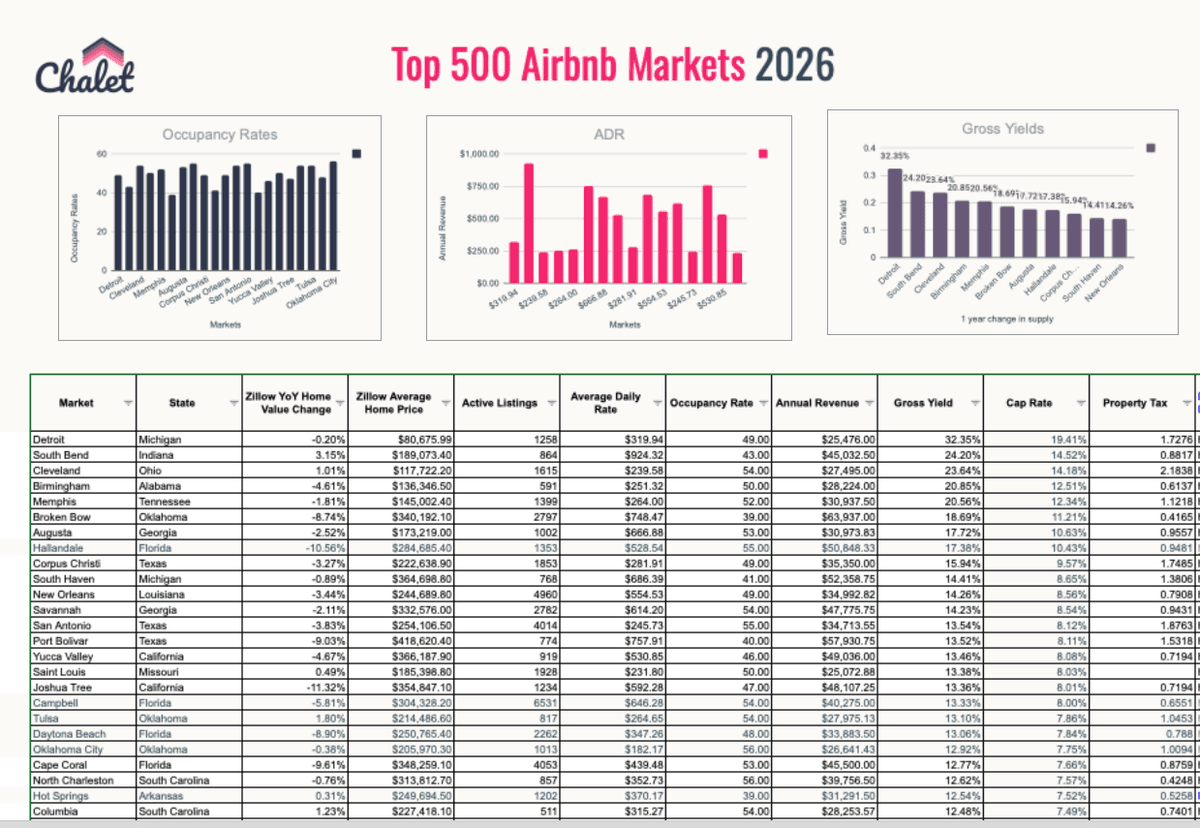
Instantly compare top 500 short-term (Airbnb) rental markets in the US
Frequently Asked Questions
Basics
What is considered a short-term rental in Charlotte?
A short-term rental is defined as the rental of a dwelling for less than 90 days in Charlotte (Checkmate Rentals).
Are short-term rentals legal in Charlotte?
Yes, STRs are legal with required business licensing and annual registration (Steadily).
Do Charlotte’s STR rules apply in all neighborhoods?
Rules apply within city limits; zoning district requirements may vary (Checkmate Rentals).
Licensing
Is a permit required to operate an STR in Charlotte?
Yes, both a business license and a $75/year STR registration are required (PropertyZoned.com).
How much does the STR registration cost?
The annual registration fee is $75 (PropertyZoned.com).
Is there a cap on the number of STR licenses?
No citywide cap is codified (PropertyZoned.com).
Can STR permits be transferred to a new owner?
[needs verification — no primary source found]
Taxes
What taxes apply to STRs in Charlotte?
A 4.75% state sales tax and 8% county occupancy tax apply, totaling 12.75% (NCRLA).
Who collects and remits taxes for Airbnb/VRBO bookings?
Airbnb and VRBO collect and remit all required taxes (Airbnb).
Do I need to register for tax collection if I only use Airbnb/VRBO?
No, if all bookings are through these platforms (Avalara).
What if I take direct bookings?
You must register with the NC Department of Revenue and remit both taxes (NCDOR).
Operations
Are there occupancy or minimum night limits?
No citywide occupancy cap or minimum night stay is codified (Municode).
Is owner-occupancy required for STRs?
No, owner-occupancy is not required (PropertyZoned.com).
Are inspections required?
Properties must comply with housing and fire codes (PropertyZoned.com).
Are there parking or local contact requirements?
No separate citywide rules are codified (Municode).
Enforcement
How is STR compliance enforced in Charlotte?
Enforcement is primarily complaint-driven, with escalation to fines for violations (Minut).
What are the penalties for violations?
Escalating fines and daily penalties for repeat or uncorrected violations (Minut).
Who enforces STR rules?
The Charlotte-Mecklenburg Police Department and county officials jointly enforce STR regulations (Steadily).
Permit Process
Charlotte requires both a business license and a $75 annual STR registration for all short-term rentals. The registration number must be displayed on all listings. The process is handled by Charlotte Development Services, and properties must comply with housing and fire codes (PropertyZoned.com).
Zoning
Charlotte’s Unified Development Ordinance (UDO) governs STRs, with 30 zone classifications. Requirements depend on the zoning district and rental type (homestay or whole-house). No owner-occupancy, density, or parking requirements are codified for STRs (Checkmate Rentals; PropertyZoned.com).
Taxes and Remittance
STRs in Charlotte are subject to a 4.75% state sales tax and an 8% county occupancy tax, totaling 12.75%. Airbnb and VRBO collect and remit these taxes automatically. For direct bookings, hosts must register with the NC Department of Revenue and remit both taxes (NCRLA; NCDOR).
Enforcement and Recent Actions
Enforcement is primarily complaint-driven, with routine checks by city and county officials. Violations can result in escalating fines and daily penalties. Charlotte has increased enforcement in recent years, especially in residential neighborhoods (Minut; Steadily).
Recent Changes and Pending Legislation
Charlotte’s UDO took effect June 1, 2023, clarifying STR rules. State-level preemption bills (e.g., Senate Bill 291) have been introduced but not enacted as of June 2026. No major city amendments or moratoriums are pending (Minut).
Comparable Markets
- Asheville, NC — Consider if you want a tourism-driven mountain market with stricter caps.
- Raleigh, NC — Consider for a capital city with a different zoning and enforcement climate.
- Wilmington, NC — Consider for a coastal market with unique local tax and permitting rules.
Sources
- North Carolina Department of Revenue (NCDOR): https://www.ncdor.gov/taxes-forms/sales-and-use-tax/rentals-accommodations
- Code of Ordinances | Charlotte, NC – Municode Library: https://library.municode.com/nc/charlotte
- 2024 Profile of North Carolina Occupancy Taxes and Their Investment (Magellan Strategy Group): https://www.ncrla.org/wp-content/uploads/2024/04/2024-Profile-of-NC-Occupancy-Taxes-and-Their-Allocation.-March-2024.pdf
- Airbnb Help Center: https://www.airbnb.com/help/article/2320
- Checkmate Rentals – North Carolina Short-Term Rental Laws: https://www.checkmaterentals.com/blog/north-carolina-short-term-rental-laws
- PropertyZoned.com (citing Charlotte Unified Development Ordinance): https://www.propertyzoned.com/city/north-carolina/charlotte
- Steadily – Airbnb & Short Term Rental Laws and Regulations In Charlotte – 2026: https://www.steadily.com/blog/airbnb-short-term-rental-laws-regulations-charlotte
- Minut: Charlotte short-term rental laws: zoning rules, permits, and compliance explained: https://www.minut.com/blog/charlotte-short-term-rental-laws
- Avalara MyLodgeTax: https://www.avalara.com/mylodgetax/en/resources/vacation-rental-tax-guides/north-carolina.html
- GoWithSurge: North Carolina Short Term Rental Laws: https://www.gowithsurge.com/blog/north-carolina-short-term-rental-laws
This page is research, not legal advice. Consult local counsel before acquiring or operating a short-term rental in City of Charlotte, Mecklenburg County, North Carolina.
Ready to evaluate Charlotte as an STR market?
- See Charlotte revenue data → — Get up-to-date STR performance and occupancy trends.
- Run this deal in our calculator → — Model cash flow and compliance costs for any Charlotte property.
- Match with a Charlotte STR agent → — Connect with local experts for acquisition and setup.