
In 2025, short-term rental (STR) investors showed clear, measurable patterns in where they focused their attention and where capital ultimately closed. By analyzing tens of thousands of Airbnb calculator searches across 3,080 cities throughout all 50 U.S. states on our platgorm, alongside actual closed deals, a consistent picture emerges: investors explored individual markets broadly, but deals are concentrated in a narrower set of regional and leisure-driven markets.
The data reveals emerging Airbnb markets and cooling former hotspots, signaling strategic shifts for investors heading into 2026. By analyzing where and what users searched on Chalet’s free investment tools, we identified key behavioral trends that offer a directional guide for 2026 planning.
Key Takeaways
- Sun Belt and Drive-To Destinations Dominated: Warm-weather Sun Belt states led investor interest in 2025 (Florida, California, and Texas – the top 3 states – comprised 32.5% of all investor searches), with Florida alone representing about 13% of all Chalet user searches, the highest of any state. Drive-to vacation spots (mountains, lakes, and regional beach towns) saw a surge in attention as travelers stuck to closer getaways.
- Investors Buy Where They Search: Even more dominantly, the Sun Belt’s appeal carried through to actual purchases. Florida, Texas, and California were the top destinations for Chalet-assisted acquisitions, collectively accounting for approximately 69% of all STR deals closed on the platform in 2025. Florida alone represented about 30% of closed transactions, reinforcing its position as the nation’s most active STR investment state, followed by Texas at roughly 27% and California at approximately 12%.
- While investors deploy capital selectively, they continue to research broadly: The most-searched individual market accounted for only about 1.8% of total searches. This underscores how widely distributed investor interest was in 2025 – no single city dominated.
- Regional Markets Outshine Big Cities: Secondary “drive-to” vacation markets saw higher engagement rates per listing than major cities, as investors increasingly target regional destinations over traditional urban hotspots.
Chalet users closed 205% more STR property deals in 2025 than the year prior, with big city markets accounting only for 27.3% of all deals closed. - Caution in Regulated Markets: Investor interest cooled in places with strict regulations or oversupply. New York City and Los Angeles each accounted for under 0.2% of searches, reflecting how local bans and permit crackdowns steered buyers away.
- Tech Tools Matter More Than Ever: Data-driven decision making was a key theme. Investors gravitated to analytics and calculators (Chalet saw record usage of its Airbnb income calculator), and in 2026 this trend will accelerate with AI. Chalet’s AI Copilot, launching in early 2026, will bring real-time analysis and automation to investors’ fingertips, cutting research time and boosting confidence in deal choices.
Where Airbnb Investors Were Looking (Search Trends)
In 2025, short-term rental (STR) investors gravitated heavily toward certain regions and market types. By crunching thousands of search queries and submissions on Chalet’s platform, clear patterns emerged about where investor attention surged. Two big winners: the Sun Belt states and classic “drive-to” leisure markets within a few hours’ ride of major cities. Let’s break down each trend.
Sun Belt Steals the Spotlight
Investors used Chalet’s Airbnb calculator heavily in 2025, with demand clustered in familiar STR hotspots. By state, Florida led all others with 12.85% of calculator queries, followed by California (11.02%) and Texas (8.59%). These top three states alone represented about one-third of all search activity. These traditional STR strongholds captured the lion’s share of investor curiosity.
In other words, one in three potential buyers on Chalet’s platform was looking in FL, CA, or TX – a testament to the strong tourism draw and generally friendly STR laws in those states.

Why the Sun Belt? Warm climates and year-round tourism play a big role. Florida offers everything from theme park hubs like Orlando to beach escapes in the Panhandle and South Florida. Texas boasts urban STR markets (Austin, Dallas, Houston) as well as Hill Country and Gulf Coast getaways. Investor-friendly regulations also help, states like Florida, Texas, and Arizona have a reputation for balancing high travel demand with laws favorable to STR owners. This regulatory predictability gave investors confidence to keep funneling money into markets like these.
Investor Insight: Sun Belt markets are popular for good reason – they offer the triple threat of strong rental demand, growing home values, and generally landlord-friendly policies. For 2026, expect Sun Belt supremacy to continue (particularly in the states of Florida, Texas and California). Investors should still prioritize due diligence on a city’s specific regulations (they can vary by county or city), but overall the southern markets remain fertile ground for STR opportunities.
Drive-to Vacation Destinations on the Rise
Beyond the big states, 2025 saw huge interest in “drive-to” leisure markets, think charming mountain towns, lakeside retreats, and regional beach areas within a few hours’ drive of major metro areas. These markets boomed during the pandemic travel shift, and investor appetite hasn’t let up.
Some of the most-searched cities on Chalet fell into this category. Sevierville, TN – a gateway to the Smoky Mountains – was the #1 most searched city with 1.8% investor searches for properties there. Its neighbors Gatlinburg, TN (0.8%) and Pigeon Forge also ranked in the top 20. Together, this Smoky Mountain trio drew thousands of would-be buyers seeking lucrative cabin rentals. The appeal? Driveable from many East Coast and Midwest cities, year-round family demand at Great Smoky Mountains National Park, and relatively affordable large cabins, a perfect recipe for STR ROI.

Other drive-to darlings included Myrtle Beach, SC, which cracked the top 5 most-searched markets (1.0%) as a beach destination accessible to millions of Southeastern road-trippers. Broken Bow, OK, a rural lake and woods getaway for Texans, also made the top 10 by investor interest (0.7%). In the Blue Ridge Mountains of North Georgia, tiny Blue Ridge, GA saw outsized attention with investors drawn to its cozy cabin culture. And up north, the Poconos in Pennsylvania quietly racked up searches as a classic driveable vacation home region for Northeast urbanites.
These trends show investors chasing where travelers are going. With many Americans still preferring closer-to-home vacations, rentals in drivable getaways offered a sense of safety and convenience that translated into strong occupancy, and investors took notice. It’s no accident that several of 2025’s top markets (by number of investor searches) were places like “cabins in the woods,” “lakeside cottages,” or “mountain ski lodges.” These properties often come at lower price points than big-city condos or coastal villas, yet they tap into reliable year-round demand from families and friend groups.
Investor Insight: If you’re looking toward 2026, don’t ignore the “backyard vacation” trend. Regional leisure markets can offer high yield for a lower cost. However, be mindful of competition – many of these spots (Smokies, Poconos, etc.) have seen inventory balloon as so many investors piled in. The best strategy is to identify a unique value-add for your property (amazing game room, scenic view, top-notch management) that helps it stand out in a crowded market.
Where Investors Were Buying (Closed Deals)
Finally, we look at where investor interest translated into purchases. In 2025, the closed deals were distributed across diverse locations, but a few markets clearly stand out. Austin, TX led the list with roughly 9% of all Chalet deals. Next came San Diego, CA, Kissimmee, FL, Fort Lauderdale, FL, Dallas, TX, and Myrtle Beach, SC – each with just over 6%. No other market contributed to more than 3% of total deals.
Interestingly, the markets driving closed deals largely echo the search and inquiry leaders, though not perfectly. For example, San Diego (5th in searches) and Kissimmee (6th in searches) each delivered 6% of total deals closed. Similarly, Dallas (15th in searches) and Fort Lauderdale (24th in searches) each contributed to roughly 6%, reflecting strong conversion. In contrast, the top search market Sevierville, TN had zero closed deals in 2025 despite its robust query count. Conversely, Orlando (25th in searches) only produced around 3% of total closed dealss, well below its share of inquiries.
Overall, these results underscore a classic funnel effect: of hundreds of markets investors looked at, only a handful yielded actual purchases. This pattern suggests that investors remain selective, drilling down from broad research to focused engagement. Markets like Austin, Dallas, San Diego and Kissimmee not only attract attention but have also proven their ability to close deals, marking them as high-conversion markets in 2025.
Top 500 US Airbnb Rental Markets - 2026
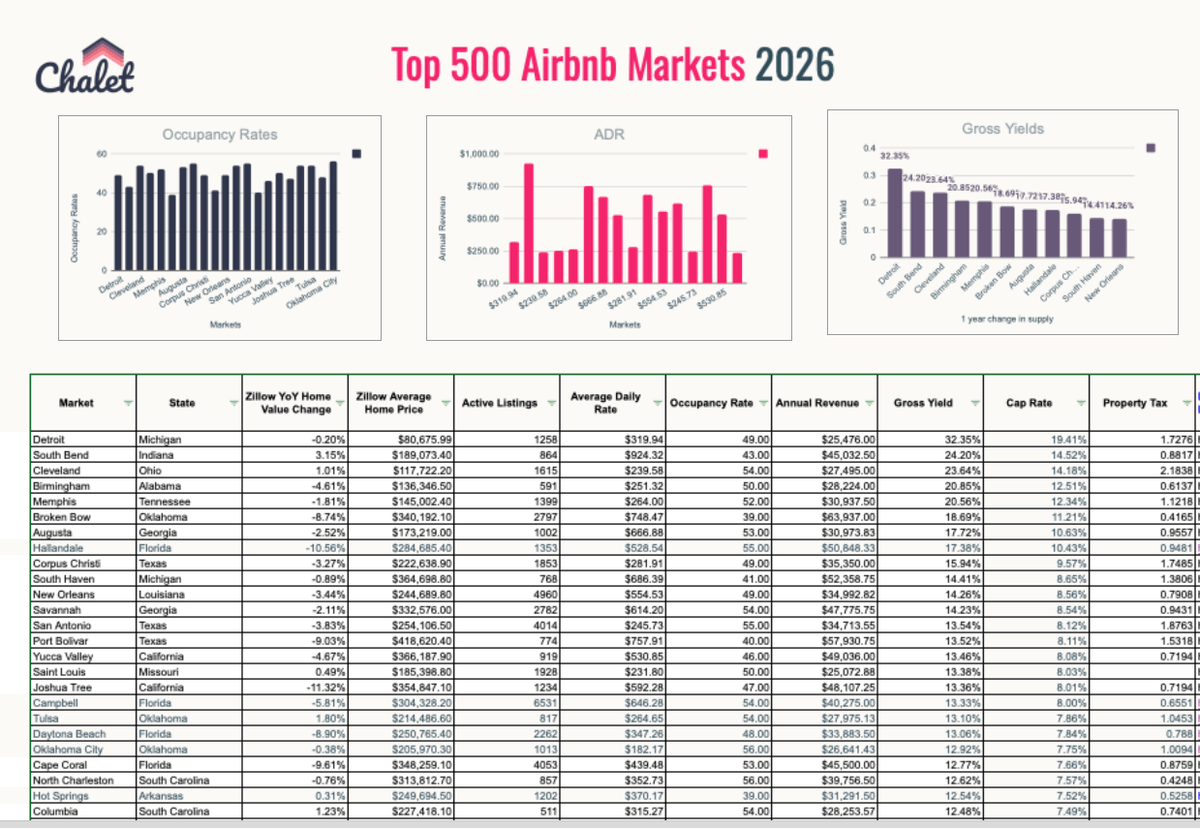
Instantly compare top 500 short-term (Airbnb) rental markets in the US
Markets Losing Steam in 2025
Not all markets shined in 2025. In fact, some locations that were yesterday’s darlings saw cooling interest amid regulatory crackdowns or oversaturation concerns. Smart investors took note of red flags in these areas and in many cases reallocated their focus. Here’s where we saw momentum slow:
Strict Regulations = Investor Deterrence
If 2025 taught STR investors anything, it’s that regulation can make or break a market. A stark example is New York City. Once an Airbnb haven, NYC implemented stringent rules (like its 2023 registration law) that effectively eliminated most short-term rentals. The impact on investor interest was immediate: New York didn’t even rank in the top 50 markets by searches on Chalet. In fact, NYC represented barely 0.18% of all searches. Investors got the memo – the Big Apple is essentially off-limits for STR, so capital flowed elsewhere.
The same story played out in other high-regulation urban centers. Los Angeles, San Francisco, and Boston all have restrictive STR ordinances and saw relatively paltry search interest as a result. For instance, Los Angeles accounted for only 38 searches out of thousands. Many investors explicitly filtered these cities out of their analyses, deciding the legal hurdles and license caps weren’t worth the headache. Even some smaller cities made the “no-go” list due to regulations (e.g., Santa Monica, CA or Cambridge, MA – known for strict rules – barely registered any investor activity on our platform).
Beyond city laws, certain entire regions signaled red flags. Hawaii’s Big Island, for example, boasts incredible rental returns on paper, but new permit caps made it nearly impossible for newcomers to break in – by late 2025 investor chatter about Hawaii had noticeably cooled.
The takeaway: Investors are much savvier now about regulatory risk. Many 2025 buyers actively sought “landlord-friendly” markets (hence the popularity of places in Florida, Texas, Arizona, etc. with state-level support for STRs). Conversely, heavily regulated markets saw an exodus of interest. Going into 2026, this trend will only intensify, always check the local laws before falling in love with a market’s numbers. If the city council is hostile to STRs, think twice, because a great cap rate means nothing if you can’t legally rent the place.
2026 Outlook: What’s Ahead for STR Investors
With 2025’s lessons in mind, what should investors expect (and plan for) in 2026? The short answer: a year of opportunity tempered by selectivity. The STR sector is maturing. Simply buying anywhere and expecting easy profits is yesterday’s playbook. In 2026, success will favor those who understand the evolving landscape, and leverage the right tools to navigate it.
Here are some key elements of the 2026 outlook:
Continued Migration to High-Demand, Low-Drama Markets
Investors will likely double down on markets that offer strong guest demand without the drama of hostile regulations or oversupply. Expect the Sun Belt momentum to continue. States with growing populations and tourism (Florida, Texas, Arizona, the Carolinas) should see sustained or even increased investor interest. These areas benefit from macro trends (people moving South and West, preference for warm climates) that aren’t slowing down.
Drive-to vacation markets should also remain attractive, but with a caveat: investors will be choosier within these categories. For example, instead of buying yet another generic cabin in Gatlinburg, one might target an up-and-coming mountain lake town with less competition. Instead of the most crowded beach towns, look at secondary coastal markets nearby. The name of the game is finding pockets of opportunity adjacent to the well-trodden paths.
Additionally, watch for regulatory shifts in 2026. Some cities that cracked down hard (like New Orleans) might ease rules if tourism suffers, opening a window for brave investors. Other places might tighten laws, so vigilance is key. Overall, the “safe bets” will be markets and regions with a track record of tourism and a political climate favorable to STRs (for instance, many counties in Florida are actually enacting clearer guidelines to welcome rentals, learning from others’ mistakes).
Faster Deals and Smarter Analysis
One striking behavior in late 2024 and 2025 was how quickly some investors went from analysis to action. The phrase “search-to-close momentum” sums it up: those who found a good deal moved fast to make offers, a response to competitive conditions. In popular markets, we saw many instances of multiple investors eyeing the same property via Chalet’s address searches, for example, a unique listing in Georgia had over 15 different users analyze it, far above average. When a truly attractive deal hits the market in 2026, expect it to get snapped up in days, not weeks.
This means having your financing ready and your criteria clear heading into 2026. It also means leveraging tech for smarter analysis. Chalet’s platform usage spiked in 2025, with investors running more pro formas and scenario analyses than ever. We anticipate data-savvy investing will only grow. Cap rate calculators, dynamic pricing forecasts, and market comps – these are no longer “nice to have,” they’re essential parts of an investor’s toolkit. The goal is to recognize a great deal (or a red flag) faster than the next person.
Enter the AI Copilot: Investing in 2026 and Beyond
One of the most exciting developments for 2026 is how artificial intelligence will turbocharge real estate investing. At Chalet, we’re introducing AI Copilot – an intelligent assistant designed to help investors and agents work smarter. What is it? Think of it as your round-the-clock analyst and concierge. It can answer complex questions about a market or property, perform instant rent comps and yield calculations, and even draft property listings or emails. All tailored to your needs, in plain language, 24/7.
Why does it matter? Because the STR landscape moves quickly, and information is power. If you can ask something like, “What’s the seasonality-adjusted occupancy for 3-bed cabins in Blue Ridge, GA, and how does it compare to Pigeon Forge?” and get a credible answer in seconds, that’s a game changer. AI Copilot will help investors spot trends and troubleshoot challenges in real time, whether it’s analyzing how a new regulation might impact revenues or suggesting improvements to your listing description to maximize bookings. It’s like having a personal data scientist and STR mentor by your side.
And when is it coming? Early 2026. Chalet’s AI Copilot is currently in development and it’s slated for a beta release soon. Investors should keep an eye out, we’ll announce a firm launch date and how to access it. We truly believe that those who embrace tools like this will have an edge. Imagine being able to run forecasts, draft a business plan, or get local ordinance summaries just by chatting with your Copilot. That frees you up to focus on decision-making and strategy, while the AI handles the heavy data lifting and even some tedious tasks.
Why AI matters: The AI Copilot is part of a broader trend in 2026, the blending of tech with real estate investing. From smart pricing algorithms to automated market alerts, the investors who leverage technology will outmaneuver those who rely on gut alone. Chalet’s AI Copilot is our answer to help level the playing field, especially for independent investors who don’t have a full team of analysts behind them.
Key Takeaways for Investors Heading into 2026
To wrap up, here are the top takeaways STR investors should carry into the new year:
- Double down on proven markets: Florida, Texas and California remain engines of investor interest. The Sunshine State and Lone Star State, together with California accounted for about one-third of all search activity, and their top cities appear throughout the inquiry and deal rankings. Investors looking for the best odds may focus here, especially in cities like Austin, Dallas, Orlando, Kissimmee, San Diefo and Ft. Lauderdale which showed both high interest and multiple closings
- Monitor rising markets early: High search engagement can signal the next big opportunity. Sevierville and Gatlinburg, TN led in queries per property despite limited deals in 2025. Early movers in such markets could capture value before competition catches up. Other growing areas – e.g. historic vacation spots or newly popular mountain lakes – merit watchful eye if chalet data show rising interest in late 2025.
- Balance interest with conversion: Not all popular markets pay off equally. As 2025 showed, a market like Orlando saw heavy inquiries but relatively few closings, while Austin converted more efficiently. In 2026, savvy investors should consider both how much demand a market is drawing and how many deals have actually closed. Cities with high conversion (like Austin, San Diego, Kissimmee) may indicate smoother buying conditions or better pricing relative to demand.
- Stay agile as conditions change: Macro factors (interest rates, regulation, travel trends) will continue to shift. The 2025 data suggest that flexibility is key – maintaining a watch list of both “safe” big markets and smaller, high-engagement markets. Tracking Chalet’s ongoing analytics (search volume, inquiries, yields) can help investors pivot quickly if a previously overlooked market (like some Tennessee or Carolinas resort towns) starts heating up.
- Leverage Data and AI: Give yourself an edge by using the latest tech. Whether it’s Chalet’s analytics dashboard or the upcoming AI Copilot, make data-driven decisions your norm. Automate what you can – from calculating returns to crafting that perfect listing blurb – so you can focus on high-level strategy.
In summary, the 2025 trends highlight a funnel from broad interest to selective purchasing. Investors who follow these signals, leaning into markets with proven demand but also scouting the high-engagement up-and-comers, will be best positioned for success in 2026.
By learning from the past year and embracing an informed, proactive approach, you’ll be well positioned to seize the opportunities 2026 has in store. Happy investing, and here’s to your STR success in the New Year!