




This guide covers the City of San Diego only. Neighboring markets have separate STR rules and are often confused with San Diego:
- Chula Vista: Separate city with its own STR ordinance and enforcement.
- Carlsbad: Distinct city north of San Diego, with different permit caps and zoning.
- Oceanside: North coastal city with its own STR licensing and enforcement.
- La Jolla: Most of La Jolla is within San Diego city limits, but some unincorporated pockets fall under county rules.
- Mission Beach: A neighborhood within San Diego city, but often discussed separately due to unique STR density and history.
Legality Verdict
Short-term rentals are legal in San Diego with a binding city license, a strict 1% cap on non-primary whole-home permits, and aggressive enforcement. The regulatory climate is stable, but compliance is non-optional and platform monitoring is active.
- Legality Status: 4/5
- License Availability: 2/5
- Compliance Cost (% revenue): 3/5
- Regulatory Stability: 4/5
- Enforcement Climate: 2/5
TL;DR
San Diego defines STRs as rentals under 31 nights and requires a Short-Term Residential Occupancy (STRO) license for all operators. The city imposes a 13.75% maximum TOT (lodging tax), with a hard cap on non-primary whole-home licenses (1% of housing stock). Enforcement is aggressive, with $1,000/day fines and platform data-matching. The single biggest gotcha: Tier 3 (whole-home, non-primary) licenses are capped and often waitlisted.
Quick Facts
| Item | Detail |
|---|---|
| STR Definition | Rental of a dwelling unit for fewer than 31 consecutive nights City of San Diego |
| Registration Required | Yes — STRO license required for all STRs City of San Diego |
| Permit Cost | [needs verification — no primary source found] |
| Annual Renewal | [needs verification — no primary source found] |
| License Cap | Yes — Tier 3 (whole-home, non-primary residence) capped at ~1% of city housing stock West Coast Homestays |
| Permitted Zones | All residential zones; STRO ordinance applies citywide City of San Diego |
| Prohibited Zones | None specified; subject to HOA/condo restrictions City of San Diego |
| HOA/Condo Override | Not codified — HOAs may prohibit STRs even if city license is issued West Coast Homestays |
| Local Contact Requirement | Yes — 24/7 local contact required San Diego Union-Tribune |
| Inspection Requirement | Not codified — must comply with health and safety codes Steadily |
| Occupancy Cap | [needs verification — no primary source found] |
| Parking Requirement | [needs verification — no primary source found] |
| Primary Residence Rule | Yes — applies to Tier 1/2; Tier 3 (whole-home, non-primary) is capped City of San Diego |
| Transferability | Not transferable — new owner must apply Guestable |
| Enforcement Penalties | $1,000/day for unlicensed operation; permanent disqualification possible San Diego Lineup |
| State Sales Tax | Not generally applied to STRs in San Diego GoWithSurge |
| State Accommodations Tax | None Avalara |
| Local Accommodations Tax | Transient Occupancy Tax (TOT): 11.75%, 12.75%, or 13.75% depending on zone Inside San Diego |
| County/District Tax | None within city limits San Diego County Treasurer-Tax Collector |
| Total Effective Lodging Tax | 11.75%–13.75% (TOT only) Inside San Diego |
| Last Updated | 2026-05-21 |
Regulatory Impact Snapshot
San Diego’s STR regime is defined by a four-tier license system, a strict 1% cap on non-primary whole-home permits, and a citywide Transient Occupancy Tax (TOT) of up to 13.75%. Underwriters should model compliance costs at 13.8% of gross revenue, with median San Diego, CA STRs earning $50,988 at an average daily rate of $245 and 55% occupancy. The binding constraint is the Tier 3 license cap, which limits non-primary whole-home STRs and often results in a waitlist. Enforcement is aggressive, with automated platform data-matching and $1,000/day fines for violations. Run this market in our Airbnb Calculator →
Top 500 US Airbnb Rental Markets - 2026
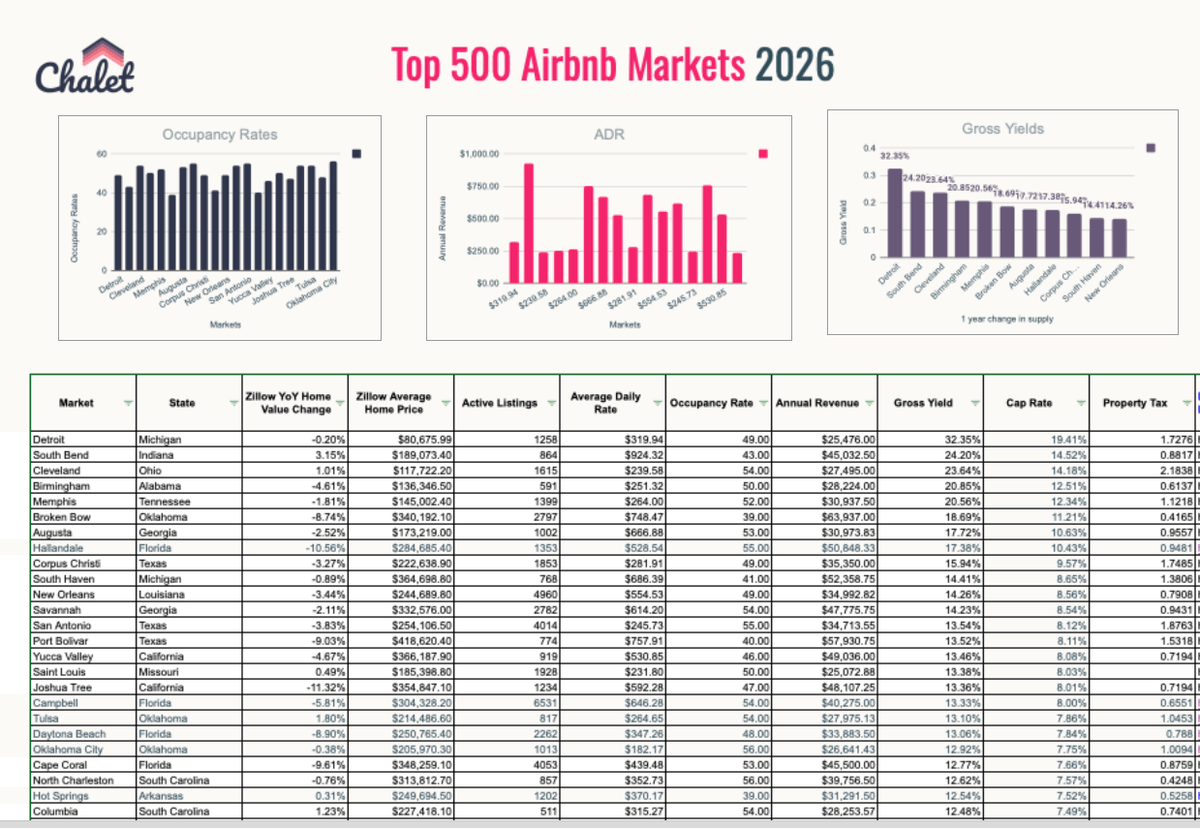
Instantly compare top 500 short-term (Airbnb) rental markets in the US
Frequently Asked Questions
Basics
What is considered a short-term rental in San Diego?
A short-term rental is any dwelling unit rented for fewer than 31 consecutive nights City of San Diego.
Are STRs legal in San Diego?
Yes, STRs are legal with a valid STRO license and compliance with city rules City of San Diego.
Does the city allow whole-home STRs?
Yes, but only under Tier 3, which is capped at about 1% of the city’s housing stock West Coast Homestays.
Licensing
Is a license required for all STRs?
Yes, all STRs require a Short-Term Residential Occupancy (STRO) license City of San Diego.
How many licenses can one person hold?
A host may only hold one STRO license at a time and may not operate more than one STR unit in the city City of San Diego.
Are licenses transferable if I sell my property?
No, STRO licenses are not transferable; new owners must apply Guestable.
What is the cost to apply or renew a license?
[needs verification — no primary source found]
Taxes
What taxes apply to STRs in San Diego?
The Transient Occupancy Tax (TOT) applies at 11.75%, 12.75%, or 13.75% depending on location Inside San Diego.
Is there a state accommodations tax?
No, California does not impose a state-level accommodations tax Avalara.
Does state sales tax apply to STRs?
Generally, state sales tax does not apply to STRs in San Diego GoWithSurge.
Do I need a separate tax certificate?
Yes, hosts must obtain a TOT Certificate from the City Treasurer City of San Diego.
Operations
Are there occupancy or parking limits for STRs?
[needs verification — no primary source found]
Is a local contact required?
Yes, a 24/7 local contact must be available to respond to complaints San Diego Union-Tribune.
Do HOA or condo rules override city STR rules?
Yes, HOAs may prohibit STRs even if the city issues a license West Coast Homestays.
Are health and safety requirements enforced?
Yes, STRs must comply with health and safety codes, including smoke and CO detectors Steadily.
Enforcement
What are the penalties for unlicensed STR operation?
Fines start at $1,000 per day and can include permanent disqualification San Diego Lineup.
How does the city enforce STR rules?
San Diego uses automated platform data-sharing, complaint-driven investigations, and matches listings to its license database San Diego Lineup.
Who handles enforcement?
The Building and Land Use Enforcement (BLUE) team investigates complaints and enforces the STRO ordinance City of San Diego.
Are there any new taxes or moratoriums for 2026?
No new taxes or moratoriums have been enacted for 2026; a proposed $8,000 tax was rejected inewsource.
Permit Process
San Diego requires all short-term rental operators to obtain a Short-Term Residential Occupancy (STRO) license before accepting bookings for stays under 31 nights. The application is managed by the City Treasurer’s Office, and the process includes selecting the appropriate license tier based on whether the property is a primary residence and the number of nights rented annually. Only one license may be held per person, and each property must display its license number in all listings. Tier 3 (whole-home, non-primary residence) licenses are capped at approximately 1% of the city’s housing stock, and this cap is often reached, resulting in a waitlist. Licenses are not transferable upon sale, and renewal requirements are set by the city. Fines for unlicensed operation are substantial, and compliance is strictly enforced City of San Diego.
Zoning
San Diego’s STRO ordinance applies to all residential zones, regardless of underlying zoning designation. There are no citywide prohibited zones for STRs, but homeowners’ associations and condo boards may impose their own restrictions, which the city does not override. The ordinance defines home sharing as STR activity in a host’s primary residence or a separate unit on the same premises, including duplexes and eligible accessory dwelling units, provided the host resides on site. The city does not separately codify minimum night stays, occupancy caps, or parking requirements in the available primary sources, so defaults or HOA rules may apply. All STR units must comply with health and safety codes, including smoke detectors, carbon monoxide detectors, and fire extinguishers City of San Diego.
Taxes and Remittance
San Diego imposes a Transient Occupancy Tax (TOT) on all short-term rentals for stays under 30 days, with rates of 11.75%, 12.75%, or 13.75% depending on proximity to the Convention Center. There are no additional city, county, or state accommodations taxes, and state sales tax generally does not apply to STRs in San Diego. Hosts must obtain a TOT Certificate from the City Treasurer and are responsible for remitting TOT unless using a platform like Airbnb, which collects and remits TOT automatically. For direct bookings or platforms that do not remit, hosts must handle tax collection and payment themselves. No separate California Department of Revenue license is required for STRs Inside San Diego.
Enforcement and Recent Actions
San Diego’s enforcement of STR regulations is aggressive and data-driven. The Building and Land Use Enforcement (BLUE) team investigates complaints and uses automated data-sharing agreements with platforms like Airbnb and VRBO to match listings against the city’s licensing database. Unlicensed operators face fines starting at $1,000 per day, with repeat violations potentially resulting in permanent disqualification from future licensing. As of January 2026, California Senate Bill 346 empowers the city to require platforms to share host and listing data, with platforms facing fines up to $10,000 per day for noncompliance. The city also requires platforms to remove unlicensed listings promptly. No new taxes or moratoriums have been enacted for 2026, and the current enforcement posture is among the strictest in California San Diego Lineup.
Recent Changes and Pending Legislation
The most significant recent change is the implementation of California Senate Bill 346, effective January 1, 2026, which mandates platform data-sharing and TOT remittance but does not preempt local STR ordinances. In January 2026, the San Diego City Council rejected a proposed $8,000 annual tax on vacant second homes and full-time vacation rentals, so no such tax is in effect. No major regulatory overhaul or new STR ordinance has been announced for 2026; the existing STRO framework remains in force. The city’s approach is stable, but underwriters should monitor for any future amendments or changes to the license cap, enforcement mechanisms, or tax rates inewsource.
Comparable Markets
- Carlsbad, CA: Consider if you want a North County market with different STR caps and zoning.
- Oceanside, CA: Consider for a coastal city with its own licensing and enforcement.
- Chula Vista, CA: Consider for a separate city with distinct STR rules and enforcement.
- Los Angeles, CA: Consider for a major metro with a different STR regulatory landscape.
Sources
- City of San Diego Official Website: https://www.sandiego.gov/treasurer/short-term-residential-occupancy
- City of San Diego Official Website TOT: https://www.sandiego.gov/treasurer/taxesfees/tot
- City of San Diego Office of the City Treasurer (STRO FAQ): https://www.sandiego.gov/sites/default/files/trs_stro_faq_feb2022.pdf
- Inside San Diego (City of San Diego): https://www.insidesandiego.org/hotel-room-tax-increase-starting-may-1
- San Diego Union-Tribune: https://www.sandiegouniontribune.com/2023/07/02/san-diego-short-term-rental-rules-how-to-complain-maps-and-more/
- San Diego Lineup: https://sandiegolineup.com/roster/neighborhood-guides/short-term-rental-crackdown-mission-beach-pacific-beach-sb-346-2026
- San Diego County Treasurer-Tax Collector: https://www.sdttc.com/content/ttc/en/tax-collection/transient-occupancy-tax.html
- Guestable: https://www.guestable.com/blog/shot-term-rental-regulations-san-diego/
- West Coast Homestays: https://www.westcoasthomestays.com/post/a-property-owner-s-guide-to-san-diego-short-term-rental-laws
- Steadily: https://www.steadily.com/blog/airbnb-short-term-rental-laws-regulations-san-diego
- Airbnb Help Center: https://www.airbnb.com/help/article/2297
- Avalara MyLodgeTax: https://www.avalara.com/mylodgetax/en/resources/vacation-rental-tax-guides/california.html
- GoWithSurge: https://www.gowithsurge.com/blog/california-str-tax
- inewsource: https://inewsource.org/2026/01/28/san-diego-vacation-home-tax-proposal-housing-affordability-crisis/
- Stay Classy Homes: https://www.stayclassyhomes.com/blogs/news/san-diego-short-term-rental-regulations-updated-for-2026
- PermitByState.com: https://www.permitbystate.com/short-term-rental-rules-california
- Penny Realty: https://www.pennyrealty.com/blog/san-diego-short-term-rental-ordinances-how-to-stay-compliant-in-2026
This page is research, not legal advice. Consult local counsel before acquiring or operating a short-term rental in City of San Diego (municipal code); California state law.
Ready to evaluate San Diego as an STR market?
- See San Diego revenue data → — Get up-to-date STR performance and occupancy trends.
- Run this deal in our calculator → — Model cash flow and compliance costs for any San Diego property.
- Match with a San Diego STR agent → — Connect with local experts for on-the-ground guidance.