




This guide covers Seattle, Washington only. Neighboring markets have separate STR rules and are often confused with Seattle:
- Bellevue: STRs are generally not allowed in single-family zones; stricter than Seattle.
- Shoreline: Has its own STR ordinance; requirements differ from Seattle.
- Renton: Separate licensing and zoning rules for STRs.
- SeaTac: Distinct STR regulations, especially near the airport.
Legality Verdict
Short-term rentals are legal in Seattle with a strict licensing regime, a two-unit cap, and robust enforcement. The city’s primary residency rule and high tax stack are binding constraints for investors.
- Legality Status: 4/5
- License Availability: 4/5
- Compliance Cost (% revenue): 2/5
- Regulatory Stability: 3/5
- Enforcement Climate: 2/5
TL;DR
Seattle defines STRs as rentals under 30 nights and requires a Short-Term Rental Operator License ($75/year per unit). The total tax burden is 16.6% of gross revenue. Most hosts are limited to two units, one being their primary residence. Enforcement is proactive, with fines and platform delisting for noncompliance. The biggest gotcha: strict owner-occupancy and software-driven enforcement make noncompliance highly risky.
Quick Facts
| Item | Detail |
|---|---|
| STR Definition | Dwelling unit rented for less than 30 consecutive nights (Checkmate Rentals) |
| Registration Required | Yes, Short-Term Rental Operator License (City of Seattle) |
| Permit Cost | $75 per unit, annually (Seattle Services Portal) |
| Annual Renewal | Yes, every 12 months (City of Seattle) |
| State Sales Tax | 6.5% (WA Dept. of Revenue) |
| Special Hotel/Motel Tax | 2.0% (WA Dept. of Revenue) |
| Convention & Trade Center Tax | 7.0% (WA Dept. of Revenue) |
| Tourism Promotion Area Charge | $2.00 per room per night (WA Dept. of Revenue) |
| Total Effective Lodging Tax | 10.1% (excludes state sales tax; includes local lodging taxes) (WA Dept. of Revenue) |
| Total Tax Burden (all taxes) | 16.6% (Recreation Stays) |
| License Cap | Yes, 2 units per operator (Seattle Services Portal) |
| Primary Residence Rule | Yes, must live in one unit at least 270 days/year (Checkmate Rentals) |
| Transferability | Not transferable; new owner must reapply (Seattle Services Portal) |
| Inspection Requirement | Secondary units must register with RRIO (Seattle Services Portal) |
| Occupancy Cap | Not codified — no specific city rule (SDCI) |
| Parking Requirement | Not codified — no specific city rule (SDCI) |
| Density Limit | Not codified — no specific city rule (SDCI) |
| HOA/Condo Override | Not codified — private covenants may apply (SDCI) |
| Local Contact Requirement | Not codified — no specific city rule (SDCI) |
| Enforcement Penalties | $500 first violation, $1,000 subsequent; $150–$500/day for ongoing violations (Truvi, Recreation Stays) |
| Prohibited Zones | Live-work units, caretaker’s quarters, houseboats, waterfront, Shoreline Code areas (City of Seattle) |
| Primary Regulator | Department of Finance and Administrative Services (FAS), (206) 386-1267 (City of Seattle) |
| Last Updated | 2026-05-22 |
Regulatory Impact Snapshot
Seattle’s STR regime is defined by a two-unit cap, a strict primary residency rule, and a high tax stack. Permit and renewal fees are modest at $75 per unit, but the 16.6% total tax burden (including state sales tax and local lodging taxes) is among the highest in the U.S. Enforcement is proactive, with software cross-checks and platform delisting for unlicensed units. Underwriters should model compliance costs at 16.8% of gross revenue, with median Seattle STRs earning $30,350 at an average daily rate of $172 and 50% occupancy. The binding constraint is the owner-occupancy rule and two-unit limit. Run this market in our Airbnb Calculator →
Top 500 US Airbnb Rental Markets - 2026
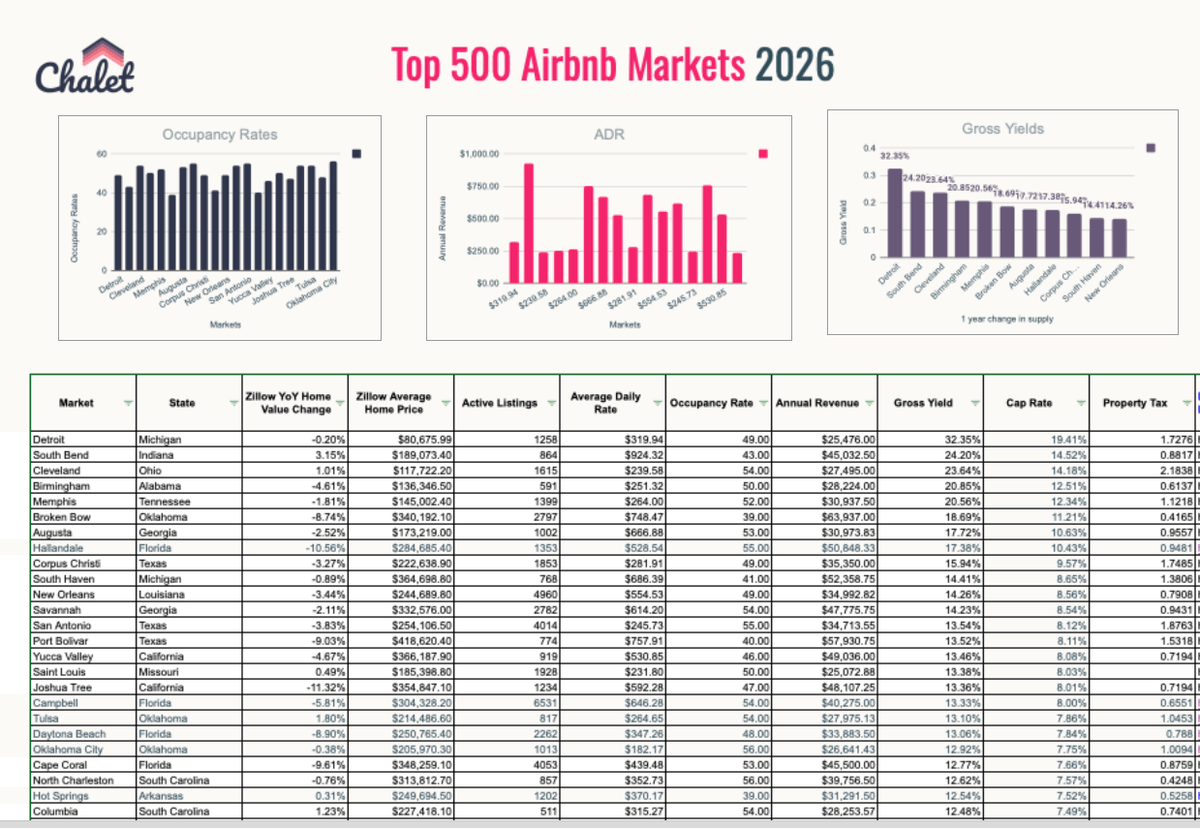
Instantly compare top 500 short-term (Airbnb) rental markets in the US
Frequently Asked Questions
Basics
What is considered a short-term rental in Seattle?
A short-term rental is any dwelling unit rented for less than 30 consecutive nights (Checkmate Rentals).
Are short-term rentals legal in Seattle?
Yes, STRs are legal with a city-issued license and compliance with local rules (City of Seattle).
Does Seattle have its own STR rules, or do state laws apply?
Seattle has its own municipal code (Chapter 6.600) and STR rules; state law does not preempt local regulation (Seattle Municipal Code).
Licensing
Do I need a license to operate an STR in Seattle?
Yes, a Short-Term Rental Operator License is required for each unit (City of Seattle).
How much does the STR license cost?
The annual fee is $75 per unit (Seattle Services Portal).
Is the license transferable if I sell my property?
No, licenses are not transferable; new owners must apply for their own (Seattle Services Portal).
Is there a cap on the number of STR licenses per host?
Yes, most hosts are limited to two units, one of which must be their primary residence (Seattle Services Portal).
Taxes
What taxes apply to Seattle STRs?
STRs are subject to 6.5% state sales tax, 2% hotel/motel tax, 7% convention tax, and a $2/night TPA charge (WA Dept. of Revenue).
What is the total tax burden for STRs in Seattle?
The total tax burden is approximately 16.6% of gross rental revenue (Recreation Stays).
Do I need a state business license?
Yes, if you gross over $12,000/year or make taxable sales, you must register with the Washington Department of Revenue (WA Dept. of Revenue).
Operations
Is there a minimum night stay requirement?
No, Seattle does not codify a minimum night stay for STRs (SDCI).
Are there occupancy or parking limits for STRs?
No specific city rules on occupancy or parking for STRs (SDCI).
Are there zones where STRs are prohibited?
Yes, STRs are prohibited in live-work units, caretaker’s quarters, houseboats, waterfront, and Shoreline Code areas (City of Seattle).
Do secondary units need special registration?
Yes, secondary STR units must register with the RRIO program (Seattle Services Portal).
Enforcement
What are the penalties for operating without a license?
$500 for the first violation, $1,000 for subsequent violations; $150–$500/day for ongoing code violations (Truvi, Recreation Stays).
How does Seattle enforce STR rules?
Seattle uses software to cross-check listings, issues fines, and works with platforms to delist unlicensed properties (Beenstay).
Are platforms required to report STR activity?
Yes, platforms must submit monthly and quarterly reports on licensed operators and booked nights (Truvi).
Is the owner-occupancy rule enforced?
Yes, violations can result in fines of $600–$1,100 per month (RedAwning).
Permit Process
Seattle requires all STR operators to obtain a Short-Term Rental Operator License, issued by the Department of Finance and Administrative Services (FAS). The annual fee is $75 per unit. Operators must also hold a City of Seattle Business License Tax Certificate, which can be obtained online. Licenses are valid for 12 months and must be renewed annually. Licenses are not transferable; new owners must apply for their own license (City of Seattle).
Secondary units used as STRs must be registered under the Rental Registration and Inspection Ordinance (RRIO) program. The license number must be posted on every listing, including platforms like Airbnb and VRBO (Seattle Services Portal).
Zoning
Seattle prohibits STRs in live-work units, caretaker’s quarters, floating on-water residences, waterfront properties, and areas restricted by the Shoreline Code. Most residential zones permit STRs, but operators must comply with the primary residency rule—living in one unit at least 270 days per year. There is no codified minimum night stay, occupancy cap, parking requirement, or density limit in city code (City of Seattle).
HOA and condo covenants are not regulated by the city, but private restrictions may still apply. Secondary STR units must register with the RRIO program (SDCI).
Taxes and Remittance
Seattle STRs are subject to a 6.5% state sales tax, 2% Special Hotel/Motel Tax, 7% Convention and Trade Center Tax, and a $2 per room per night Tourism Promotion Area charge. The total tax burden is approximately 16.6% of gross revenue. Hosts must register with the Washington Department of Revenue if they gross over $12,000 per year. Airbnb and other platforms collect and remit most taxes automatically (WA Dept. of Revenue).
Enforcement and Recent Actions
Seattle enforces STR rules proactively, using software to cross-check listings with its license database. Fines for operating without a license start at $500 for the first violation and escalate to $1,000 for subsequent violations. Ongoing code violations can result in daily fines of $150–$500. Major platforms cooperate with the city to delist unlicensed properties. Owner-occupancy violations can result in fines of $600–$1,100 per month (Truvi, RedAwning).
Platforms must submit monthly and quarterly reports on licensed operators and booked nights, supporting enforcement efforts (Truvi).
Recent Changes and Pending Legislation
Seattle passed a rent pricing ordinance in 2025 restricting algorithmic pricing for rental units, effective August 1, 2025. No major amendments to the STR ordinance have been reported in 2024–2026, but investors should monitor for updates. The city’s enforcement posture has become stricter, with increased use of software and platform cooperation (Washington Multi-Family Housing Association).
Comparable Markets
- Portland, OR: Consider if you want a West Coast market with a primary residence rule but lower tax stack.
- San Diego, CA: Consider if you want a large city with a capped lottery system and strong enforcement.
- Austin, TX: Consider if you want a tech-driven market with strict zoning and permit quotas.
- Denver, CO: Consider if you want a city with a primary residence rule and moderate compliance costs.
Sources
- City of Seattle – Business Regulations: Short-Term Rentals: https://www.seattle.gov/business-regulations/short-term-rentals
- Seattle Municipal Code Chapter 6.600 – Short-Term Rentals: https://library.municode.com/wa/seattle/codes/municipal_code?nodeId=TIT6BURE_SUBTITLE_IVNELICO_CH6.600SHRMRE
- Seattle Services Portal Help Center: https://seattlegov.zendesk.com/hc/en-us/articles/360033892933-How-do-I-apply-for-a-Short-term-Rental-Operator-s-License
- Rental Registration & Inspection Ordinance – Owners & Managers – SDCI: https://www.seattle.gov/sdci/codes/licensing-and-registration/rental-registration-and-inspection-ordinance/owners-and-managers
- Short-Term Rentals – SDCI: https://www.seattle.gov/sdci/codes/common-code-questions/short-term-rentals
- Washington Department of Revenue (Personal home rentals): https://dor.wa.gov/education/industry-guides/lodging-guide/personal-home-rentals
- Washington Department of Revenue (Lodging Information Rates and Changes): https://dor.wa.gov/sites/default/files/2024-11/Q125_Lodging_flyer.pdf
- HouseHack Seattle – Short-Term Rental Rules in Washington: https://househackseattle.com/blog/washington-state-short-term-rental-rules-what-hosts-need-to-know-in-2024
- Checkmate Rentals – Washington State Short-Term Rental Laws: Seattle & Beyond: https://www.checkmaterentals.com/blog/washington-short-term-rental-laws
- Recreation Stays: https://recreationstays.com/blog/can-i-airbnb-my-house-in-seattle-heres-what-you-need-to-know-and-why-most-hosts-get-it-wrong/
- Recreation Stays (Tax Guide): https://recreationstays.com/blog/how-do-i-deal-with-seattles-short-term-rental-occupancy-taxes-2026-update/
- Airbnb Help Center: https://www.airbnb.com/help/article/2336
- Beenstay: https://www.beenstay.com/blog/washington-vacation-rental-management-laws/
- Truvi: https://truvi.com/blog/seattle-airbnb-laws/
- RedAwning: https://www.redawning.com/pm/post/washington-state-str-regulations-property-managers-2026
- Washington Multi-Family Housing Association: https://www.wmfha.org/news/seattle-passes-rent-pricing-ordinance–what-it-means-for-operators
- Secord Insurance Agency: https://secordagency.com/news/2026/05/washington-vacation-rental-insurance-what-hosts-should-know/
- Guestable: https://www.guestable.com/blog/seattles-business-license-tax-certificate/
This page is research, not legal advice. Consult local counsel before acquiring or operating a short-term rental in City of Seattle, King County, Washington State.
Ready to evaluate Seattle as an STR market?
- See Seattle revenue data → — Get live median revenue, ADR, and occupancy for Seattle STRs.
- Run this deal in our calculator → — Model cash flow and compliance costs for any Seattle property.
- Match with a Seattle STR agent → — Connect with a local expert for on-the-ground guidance.