




Cost segregation for rental property is a savvy tax strategy that lets real estate investors speed up depreciation, freeing up a significant amount of cash in the early years of owning a property. Instead of the slow, standard depreciation of a building over 27.5 years, this method breaks the property down into components with much shorter tax lives.
Unlocking Your Property's Hidden Tax Savings

The best way to think about your rental property isn't as one giant asset. It's actually a collection of many smaller assets, all bundled together. The IRS considers the core structure—the foundation, walls, and roof—to be "real property," which is why it gets stuck with that long 27.5-year depreciation schedule for residential rentals.
But what about everything else? All the other pieces of your property have much shorter lifespans, and that’s exactly where cost segregation for rental property comes into play.
Deconstructing Your Property for Tax Benefits
A cost segregation study is a detailed, engineering-based analysis that essentially disassembles your property on paper. It separates the "bones" of the house from its "skin and systems."
For instance, things like carpeting, kitchen cabinets, and special lighting fixtures can often be reclassified into 5-year or 7-year property. Land improvements outside the building, like fencing, parking lots, and landscaping, can be moved into a 15-year depreciation category.
By accelerating the depreciation on these items, you generate much larger "paper losses" in the early years. These bigger deductions can dramatically reduce your taxable rental income, leading to a smaller tax bill or even letting you defer taxes altogether.
The core idea is simple: Instead of waiting nearly three decades to claim all your depreciation deductions, cost segregation lets you front-load those tax benefits. This puts more cash back in your pocket today.
Why This Matters for Investors
For any serious investor, this strategy is a game-changer. The immediate tax savings directly boost your cash flow, freeing up capital you can put to work elsewhere. For landlords focused on getting the most out of their investments, this fits right in with other essential operational tasks, like those found in a landlords' property inspection checklist.
The benefits of a cost segregation study are clear:
- Increased Cash Flow: A lower tax bill means you keep more of the rent you collect. Plain and simple.
- Capital for Reinvestment: You can use those tax savings to pay down your mortgage, fund property upgrades, or even acquire your next rental property sooner.
- Improved ROI: By pulling your tax benefits forward, you enhance the overall return on your investment right from the start.
Ultimately, cost segregation doesn't create new deductions—it just changes the timing. It gives you access to your money now, when it can have the biggest impact on growing your real estate portfolio.
How Cost Segregation Actually Works
Think of your rental property like a car. From a distance, it’s one big object. But up close, you know it’s made of countless different parts—the engine, tires, seats, stereo system. Each of those components wears out at a different rate. The IRS gets this, and the same logic applies to buildings.
Without cost segregation, the IRS forces you to treat your entire rental property as a single asset, depreciating it over a painfully long 27.5-year period. That’s like saying the engine and the air freshener will both last for exactly 27.5 years. It just doesn’t make sense.
A cost segregation study is like bringing in a financial mechanic to take your property apart piece by piece, at least on paper. This detailed, engineering-based analysis identifies everything that isn't part of the core building structure and reclassifies it into categories with much shorter depreciation timelines. This allows you to front-load your tax deductions and get your money back faster.
Deconstructing the Property for Tax Purposes
At its heart, a cost segregation study is about deconstructing your property’s cost basis and reallocating it. The entire goal is to move as much value as possible out of that slow-moving 27.5-year bucket and into faster ones.
Here’s how a property typically gets broken down:
- 5-Year Property: This is where you find personal property and decorative fixtures. Think carpeting, appliances, cabinetry, and special-purpose lighting. These items have a much shorter useful life than the building itself.
- 7-Year Property: This bucket often includes things like furniture and other fixtures, especially if you’re furnishing the rental.
- 15-Year Property: This category is specifically for land improvements—basically, anything outside the building’s foundation. We’re talking about sidewalks, fences, parking lots, and landscaping.
- 27.5-Year Property: This is the default classification for the structural shell of a residential building. It covers the foundation, walls, roof, plumbing, and core electrical systems.
By shifting costs into these faster lanes, you can generate significant "paper losses" in the early years of owning the property, which directly slashes your taxable income.
From Theory to Tangible Savings
So, what does this actually look like in dollars and cents? The impact is huge. As experts at Kaufman Rossin point out, reclassifying your property's assets accelerates depreciation deductions in a major way. For every $1 million in property cost that gets moved from a 39-year commercial schedule to a 5-year one, the present value of the tax savings can be around $200,000.
A cost segregation study doesn't invent new deductions. It simply changes the timing, letting you claim your tax benefits now when they can make the biggest difference to your cash flow and growth.
Let’s run a simple example. Say you buy a duplex for $600,000 (after subtracting the land value). Without a study, you'd depreciate that entire amount over 27.5 years, which gives you a deduction of roughly $21,818 each year.
But what if a cost segregation study finds that $120,000 of that cost can be reclassified?
- $70,000 in 5-year assets (carpets, appliances, cabinets).
- $50,000 in 15-year assets (driveway, landscaping, fencing).
This strategic reallocation lets you deduct the value of those assets far more quickly, leading to a much larger total deduction in the first few years. That bigger write-off lowers your taxable income and puts thousands of dollars right back in your pocket.
The Real Financial Impact on Your Investments

While the engineering and tax code behind cost segregation can feel a bit dense, its impact on your wallet is beautifully simple. The main benefit is a direct, powerful boost to your cash flow, especially in the first few years after you buy a rental property.
By reclassifying assets and speeding up their depreciation, a cost segregation study lets you generate significant "paper losses" right away. These aren't real financial losses. They're tax deductions that can slash your rental income, often dropping your current tax bill to nearly zero.
Think of it as getting an interest-free loan from the government. You're not erasing your tax obligation forever, but you are strategically pushing a big chunk of it down the road. This powerful concept is known as tax deferral.
The Power of Immediate Capital
Tax deferral gives you immediate access to a pile of cash that would have otherwise gone straight to the IRS. Instead of waiting decades for those savings to trickle in, you get to put that money to work today—when it has the most potential to grow.
This freed-up cash flow opens up a world of possibilities for a savvy real estate investor. You could use these funds to:
- Acquire new properties: Use the tax savings as a down payment on your next rental, letting you scale your portfolio much faster than you thought possible.
- Fund renovations and improvements: Upgrade your existing property to increase its value, attract better tenants, or command higher rent.
- Pay down debt: Chip away at your mortgage faster, building equity and cutting down your long-term interest payments.
- Build a capital reserve: Create a healthy cash cushion for those inevitable surprise repairs, vacancies, or other operational headaches.
The core advantage of cost segregation for rental property isn't just about saving money on taxes—it's about gaining financial agility. It transforms tax liabilities into immediate working capital.
This strategy lets you compound your returns by reinvesting tax savings right back into your business, kicking off a powerful cycle of growth. Rather than letting that capital sit idle with the government, you actively deploy it to build your wealth.
Amplifying Your Savings with Bonus Depreciation
To make this strategy even more potent, investors can pair cost segregation with bonus depreciation. This tax incentive is like a turbocharger, allowing you to deduct a huge percentage—sometimes up to 100%—of the cost of those shorter-lived assets in the very first year.
Imagine your study reclassifies $80,000 worth of assets into a 5-year category. Normally, you’d write that off over five years. With bonus depreciation, you could potentially deduct the entire $80,000 in year one.
This creates an enormous upfront deduction that can wipe out your taxable income and even generate a substantial net operating loss, which can sometimes be used to offset other income. The rules around this incentive do change, so it's critical to know the specifics. You can get a much deeper understanding by learning more about how bonus depreciation works and its current regulations.
Ultimately, combining a cost segregation study with bonus depreciation is one of the most effective ways to maximize your financial returns and supercharge your cash flow from day one. It’s all about being strategic with your tax planning to fuel your investment goals.
Is Your Rental Property a Good Candidate?
While the tax benefits are compelling, a cost segregation study isn't a silver bullet for every rental property owner. It delivers incredible value in the right situations, but it's not a one-size-fits-all solution. You need to know if your specific property is a strong candidate before you dive in.
Think of it like any other strategic investment in your portfolio. You wouldn't sink money into a renovation without making sure the return justifies the cost. The same logic applies here. A few key factors will tell you pretty quickly if your property has what it takes to unlock serious tax savings.
The Litmus Test: Purchase Price
The first and most straightforward filter is your property’s value. Generally speaking, cost segregation works best on properties with a higher cost basis because there’s simply more value to reclassify into those shorter-lived assets.
There’s no official IRS minimum, but a good industry benchmark is a purchase price of $500,000 or more, not including the value of the land.
If your property is below that number, the upfront cost of a detailed, engineering-based study might eat up too much of your immediate tax benefit. But remember, this is a guideline, not a hard rule. A property with a lower purchase price but a very high percentage of personal property and land improvements could still be a fantastic candidate.
Timing Your Strategy for Maximum Impact
When you decide to do a cost segregation study is just as important as the property's value. The right timing can seriously amplify your returns.
Certain moments in a property's lifecycle are prime opportunities:
- New Construction: A brand-new build is the perfect scenario. All the construction costs are fresh and well-documented, which makes it much easier for engineers to accurately tag every dollar to the right asset category from the get-go.
- Recent Acquisitions: If you bought a property in the last few years, you're in a great spot. You can commission a study and capture all that missed depreciation in the current year without needing to amend past tax returns. It's a clean way to maximize your year-one savings.
- Major Renovations or Improvements: Any time you pour significant capital into renovations or additions, you're creating a new pool of assets just waiting to be reclassified. Doing a study after a big project ensures all those new costs are depreciated as fast as the law allows.
The bottom line is this: the ideal time to act is near the beginning of your ownership journey. The earlier you put a cost segregation strategy in place, the more you can accelerate your deductions and pump up your cash flow when it matters most.
How Legislation Opened the Floodgates
The game really changed for cost segregation with the Tax Cuts and Jobs Act (TCJA) of 2017. Before this law, the strategy was often seen as something best suited for new construction. But the TCJA blew the doors open, making it a home run for investors buying existing (used) properties, too.
This change introduced 100% bonus depreciation for both new and used personal property placed in service between late 2017 and 2022. This move supercharged the potential savings from a cost segregation study, allowing a much wider range of real estate investors to get in on the action. You can find more great insights on the impact of the TCJA on cost segregation practices from KBKG, a leader in the space.
Navigating the Cost Segregation Study
So, you’ve decided cost segregation might be a great fit for your rental property. The next logical question is: what’s actually involved? Far from being some mysterious black box, a professional cost segregation study is a structured, engineering-based process built for accuracy and IRS compliance. Knowing the stages demystifies the whole thing and sets clear expectations from the start.
It all kicks off with a simple, no-strings-attached first step. A qualified firm will run a preliminary analysis to give you a ballpark estimate of the tax benefits for your specific property. This initial look confirms that the financial upside is worth the cost of the study, giving you a clear green light before you commit.
The Phased Approach to a Study
A proper cost segregation study isn't a one-and-done task. It unfolds in several distinct phases, with each one building on the last to create a detailed, defensible report. As the property owner, your heaviest lift is right at the beginning—mostly just providing the necessary paperwork.
To give you a clear picture, here's how a typical study breaks down.
The table below outlines the typical journey, showing what the experts handle and where you'll need to chime in.
| Phase | Key Activities | Property Owner's Role |
|---|---|---|
| 1. Preliminary Analysis & Engagement | The firm estimates potential tax savings and confirms the study is worthwhile. You sign an engagement letter to proceed. | Provide basic property details (purchase price, date, address). Review and sign the engagement letter. |
| 2. Document Gathering | The study team collects all relevant documents to build a complete picture of the property's cost basis. | Provide documents like the purchase agreement, appraisal, surveys, blueprints, and renovation invoices. |
| 3. Site Inspection & Asset ID | An engineer or specialist visits the property to physically inspect, measure, and photograph all its components. | Provide access to the property for the on-site inspection. |
| 4. Cost Allocation & Analysis | The engineering team uses IRS-approved methods to assign costs to each component, separating short-life assets from the building's structure. | Minimal involvement; be available to answer any follow-up questions about the property. |
| 5. Report Generation & Delivery | The firm compiles a comprehensive report detailing the methodology, reclassified assets, and new depreciation schedules. | Review the final report and share it with your CPA for tax filing. |
This systematic approach ensures every detail is accounted for, creating an audit-proof final product that stands up to IRS scrutiny.
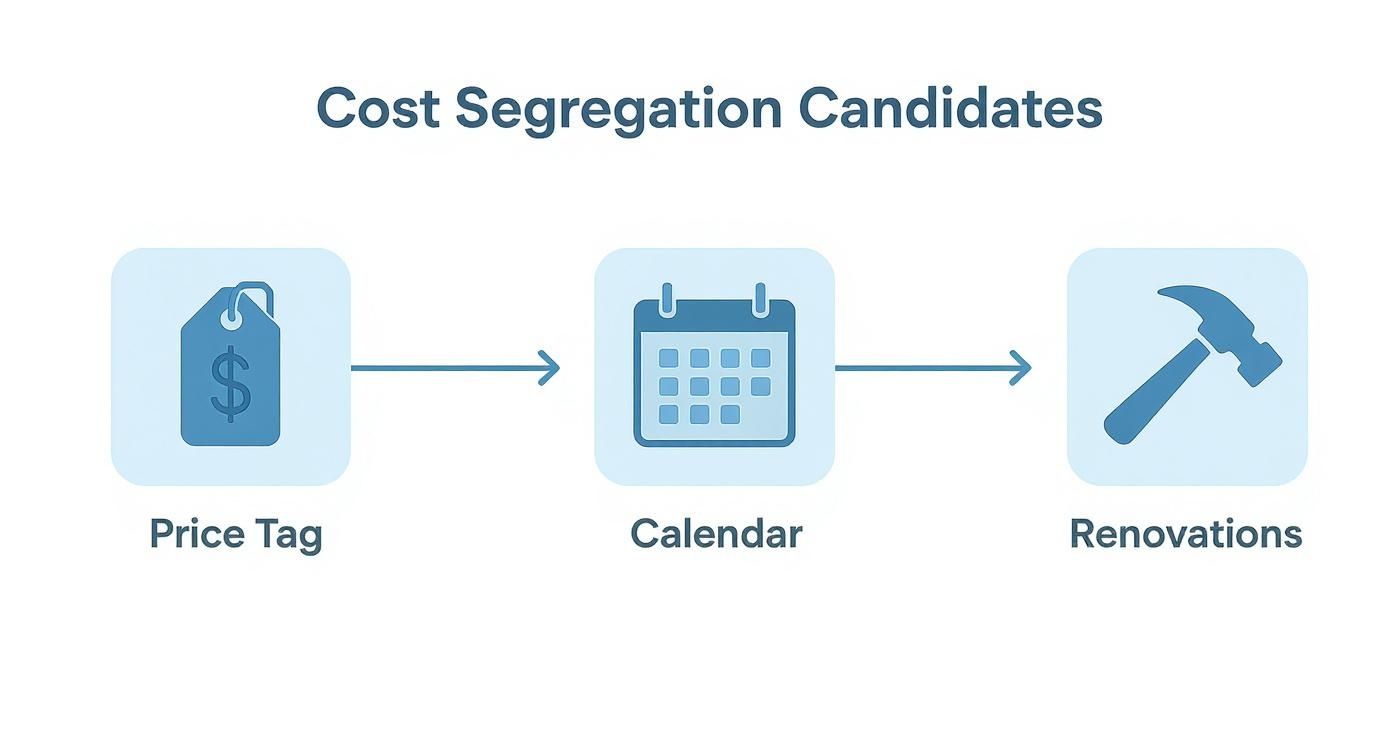
As the graphic shows, properties with a high purchase price, a recent acquisition date, or significant recent renovations are almost always prime candidates for a study.
What to Expect From Your Provider
A reputable firm will walk you through each stage, making the process feel completely transparent and manageable. They should clearly explain their findings and deliver a report that's ready for anything, including an IRS audit.
The goal of a high-quality study is not just to find tax savings but to deliver a meticulously documented and legally sound report that provides complete peace of mind. A quality provider stands behind their work, often including audit support as part of their service.
It’s also worth remembering that you don’t have to do a study in the year you buy the property. If you've owned a rental for several years already, you can still cash in on the benefits. This is done through a look-back cost segregation study, which lets you "catch up" on all the depreciation you missed in prior years without having to amend old tax returns. It's an incredibly powerful tool for investors at any point in their journey.
How to Choose a Qualified Provider
The entire success of your cost segregation strategy comes down to one thing: the quality of the study itself. Picking a provider isn't just checking a box; it's the single most important step to protect your investment and make sure your tax savings can withstand IRS scrutiny. A cheap, flimsy study is a huge risk, so finding the right partner is everything.
Think of it like this: a cost segregation study is you building a legal case for the IRS. To make it airtight, you need a team with deep expertise in both engineering and tax law. A simple breakdown from an accountant won't cut it. The best firms have engineers, architects, and tax specialists who can meticulously document and justify every single reclassification.
Key Criteria for Vetting Providers
When you're looking at different firms, you have to look past the price tag. Focus on the substance of their work. A detailed, well-defended study from a reputable provider gives you a level of peace of mind that a quick, cheap analysis just can't offer.
Here are the essential questions you need to ask any potential provider:
- What is their methodology? Make sure they perform an engineering-based study. This is the most detailed and is the gold standard for the IRS. Our guide on how to choose the right cost segregation methodology dives deeper into why this matters so much.
- Do they have experience with similar rental properties? A firm that mostly handles massive commercial buildings might miss the specific details of a residential fourplex. You want someone who knows your exact property type.
- Who is doing the site visit? A qualified engineer or construction professional must physically inspect your property. A study based only on photos or blueprints is a major red flag.
- Do they offer audit support? This is non-negotiable. A top-tier provider will stand by their work and defend their report if the IRS comes knocking, often at no extra charge.
A quality cost segregation report is your insurance policy. The provider’s willingness to defend their work is a direct reflection of their confidence in its accuracy and compliance.
Balancing Cost and Quality
Fortunately, the cost of a cost segregation for rental property study is no longer out of reach for most investors. In the past, a full engineering study could easily run from $5,000 to $20,000, making it a tool reserved for much larger commercial properties. But the game has changed.
The rise of specialized software and platforms has opened this strategy up to a much wider audience. For instance, some companies now offer DIY and automated studies for smaller single-family and multi-family rentals for a fraction of the old price—sometimes under $500. You can learn more about these accessible cost segregation options and how they deliver accurate, audit-protected results in minutes. This evolution means you can now find a solution that perfectly balances cost with the quality and peace of mind you need.
Common Questions About Cost Segregation
Even after seeing the numbers, it’s natural to have a few lingering questions before pulling the trigger on a cost segregation study. It's a big move, and you want to be sure you've covered all your bases.
We get it. That's why we’ve rounded up some of the most common questions investors ask. Think of this as the final gut-check before you unlock some serious tax savings.
Is It Too Late to Start?
This is easily the most frequent question we hear: "I've owned my rental for years—did I miss the boat?"
The answer is a hard no. It is almost never too late to take advantage of a cost segregation for rental property study. The IRS allows you to perform what’s called a “look-back” study.
This lets you catch up on all the accelerated depreciation you missed out on in previous years. And the best part? You don't have to go back and amend a pile of old tax returns. You can claim all those missed deductions from prior years on your current year's tax return by filing a Form 3115, "Application for Change in Accounting Method." This can create a massive one-time deduction that slashes your tax bill for the year you do the study.
What Happens When I Sell the Property?
Okay, this is the other big one. What happens to all those juicy tax benefits when you decide to sell? This is where a little concept called depreciation recapture enters the chat.
When you sell, the IRS "recaptures" the depreciation you claimed over the years by taxing it as ordinary income. So, you do have to pay it back. But here's the key: you benefited from the time value of money. You got huge tax savings upfront, freeing up cash that you could reinvest to buy more properties or grow your portfolio.
Deferring a tax payment for years while that money is out there working for you is almost always a winning strategy. The returns you can generate with that deferred tax cash often blow the eventual recapture tax out of the water. For a deeper dive, check out this extensive guide covering frequently asked questions about cost segregation for rental property.
Depreciation recapture means you eventually pay tax on the benefits you claimed. But a dollar saved today is far more valuable than a dollar paid in taxes a decade from now.
What Are the Potential Risks?
The main risk with cost segregation isn't the strategy itself—it's the quality of the study. A cheap, rushed, or poorly documented study is a huge red flag for the IRS and can put a target on your back for an audit.
This is exactly why you can't cut corners. You need a reputable provider who conducts a detailed, engineering-based study.
A solid, defensible report should always include:
- A detailed methodology explaining how every dollar was allocated.
- Photos and documentation from an actual on-site inspection.
- Clear, logical justification for every single asset reclassification.
By investing in a thorough, compliant study, you're essentially buying peace of mind. You mitigate the risk and ensure your tax savings are built on a foundation that can stand up to scrutiny.
Ready to analyze your next rental property investment with confidence? At Chalet, we provide the data-driven tools and expert connections you need to make smarter decisions. Explore our free analytics, connect with STR-focused agents, and find your next high-performing property. Visit us at https://www.getchalet.com to get started.